
Whole exome sequencing in a family with thromboangiitis obliterans
All claims expressed in this article are solely those of the authors and do not necessarily represent those of their affiliated organizations, or those of the publisher, the editors and the reviewers. Any product that may be evaluated in this article or claim that may be made by its manufacturer is not guaranteed or endorsed by the publisher.
Authors
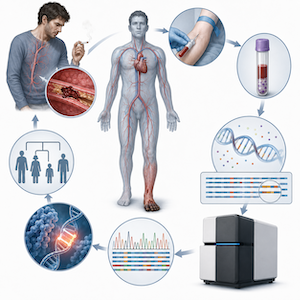
Low-frequency candidates for susceptibility to thromboangiitis obliterans (TAO) were investigated by whole exome sequencing in a family with a young member with migrating thrombophlebitis, artery thrombosis, and ulcerations followed by below-knee amputation. Filtering among 193 candidates for venous thromboembolism (VTE) detected rare heterozygous variants: the PPIF (peptidylprolyl-isomerase F) frameshift p.Tyr121fs*0 [minor allele frequency (MAF)= 0.000004], the F2 (thrombin) synonymous/splicing p.Gly271=, and 5 missense variants. Among these, the novel PTGIR (prostaglandin I2 receptor) p.Tyr144Asn would interfere with transmembrane helix interaction, and potentially decrease prostacyclin response. Filtering among 92 genes, suggested by previous genomic and transcriptomic studies in TAO patients, detected a rare combination of HLA-DQB1 alleles, and two in linkage variants (MAF=0.0003) in titin (TTN). Interestingly, TTN is also reported among VTE proteome alterations. By exploring the whole exome, the novel BET1 nonsense p.Glu33Ter change may indirectly influence hemostasis and endothelial integrity. This study pinpoints novel TAO candidate genetic components for further investigation
Downloads
Citations




Ethics Approval
The study, an investigator-initiated institutional review board-approved investigation for improved genetic diagnosis, was conducted according to the guidelines of the Declaration of Helsinki, and approved (June 2015) by the Institutional Review Board of the San Raffaele Hospital.CRediT authorship contribution
GM, ADA and FB study concept; PDV and ADA collected clinical data; PDV performed laboratory analysis; BL, NZ, GP and MB, methodology; NZ, GP and MB bioinformatics analysis; BL, NZ and DB data analysis; BL, GM and FB data interpretation and resources; BL, MP, GM and FB writing-review and editing; BL and DB preparation of tables and figure; FB supervision. All the authors approved the final manuscript.
Supporting Agencies
This research was funded by FAR (Fondo di Ateneo per la Ricerca Scientifica) of the University of FerraraData Availability Statement
All relevant data are included in the manuscript. Additional original data will be made available by contacting the corresponding author within the regulations of ethical approval.
How to Cite

This work is licensed under a Creative Commons Attribution-NonCommercial 4.0 International License.
Most read articles by the same author(s)
- Robert Parambi, Nicole Ziliotto, Francesco Bernardi , Marcello Baroni , Richard W Browne , Dejan Jakimovski, Bianca Weinstock-Guttman, Robert Zivadinov, Murali Ramanathan, Crosstalk between hemostasis inhibitors and cholesterol biomarkers in multiple sclerosis , Bleeding, Thrombosis and Vascular Biology: Vol. 1 No. 3 (2022)
- Marcello Baroni, Paolo Ferraresi, Nicole Ziliotto, Daria Bortolotti, Pierfilippo Acciarri, Nicola Martinelli, Giovanna Marchetti, Matteo Coen, Francesco Bernardi, Protein S on the surface of plasma lipoproteins: a potential mechanism for protein S delivery to the atherosclerotic plaques? , Bleeding, Thrombosis and Vascular Biology: Vol. 1 No. 3 (2022)
- Barbara Lunghi, Massimo Morfini, Silvia Linari, Dario Balestra, Alessio Branchini, Lisa Pieri, Donata Belvini, Laura Banov, Cristina Santoro, Giancarlo Castaman, Francesco Bernardi, Pharmacokinetics of extended half-life albumin-fused factor IX and heterogeneous F9 variants in hemophilia B: a retrospective cohort study , Bleeding, Thrombosis and Vascular Biology: Vol. 5 No. 1 (2026)