Reviews
Vol. 5 No. 3 (2026): In memory of Armando D’Angelo

Inflammation and hemostatic system: a selection of involved clinical disorders
Publisher's note
All claims expressed in this article are solely those of the authors and do not necessarily represent those of their affiliated organizations, or those of the publisher, the editors and the reviewers. Any product that may be evaluated in this article or claim that may be made by its manufacturer is not guaranteed or endorsed by the publisher.
Published: 28 August 2026
0
Views
0
Downloads

Authors

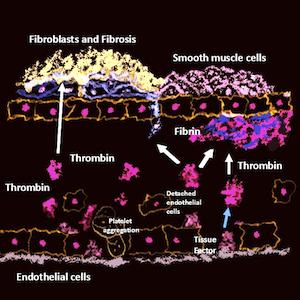
The role of the hemostatic system in host defense underscores the significant connection among coagulation, platelets, and inflammation. Both the hemostatic and the immune systems share a common ancestral origin. During infections, blood coagulation and platelet activation work in tandem with the immune system to combat bacterial and viral threats. Together, they help limit the spread of these pathogens by forming a fibrin clot network that not only kills pathogens but also promotes tissue repair. However, an excessive response is dangerous, as it can lead to both thrombosis and bleeding. The aim of this narrative review is to present the link between inflammation and the hemostatic system across different pathological conditions, such as infectious diseases (sepsis, plague, COVID-19 infection, Ebola, and Dengue virus infection, and malaria) and autoimmune diseases (antiphospholipid syndrome, systemic sclerosis, and rheumatoid arthritis). Although infectious diseases are characterized by a direct attack on the innate immune system, which in turn activates blood coagulation and platelets, Autoimmune diseases, through antibody production, can induce a coagulative reaction that can generate both thrombosis and fibrosis.

Downloads

Download data is not yet available.

Citations

1. Gaertner F, Massberg S. Blood coagulation in immunothrombosis-at the frontline of intravascular im munity. Semin Immunol 2016;28:561-9.
2. Bonaventura A, Vecchié A, Dagna L, et al. Endothelial dysfunction and immunothrombosis as key pathogenic mechanisms in COVID-19. Nat Rev Immunol 2021;21:319-29.
3. Marongiu F, Grandone E, Scano A, et al. Infectious agents including COVID-19 and the involvement of blood coagulation and fibrinolysis. A narrative review. Eur Rev Med Pharmacol Sci 2021;25:3886-97.
4. Xu J, Lupu F, Esmon CT. Inflammation, innate immunity and blood coagulation. Hamostaseologie 2010;30:5-9.
5. Esmon CT. The impact of the inflammatory response on coagulation. Thromb Res 2004;114:321-7.
6. Levi M, van der Poll T. Inflammation and coagulation. Crit Care Med 2010;38:S26-34.
7. Kaiser R, Gold C, Stark K. Recent advances in immunothrombosis and thromboinflammation. Thromb Haemost 2025;125:1181-94.
8. Iba T, Levi M, Thachil J, et al. Disseminated intravascular coagulation: the past, present, and future considerations. Semin Thromb Hemost 2022;48:978-87.
9. Strukova S. Blood coagulation-dependent inflammation. Coagulation-dependent inflammation and inflammation-dependent thrombosis. Front Biosci 2006;11:59-80.
10. Wu C, Lu W, Zhang Y, et al. Inflammasome activation triggers blood clotting and host death through pyroptosis. Immunity 2019;50:1401-11.
11. Badulescu OV, Ciocoiu M, Vladeanu MC, et al. The role of platelet dysfunctions in the pathogenesis of the hemostatic-coagulant system imbalances. Int J Mol Sci 2025;26:2756.
12. Gando S, Levi M, Toh CH. Disseminated intravascular coagulation. Nat Rev Dis Primers 2016;2:16037.
13. Schwameis M, Schörgenhofer C, Assinger A, et al. VWF excess and ADAMTS13 deficiency: a unifying pathomechanism linking inflammation to thrombosis in DIC, malaria, and TTP. Thromb Haemost 2015;113:708-18.
14. Brinkmann V, Reichard U, Goosmann C, et al. Neutrophil extracellular traps kill bacteria. Science 2004;303:1532-5.
15. Iba T, Levy JH. Inflammation and thrombosis: roles of neutrophils, platelets and endothelial cells and their interactions in thrombus formation during sepsis. J Thromb Haemost 2018;16:231-41.
16. Hassani S, Fazeli A, Dorgalaleh A, et al. Neutrophil-mediated effects on hemostasis and thrombosis: unraveling their complex interaction in thrombotic events. Semin Thromb Hemost 2026;52:92-105.
17. Levi M, Sivapalaratnam S. Disseminated intravascular coagulation: an update on pathogenesis and diagnosis. Expert Rev Hematol 2018;11:663-72.
18. Cohee LM, Opondo C, Clarke SE, et al. Preventive malaria treatment among school-aged children in sub-Saharan Africa: a systematic review and meta-analyses. Lancet Glob Health 2020;8:e1499-e1511.
19. Angchaisuksiri P. Coagulopathy in malaria. Thromb Res 2014;133:5-9.
20. Moxon CA, Chisala NV, Mzikamanda R, et al. Laboratory evidence of disseminated intravascular coagulation is associated with a fatal outcome in children with cerebral malaria despite an absence of clinically evident thrombosis or bleeding. J Thromb Haemost 2015;13:1653-64.
21. Mohanty D, Ghosh K, Nandwani SK, et al. Fibrinolysis, inhibitors of blood coagulation, and monocyte derived coagulant activity in acute malaria. Am J Hematol 1997;54:23-9.
22. O’Sullivan JM, Preston RJ, O’Regan N, et al. Emerging roles for hemostatic dysfunction in malaria pathogenesis. Blood 2016;127:2281-8.
23. Aderinto N, Abraham IC, Olatunji G, et al. Stroke incidence, presentation, and outcomes in malaria: a review of current evidence. Malar J 2025;24:193.
24. Sloop GD, De Mast Q, Pop G, et al. The role of blood viscosity in infectious diseases. Cureus 2020;12:e7090.
25. Wiersinga WJ, Rhodes A, Cheng AC, et al. Pathophysiology, transmission, diagnosis, and treatment of coronavirus disease 2019 (COVID-19): a review. JAMA 2020;324:782-93.
26. Eslamifar Z, Behzadifard M, Soleimani M, et al. Coagulation abnormalities in SARS-CoV-2 infection: overexpression tissue factor. Thromb J 2020;18:38.
27. Tang N, Li D, Wang X, et al. Abnormal coagulation parameters are associated with poor prognosis in patients with novel coronavirus pneumonia. J Thromb Haemost 2020;18:844-7.
28. Marongiu F, Grandone E, Barcellona D. Pulmonary thrombosis in 2019-nCoV pneumonia? J Thromb Haemost 2020;18:1511-3.
29. Dolhnikoff M, Duarte-Neto AN, de Almeida Monteiro RA, et al. Pathological evidence of pulmonary thrombotic phenomena in severe COVID-19. J Thromb Haemost 2020;18:1517-9.
30. Saba L, Gerosa C, Fanni D, et al. Molecular pathways triggered by COVID-19 in different organs: ACE2 receptor-expressing cells under attack? A review. Eur Rev Med Pharmacol Sci 2020;24:12609-22.
31. Oxley TJ, Mocco J, Majidi S, et al. Large-vessel stroke as a presenting feature of COVID-19 in the young. N Engl J Med 2020;382:e60.
32. Ward SE, Curley GF, Lavin M, et al. Von Willebrand factor propeptide in severe coronavirus disease 2019 (COVID-19): evidence of acute and sustained endothelial cell activation. Br J Haematol 2021;192:714-9.
33. Coccheri S. COVID-19: the crucial role of blood coagulation and fibrinolysis. Intern Emerg Med 2020;15:1369-73.
34. Wright FL, Vogler TO, Moore EE, et al. Fibrinolysis shutdown correlates to thrombotic events in severe COVID-19 infection. J Am Coll Surg 2020;231:193-203.
35. Perkins MV, Mackman N. Potential mechanisms underlying bleeding during infection with hemorrhagic fever viruses. Arterioscler Thromb Vasc Biol 2026;46:e323625.
36. Huang YH, Lei HY, Liu HS, et al. Tissue plasminogen activator induced by dengue virus infection of human endothelial cells. J Med Virol 2003;70:610-6.
37. Rollin PE, Bausch DG, Sanchez A. Blood chemistry measurements and D-dimer levels associated with fatal and nonfatal outcomes in humans infected with Sudan Ebola virus. J Infect Dis 2007;196(Suppl 2):S364-71.
38. Kehrmann J, Popp W, Delgermaa B, et al. Two fatal cases of plague after consumption of raw marmot organs. Emerg Microbes Infect 2020;9:1878-80.
39. Korhonen TK. Fibrinolytic and procoagulant activities of Yersinia pestis and Salmonella enterica. J Thromb Haemost 2015;13(Suppl 1):S115-20.
40. Plano GV, Schesser K. The Yersinia pestis type III secretion system: expression, assembly and role in the evasion of host defenses. Immunol Res 2013;57:237-45.
41. Palace SG, Vitseva O, Proulx MK, et al. Yersinia pestis escapes entrapment in thrombi by targeting platelet function. J Thromb Haemost 2020;18:3236-48.
42. Assinger A. Platelets-disarmed guardians in the fight against the plague. J Thromb Haemost 2020;18:3169-71.
43. Hughes GR. Thrombosis, abortion, cerebral disease, and the lupus anticoagulant. Br Med J (Clin Res Ed) 1983;287:1088-9.
44. Bowie EJ, Thompson JH Jr, Pascuzzi CA, et al. Thrombosis in systemic lupus erythematosus despite circulating anticoagulants. J Lab Clin Med 1963;62:416-30.
45. Patriarcheas V, Tsamos G, Vasdeki D, et al. Antiphospholipid syndrome: a comprehensive clinical review. J Clin Med 2025;14:733.
46. Miyakis S, Lockshin MD, Atsumi T, et al. International consensus statement on an update of the classification criteria for definite antiphospholipid syndrome (APS). J Thromb Haemost 2006;4:295-306.
47. Barbhaiya M, Zuily S, Naden R, et al. 2023 ACR/EULAR antiphospholipid syndrome classification criteria. Ann Rheum Dis 2023;82:1258-70.
48. Aiello A, Sarti L, Sandri G, et al. Impact of the 2023 ACR/EULAR classification criteria on START2 antiphospholipid registry. Int J Lab Hematol 2025;47:313-7.
49. Li L, Chen J, Feng J, et al. Anti-β2 glycoprotein I domain 1 antibody as a diagnostic marker for antiphospholipid syndrome and a predictor of thrombosis: a systematic review and meta-analysis. Front Immunol 2025;16:1541165.
50. Ducker CB, Preece MV, Pericleous C, et al. Revisiting antiphospholipid syndrome: a thrombo-inflammatory disorder beyond clotting. Blood Rev 2026;101364.
51. Dignat-George F, Camoin-Jau L, Sabatier F, et al. Endothelial microparticles: a potential contribution to the thrombotic complications of the antiphospholipid syndrome. Thromb Haemost 2004;91:667-73.
52. Kornberg A, Blank M, Kaufman S, et al. Induction of tissue factor-like activity in monocytes by anti-cardiolipin antibodies. J Immunol 1994;153:1328-32.
53. Zhou H, Wolberg AS, Roubey RA. Characterization of monocyte tissue factor activity induced by IgG antiphospholipid antibodies and inhibition by dilazep. Blood 2004;104:2353-8.
54. Joseph JE, Harrison P, Mackie IJ, et al. Increased circulating platelet-leucocyte complexes and platelet activation in patients with antiphospholipid syndrome, systemic lupus erythematosus and rheumatoid arthritis. Br J Haematol 2001;115:451-9.
55. Vega-Ostertag M, Harris EN, Pierangeli SS. Intracellular events in platelet activation induced by antiphospholipid antibodies in the presence of low doses of thrombin. Arthritis Rheum 2004;50:2911-9.
56. Proulle V, Furie RA, Merrill-Skoloff G, et al. Platelets are required for enhanced endothelial activation and fibrinogen binding in a mouse thrombosis model of APS. Blood 2014;124:611-22.
57. Knight JS, Kanthi Y. Mechanisms of immunothrombosis and vasculopathy in antiphospholipid syndrome. Semin Immunopathol 2022;44:347-62.
58. Chaturvedi S, Braunstein EM, Yuan X, et al. Complement activity and complement regulatory gene mutations are associated with thrombosis in APS and CAPS. Blood 2020;135:239-51.
59. Foley JH, Conway EM. Cross talk pathways between coagulation and inflammation. Circ Res 2016;118:1392-408.
60. Dragon Durey MA, Hamidi H, Darnige L. Complement in antiphospholipid syndrome, time to target? Curr Opin Immunol 2025;96:102628.
61. Kaplan M. Eculizumab (Alexion). Curr Opin Investig Drugs 2002;3:1017-23.
62. Tinti MG, Carnevale V, Inglese M, et al. Eculizumab in refractory catastrophic antiphospholipid syndrome: a case report and systematic review of the literature. Clin Exp Med 2019;19:281-8.
63. Ruffatti A, Tarzia V, Fedrigo M, et al. Evidence of complement activation in the thrombotic small vessels of a patient with catastrophic antiphospholipid syndrome treated with eculizumab. Autoimmun Rev 2019;18:561-3.
64. Yalavarthi S, Gould TJ, Rao AN, et al. Release of neutrophil extracellular traps by neutrophils stimulated with antiphospholipid antibodies: a newly identified mechanism of thrombosis in the antiphospholipid syndrome. Arthritis Rheumatol 2015;67:2990-3003.
65. Brinkmann V. Neutrophil extracellular traps in the second decade. J Innate Immun 2018;10:414-21.
66. Hulstein JJ, Lenting PJ, de Laat B, et al. Beta2-glycoprotein I inhibits von Willebrand factor-dependent platelet adhesion and aggregation. Blood 2007;110:1483-91.
67. Rand JH, Wu XX, Quinn AS, et al. Human monoclonal antiphospholipid antibodies disrupt the annexin A5 anticoagulant crystal shield on phospholipid bilayers: evidence from atomic force microscopy and functional assay. Am J Pathol 2003;163:1193-200.
68. Joseph JE, Harrison P, Mackie IJ, et al. Increased circulating platelet-leucocyte complexes and platelet activation in patients with antiphospholipid syndrome, systemic lupus erythematosus, and rheumatoid arthritis. Br J Haematol 2001;115:451-9.
69. Antovic A, Bruzelius M. Impaired fibrinolysis in the antiphospholipid syndrome. Semin Thromb Hemost 2021;47:506-11.
70. Mameli A, Indovina L, Cocciolillo F, et al. Functional imaging reveals cerebral microvascular dysfunction in primary antiphospholipid syndrome: pathophysiologic insights and translational implications. J Neurol Sci 2026;481:125750.
71. Volkmann ER, Andréasson K, Smith V. Systemic sclerosis. Lancet 2023;401:304-18.
72. Matucci-Cerinic M, Kahaleh B, Wigley FM. Evidence that systemic sclerosis is a vascular disease. Arthritis Rheum 2013;65:1953-62.
73. Di Martino ML, Frau A, Losa F, et al. Role of circulating endothelial cells in assessing the severity of systemic sclerosis and predicting its clinical worsening. Sci Rep 2021;11:2681.
74. Marongiu F, Ruberto MF, Marongiu S, et al. A journey to vasculopathy in systemic sclerosis: focus on haemostasis and thrombosis. Clin Exp Med 2023;23:4057-64.
75. Ruberto MF, Marongiu S, Congiu T, et al. The hypercoagulable state: a study of clot waveform analysis, thrombin generation, and clot scanning electron microscopy. Arch Pathol Lab Med 2025;150:146-54.
76. Chambers RC, Laurent GJ. Coagulation cascade proteases and tissue fibrosis. Biochem Soc Trans 2002;30:194-200.
77. de Ridder GG, Lundblad RL, Pizzo SV. Actions of thrombin in the interstitium. J Thromb Haemost 2016;14:40-7.
78. Marongiu F, Ruberto MF, Barcellona D. Is anticoagulative therapy in systemic sclerosis to be reconsidered? J Scleroderma Relat Disord 2024;9:81-5.
79. Fazal ZA, Avina-Galindo AM, Marozoff S, et al. Risk of venous thromboembolism in patients with rheumatoid arthritis: a meta-analysis of observational studies. BMC Rheumatol 2024;8:5.
80. Mameli A, Barcellona D, Marongiu F. Rheumatoid arthritis and thrombosis. Clin Exp Rheumatol 2009;27:846-55.
81. Undas A, Gissel M, Kwasny-Krochin B, et al. Thrombin generation in rheumatoid arthritis: dependence on plasma factor composition. Thromb Haemost 2010;104:224-30.
82. Kondo N, Kuroda T, Kobayashi D. Cytokine networks in the pathogenesis of rheumatoid arthritis. Int J Mol Sci 2021;22:10922.
83. Kadura S, Raghu G. Rheumatoid arthritis-interstitial lung disease: manifestations and current concepts in pathogenesis and management. Eur Respir Rev 2021;30:210011.
84. Schuliga M, Grainge C, Westall G, et al. The fibrogenic actions of the coagulant and plasminogen activation systems in pulmonary fibrosis. Int J Biochem Cell Biol 2018;97:108-17.
85. Zhao T, Zhang W, Ren Z, et al. Macrophage metabolism reprogramming in sepsis: pathogenesis and therapeutic implications (review). Int J Mol Med 2026;57:152.

CRediT authorship contribution

FM, data analysis and interpretation, manuscript original drafting. AM: data analysis and manuscript preparation, SM: reference selection and interpretation. DB: overview and original draft contribution.

Data Availability Statement

The datasets used and/or analyzed during the current study are available upon reasonable request from the corresponding author.

How to Cite


1.
Marongiu F, Mameli A, Marongiu S, Barcellona D. Inflammation and hemostatic system: a selection of involved clinical disorders. Bleeding Thromb Vasc Biol [Internet]. 2026 Aug. 28 [cited 2026 Aug. 28];5(3). Available from: https://www.btvb.org/btvb/article/view/474