

Oral Communications and Posters
Vol. 5 No. s3 (2026): Abstracts of the XXIX National Congress of the Italian Society for the Study of Hemostasis and Thrombosis, 2026

PO153 | MAY–THURNER SYNDROME MIMICKING INFERIOR VENA CAVA SYNDROME: A CASE REPORT
M. Shani, G. Pelo, T. Goxhaj | Mother Theresa University Hospital, Università Nostra Signora del Buon Consiglio, Tirana, Albania
Publisher's note
All claims expressed in this article are solely those of the authors and do not necessarily represent those of their affiliated organizations, or those of the publisher, the editors and the reviewers. Any product that may be evaluated in this article or claim that may be made by its manufacturer is not guaranteed or endorsed by the publisher.
All claims expressed in this article are solely those of the authors and do not necessarily represent those of their affiliated organizations, or those of the publisher, the editors and the reviewers. Any product that may be evaluated in this article or claim that may be made by its manufacturer is not guaranteed or endorsed by the publisher.
Published: 26 October 2026
6
Views
3
Downloads
Authors
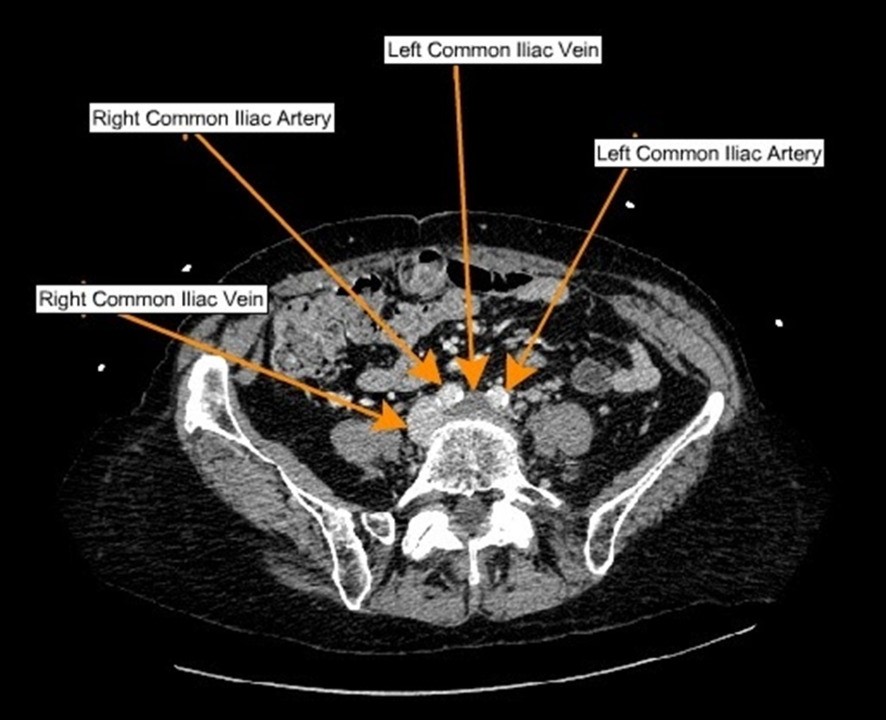
Case Presentation. Patient Information; a 42-year-old female presented to the emergency department with progressive swelling of both lower extremities for two weeks. The swelling was associated with mild discomfort and heaviness while walking. The patient denied recent trauma, prolonged immobilization, malignancy, previous thromboembolic events. She reported no significant past medical history and was not taking oral contraceptives. Clinical Findings; physical examination revealed: bilateral lower limb edema extending to the thighs, prominent superficial abdominal veins, and mild tenderness of the left calf. Vital signs were stable. No signs of heart failure or liver disease were observed. Because of the bilateral nature of the swelling, initial clinical suspicion was directed toward inferior vena cava obstruction. Diagnostic Assessment; laboratory investigations revealed mildly elevated D-dimer levels, normal coagulation profile, and normal liver and renal function tests. Thrombophilia screening was negative. Discussion; may–Thurner syndrome represents an underdiagnosed cause of venous outflow obstruction. Studies suggest that up to 20–30% of individuals may have some degree of iliac vein compression, although only a minority develop clinically significant symptoms. Pathophysiology; the primary mechanism involves chronic pulsatile compression of the left common iliac vein by the overlying right common iliac artery. This leads to: endothelial injury, intimal hypertrophy, formation of fibrous spurs, venous stasis. Together, these changes fulfill Virchow’s triad, promoting thrombosis. Mimicking Inferior Vena Cava Syndrome; in advanced cases, extensive collateral venous networks develop within the pelvis and abdominal wall. These collateral pathways may produce clinical findings similar to inferior vena cava syndrome, including: bilateral leg swelling dilated abdominal wall veins, pelvic venous congestion. Because the inferior vena cava remains patent, diagnosis requires advanced imaging modalities such as CT or MR venography.
Downloads
Download data is not yet available.
Citations




How to Cite
1.
Shani M. PO153 | MAY–THURNER SYNDROME MIMICKING INFERIOR VENA CAVA SYNDROME: A CASE REPORT: M. Shani, G. Pelo, T. Goxhaj | Mother Theresa University Hospital, Università Nostra Signora del Buon Consiglio, Tirana, Albania. Bleeding Thromb Vasc Biol [Internet]. 2026 Oct. 26 [cited 2026 Oct. 29];5(s3). Available from: https://www.btvb.org/btvb/article/view/969
Copyright (c) 2026 The Author(s)


This work is licensed under a Creative Commons Attribution-NonCommercial 4.0 International License.



