
Platelets versus monocytes as cellular sources of blood-borne tissue factor: a quantitative and functional comparison in healthy subjects and in patients with STEMI

All claims expressed in this article are solely those of the authors and do not necessarily represent those of their affiliated organizations, or those of the publisher, the editors and the reviewers. Any product that may be evaluated in this article or claim that may be made by its manufacturer is not guaranteed or endorsed by the publisher.
Authors
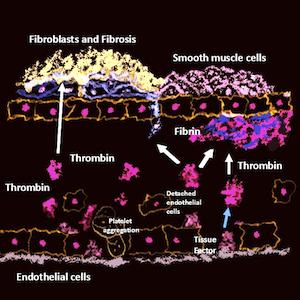
Monocytes are an established source of blood-borne tissue factor (TF), while platelet has emerged over 2 decades as a functionally and clinically relevant circulating source of TF. Their relative quantitative and functional contributions remain undefined. Surface TF was quantified by whole-blood flow cytometry in platelets and monocytes from 20 healthy subjects (HS) and 20 patients with ST-segment elevation myocardial infarction (STEMI). Calibrated automated thrombography (CAT) compared platelet and monocyte preparations at cell numbers reflecting their relative abundance in a reference blood volume. TF and Tissue Factor Pathway Inhibitor (TFPI) were neutralized with mAbs; platelet TF exposure was assessed under CAT-like conditions. TFpos fractions were similar, but TF-positive platelets per microliter were more than 400-fold more abundant in both groups. Platelets showed shorter lag times and higher thrombin peaks than monocytes in HS and STEMI; endogenous thrombin potential was greater in STEMI and numerically higher in HS. Anti-TF delayed and anti-TFPI accelerated thrombin generation. Platelet-associated TF increased under CAT-like conditions to 21±1.5% at 8 minutes. Accounting for cellular abundance identifies platelets as quantitatively predominant over monocytes, with greater thrombin-generating capacity in HS and STEMI.
Downloads
Citations




Ethics Approval
The study was approved by the Ethics Committee of Centro Cardiologico Monzino IRCCS and was conducted according to the Declaration of Helsinki. Written informed consent was obtained from all participants (approval no. R1814/23-CCM 1934)CRediT authorship contribution
MC conceived and designed the study, supervised the project, interpreted the data, and wrote the manuscript. MB coordinated the experimental work, performed experiments, analyzed and interpreted the data, and contributed to the original drafting of the manuscript. AB and PDV performed experiments and contributed to data analysis. NC, JC, GCM and DT contributed to patient recruitment, clinical characterization and interpretation of clinical data. PLAG provided expertise on thrombin generation assays and contributed to data interpretation. VT contributed to the conceptual discussion of blood-borne tissue factor biology and critically revised the manuscript. ET supervised the scientific development of the project and critically revised the manuscript for important intellectual content. All authors reviewed and approved the final version of the manuscript.
Supporting Agencies
This project was supported by a grant from the Italian Ministry of Health, Ricerca Corrente to Centro Cardiologico Monzino IRCCS.Data Availability Statement
The datasets analyzed during the current study are available upon reasonable request from the corresponding author.
How to Cite

This work is licensed under a Creative Commons Attribution-NonCommercial 4.0 International License.