
Von Willebrand Disease (VWD) 100 years after its first description: the research of Italian investigators for a better management of VWD patients
All claims expressed in this article are solely those of the authors and do not necessarily represent those of their affiliated organizations, or those of the publisher, the editors and the reviewers. Any product that may be evaluated in this article or claim that may be made by its manufacturer is not guaranteed or endorsed by the publisher.
Authors
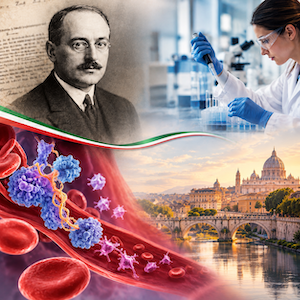
Since the first description of the von Willebrand disease (VWD) families by Erik von Willebrand in 1926, VWD has been considered an inherited bleeding disorder completely different from hemophilia, already known for many years. The pivotal role of the adhesive glycoprotein von Willebrand factor in the early phases of hemostasis has been progressively unraveled in numerous publications. Still, actual progress in the clinical management of patients with VWD has always lagged that achieved in patients with hemophilia. After the pioneering studies of the first 50 years (1926-1975), the pathophysiology and diagnostics of patients with VWD became better distinguished from those with hemophilia. However, only in the last 50 years (1976-2025) have the basic and clinical aspects of VWD been clearly defined, with the scientific contributions of Italian investigators. Thanks to their research in collaboration with colleagues from Europe and the US, management of VWD patients improved significantly. In this review article, the most important milestones achieved in the diagnosis and treatment of VWD will be presented. Despite major efforts by experts, who recently (2021) summarized their recommendations in the International Guidelines on VWD diagnosis and therapy, there are still many unmet needs in this disease management. Indeed, the recommendations of the International Guidelines must be translated into current national practice by using a simplified diagnostic approach, as proposed recently by the joint AICE (Italian Association of Hemophilia Centers) and SISET (Italian Society for the Study of Hemostasis and Thrombosis) Italian Guidelines and by organizing structured clinical observation not only of severe VWD but especially of the more frequent mild-to-moderate types.
Downloads
Citations




Ethics Approval
Not requiredCRediT authorship contribution
The authors read and approved the final version of the manuscript and agreed to be accountable for all aspects of the work.
Supporting Agencies
Not applicableData Availability Statement
The authors were invited by the Editors of BTVB to prepare an historical review article celebrating the 100th anniversary of the publication of the first family with VWD by Erik Adolf Von Willebrand. Therefore, all the data are derived by offiocial publications of the last one hundred years.
How to Cite

This work is licensed under a Creative Commons Attribution-NonCommercial 4.0 International License.