

Oral Communications and Posters
Vol. 5 No. s3 (2026): Abstracts of the XXIX National Congress of the Italian Society for the Study of Hemostasis and Thrombosis, 2026

PO146 | COMPARISON OF COAGULATION AND CHROMOGENIC METHODS IN PHARMACOKINETICS WITH EXTENDED HALF-LIFE FACTOR VIII
R. Pastorino1|2, F. Bocchi1|2, G. Murante1|2|3, S. Bergonzi1|2|3, M. Capetta1|2|3, F. Valeri2|3, C. Dainese2|3, A. Valpreda4, B. Bruno1|3, A. Borchiellini2|3 | 1Department of Molecular Biotechnology and Health Sciences, University of Turin, Torino, Italy; 2Regional Centre for Thrombotic and Hemorrhagic Diseases; 3Division of Hematology; 4Central Lab Baldi and Riberi, AOU Città della salute e della Scienza di Torino, Torino, Italy
Publisher's note
All claims expressed in this article are solely those of the authors and do not necessarily represent those of their affiliated organizations, or those of the publisher, the editors and the reviewers. Any product that may be evaluated in this article or claim that may be made by its manufacturer is not guaranteed or endorsed by the publisher.
All claims expressed in this article are solely those of the authors and do not necessarily represent those of their affiliated organizations, or those of the publisher, the editors and the reviewers. Any product that may be evaluated in this article or claim that may be made by its manufacturer is not guaranteed or endorsed by the publisher.
Published: 26 October 2026
0
Views
0
Downloads
Authors
Methods. A total of 56 pharmacokinetics were performed. For each timepoint, plasma FVIII levels were assessed on an ACL TOP 750 (Werfen Company - Barcelona, Spain) using the following methods: 1. One-stage clotting assay (OSA) with SynthasIL reagent 2. Chromogenic substrate assays (CSA) with Coamatic FactorVIII
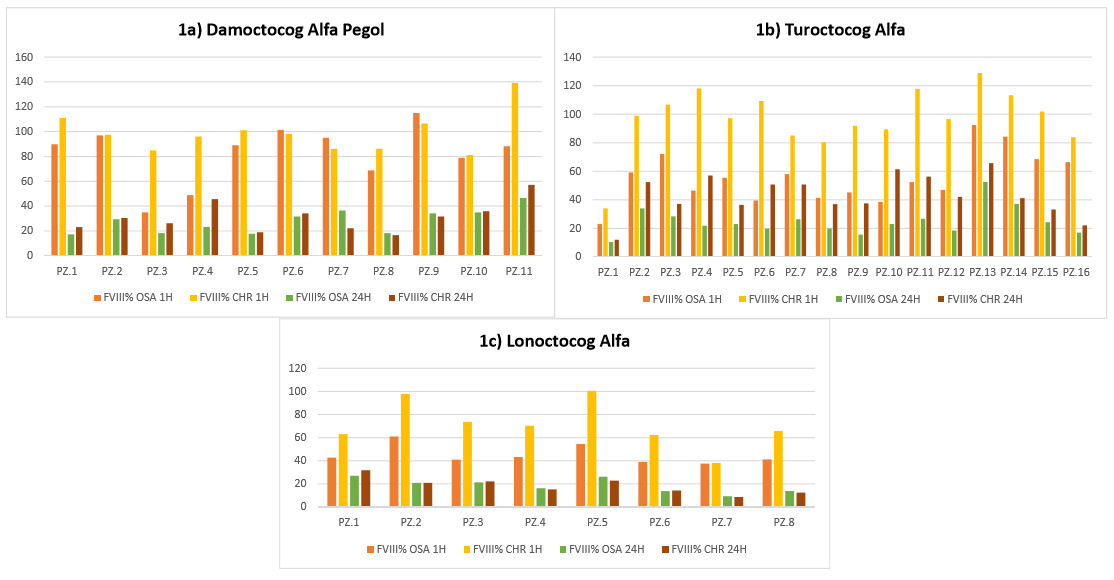
Results. A sufficient number to compare results between methods was reached only for the pharmacokinetics with 3 concentrates: 2 FVIII-EHL (Turoctocog Alfa and Damoctocog Alfa Pegol, both B domain deleted) and a single-chain FVIII (Lonoctocog Alfa). Turoctocog Alfa (16 kinetics) and Lonoctocog Alfa (8 kinetics), in line with literature data, highlighted higher FVIII levels when tested with CSA. However for Lonoctocog Alfa levels found with CSA they are not double compared to those with OSA (as indicated in the technical data sheet) and moreover the differences at 24 hours seem to disappear. Instead, Efmoroctocog Alfa (despite only 4 kinetics have been evaluated) at some timepoints did not show significant differences between OSA and CSA. For all these concentrates the same behavior (differences or equivalences) was observed for all patients. But for the kinetics with Damoctocog Alfa Pegol (11 kinetics), OSA and CSA highlighted differences but with heterogeneous behavior between patients. The numerically significant kinetics are reported in the histograms of the Figure 1.
Conclusions. To offer the best personalized replacement prophylaxis, it is essential to know whether in vivo factor levels can be monitored interchangeably with CSA and OSA (and which reagent for aPTT) or necessarily with one of these. The availability of a product-specific laboratory standard could eliminate the differences and becomes crucial when a concentrate presents heterogeneity in behavior among patients and the most appropriate method is unpredictable.
Downloads
Download data is not yet available.
Citations




How to Cite
1.
Pastorino R. PO146 | COMPARISON OF COAGULATION AND CHROMOGENIC METHODS IN PHARMACOKINETICS WITH EXTENDED HALF-LIFE FACTOR VIII: R. Pastorino1|2, F. Bocchi1|2, G. Murante1|2|3, S. Bergonzi1|2|3, M. Capetta1|2|3, F. Valeri2|3, C. Dainese2|3, A. Valpreda4, B. Bruno1|3, A. Borchiellini2|3 | 1Department of Molecular Biotechnology and Health Sciences, University of Turin, Torino, Italy; 2Regional Centre for Thrombotic and Hemorrhagic Diseases; 3Division of Hematology; 4Central Lab Baldi and Riberi, AOU Città della salute e della Scienza di Torino, Torino, Italy. Bleeding Thromb Vasc Biol [Internet]. 2026 Oct. 26 [cited 2026 Oct. 28];5(s3). Available from: https://www.btvb.org/btvb/article/view/962
Copyright (c) 2026 The Author(s)


This work is licensed under a Creative Commons Attribution-NonCommercial 4.0 International License.



