

Oral Communications and Posters
Vol. 5 No. s3 (2026): Abstracts of the XXIX National Congress of the Italian Society for the Study of Hemostasis and Thrombosis, 2026

PO145 | KINETIC ASSESSMENT OF PLATELET REACTIVITY DURING DUAL ANTIPLATELET THERAPY IN ACUTE CORONARY SYNDROMES: PRELIMINARY RESULTS FROM AN ONGOING STUDY
B. Di Marco1|2, R. Liani1, F. D’Ambrosio1|2, M. Alfonsetti1, P.G. Simeone1, M. Frezza1, S. Porro1, M. Brambilla3, P. Lanuti1, M. Camera3, F. Santilli1 | 1Department of Medicine and Aging Sciences, Center for Advanced Studies and Technology (CAST), University of Chieti, Chieti, Italy; 2ASL 2 Abruzzo, SS. Annunziata Hospital, Chieti, Italy; 3Unit of Cell and Molecular Biology in Cardiovascular Diseases, Centro Cardiologico Monzino IRCCS, Milano, Italy
Publisher's note
All claims expressed in this article are solely those of the authors and do not necessarily represent those of their affiliated organizations, or those of the publisher, the editors and the reviewers. Any product that may be evaluated in this article or claim that may be made by its manufacturer is not guaranteed or endorsed by the publisher.
All claims expressed in this article are solely those of the authors and do not necessarily represent those of their affiliated organizations, or those of the publisher, the editors and the reviewers. Any product that may be evaluated in this article or claim that may be made by its manufacturer is not guaranteed or endorsed by the publisher.
Published: 26 October 2026
65
Views
25
Downloads
Authors
Methods. Patients with ACS undergoing PCI and treated with guideline‑recommended DAPT (aspirin plus clopidogrel, prasugrel or ticagrelor) were prospectively enrolled. Platelet function was assessed at two time points, T1 (10 h after drug intake) and T2 (12 h for ticagrelor and 24 h for prasugrel and clopidogrel), to evaluate platelet inhibition across the dosing interval. P2Y₁₂ inhibition was assessed by light transmission aggregometry (LTA), VerifyNow P2Y₁₂ and VASP phosphorylation. Changes in target recovery rate were quantified by the T1–T2 slope (T2‑T1/14). Recruitment is ongoing and this is an interim analysis.
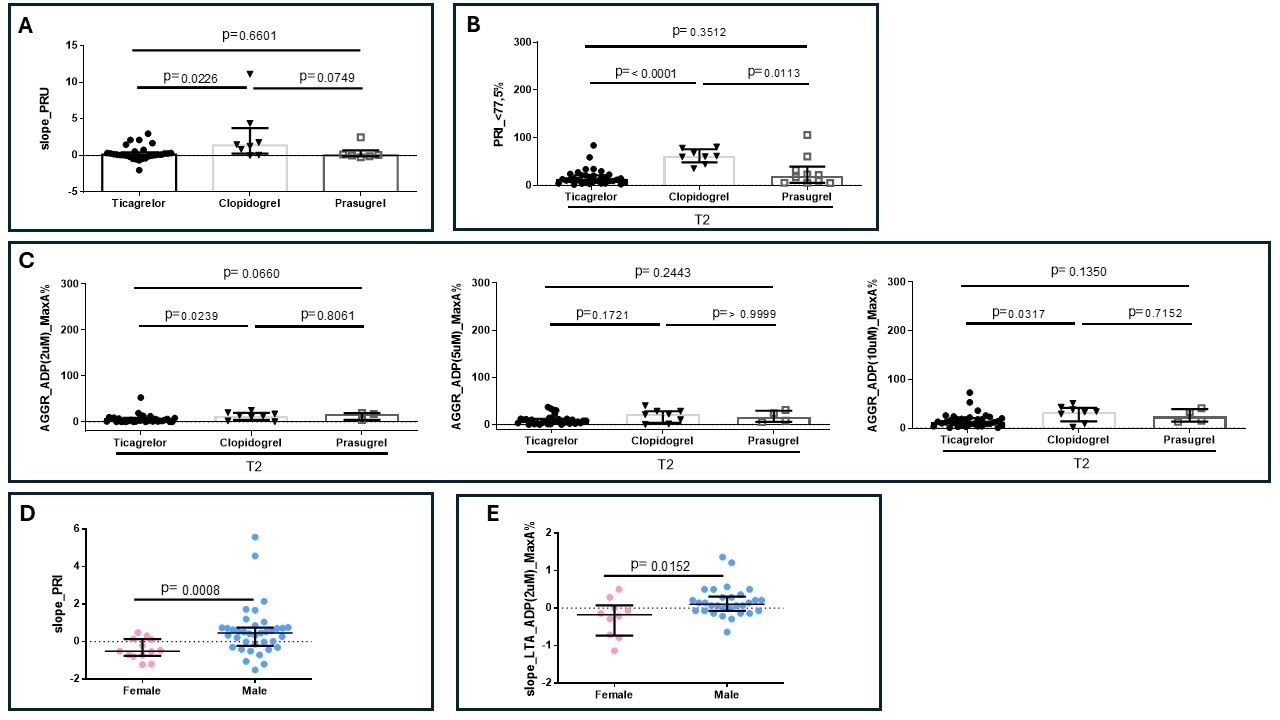
Results. Platelet reactivity kinetics differed according to the P2Y₁₂ inhibitor used. In patients treated with clopidogrel, VerifyNow P2Y₁₂ reaction units (PRU) were consistently higher at both T1 and T2 compared with patients receiving ticagrelor or prasugrel (p < 0.05), indicating greater residual P2Y₁₂ dependent HPR over the dosing interval. In addition, the increase in PRU slope was greater in clopidogrel treated patients compared with those treated with ticagrelor (p= 0.0226) (A). Consequently, platelet reactivity index (PRI) values measured by VASP were higher at both time points in clopidogrel treated patients compared with those receiving ticagrelor or prasugrel (p < 0.05) (B). Likewise, ADP induced platelet aggregation at all tested concentrations (2, 5 and 10 µM) was greater in clopidogrel treated patients than in ticagrelor treated patients (C). Recovery of P2Y₁₂ dependent platelet reactivity was further modulated by biological factors. Regardless of the drugs, the slope of PRI was significantly higher in men (Rho = 0.466; p = 0.001) (D), and a comparable sex related effect was observed for ADP induced LTA at low agonist concentration (2 µM; Rho = 0.384; p = 0.015) (E).
Conclusions. In this preliminary analysis, variability in the recovery rate of platelet reactivity over the dosing interval, previously described for aspirin, also occurs for the P2Y₁₂ pathway. Despite irreversible receptor inhibition, patients treated with clopidogrel exhibit greater residual and P2Y₁₂ dependent platelet reactivity compared with those receiving ticagrelor and prasugrel over the dosing interval. This recovery seems to be sex-influenced and suggests that pharmacodynamic recovery of platelet function represents an additional mechanism, beyond impaired bioactivation, contributing to suboptimal response to clopidogrel.
Downloads
Download data is not yet available.
Citations




How to Cite
1.
Di Marco B. PO145 | KINETIC ASSESSMENT OF PLATELET REACTIVITY DURING DUAL ANTIPLATELET THERAPY IN ACUTE CORONARY SYNDROMES: PRELIMINARY RESULTS FROM AN ONGOING STUDY: B. Di Marco1|2, R. Liani1, F. D’Ambrosio1|2, M. Alfonsetti1, P.G. Simeone1, M. Frezza1, S. Porro1, M. Brambilla3, P. Lanuti1, M. Camera3, F. Santilli1 | 1Department of Medicine and Aging Sciences, Center for Advanced Studies and Technology (CAST), University of Chieti, Chieti, Italy; 2ASL 2 Abruzzo, SS. Annunziata Hospital, Chieti, Italy; 3Unit of Cell and Molecular Biology in Cardiovascular Diseases, Centro Cardiologico Monzino IRCCS, Milano, Italy. Bleeding Thromb Vasc Biol [Internet]. 2026 Oct. 26 [cited 2026 Nov. 19];5(s3). Available from: https://www.btvb.org/btvb/article/view/961
Copyright (c) 2026 The Author(s)


This work is licensed under a Creative Commons Attribution-NonCommercial 4.0 International License.



