

Oral Communications and Posters
Vol. 5 No. s3 (2026): Abstracts of the XXIX National Congress of the Italian Society for the Study of Hemostasis and Thrombosis, 2026

PO141 | PLASMA METABOLOMIC PROFILING IDENTIFIES PLATELET-RELATED METABOLIC CHANGES AFTER PFO CLOSURE IN MIGRAINE WITH AURA
F. Marincola1, N. Zuddas1, F. Cannas1, A. Becchetti2, L.V. Renna3, M. Brambilla2, R. Cardani3, M. Conti2, K. Nallio2, M. Chessa3, D. Trabattoni2, V. Fanos4, M. Camera2|5 | 1Università degli Studi di Cagliari, Cagliari, Italy; 2Centro Cardiologico Monzino IRCCS, Milano, Italy; 3IRCCS Policlinico San Donato, San Donato, Milano, Italy; 4University Hospital of Cagliari, Cagliari, Italy; 5Università degli Studi di Milano, Department of Pharmaceutical Sciences, Milano, Italy
Publisher's note
All claims expressed in this article are solely those of the authors and do not necessarily represent those of their affiliated organizations, or those of the publisher, the editors and the reviewers. Any product that may be evaluated in this article or claim that may be made by its manufacturer is not guaranteed or endorsed by the publisher.
All claims expressed in this article are solely those of the authors and do not necessarily represent those of their affiliated organizations, or those of the publisher, the editors and the reviewers. Any product that may be evaluated in this article or claim that may be made by its manufacturer is not guaranteed or endorsed by the publisher.
Published: 26 October 2026
8
Views
2
Downloads
Authors
Methods. In this prospective study, 120 patients with MA and PFO undergoing percutaneous closure were enrolled. Plasma samples were collected before the procedure and at 6-month follow-up. Untargeted metabolomic analysis was performed using high-resolution proton nuclear magnetic resonance spectroscopy (¹H-NMR). Spectral data were processed to identify metabolites and pathway-level changes associated with PFO closure.
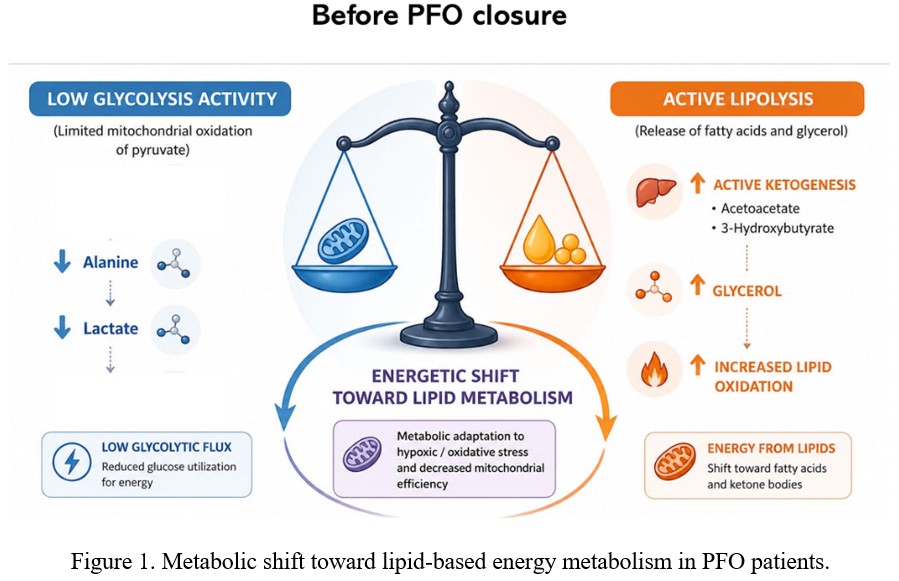
Results. NMR-based metabolomic profiling revealed consistent modulation of metabolites involved in glycolysis, lipid β-oxidation, ketone body metabolism, and the tricarboxylic acid cycle following PFO closure. At baseline, the metabolic profile was characterized by increased reliance on lipid-derived substrates, as indicated by elevated ketone bodies and lipid-related metabolites, alongside reduced levels of glycolysis-related metabolites such as lactate and alanine. At 6 months, a metabolic reprogramming was observed, with increased levels of lactate and alanine and reduced ketone bodies, indicating a shift toward glucose-based energy metabolism. Overall, these changes suggest improved metabolic flexibility and a reduction in lipid-driven energy reliance, consistent with a lower systemic metabolic stress burden.
Conclusions. In patients with MA and PFO, plasma metabolomics identified a baseline metabolic signature consistent with a systemic redox-sensitive and prothrombotic environment, in line with previously reported platelet activation and oxidative imbalance. The observed post-closure metabolic shift toward glucose utilization supports the hypothesis that PFO contributes to a metabolically dysregulated state that may be, at least partially, reversible after closure (Figure 1). These findings highlight metabolomics as a valuable tool to investigate the molecular mechanisms underlying the PFO–migraine association and to link metabolic reprogramming with platelet-driven thrombo-inflammatory processes.
Funding: M6C2I2.1_PNRR_NEXT_GENERATION_EU, PNRR-MAD-2022-12376277, CUP-B43C22001110008 Clinical trial: NCT06046508.
Downloads
Download data is not yet available.
Citations




How to Cite
1.
Conti M. PO141 | PLASMA METABOLOMIC PROFILING IDENTIFIES PLATELET-RELATED METABOLIC CHANGES AFTER PFO CLOSURE IN MIGRAINE WITH AURA: F. Marincola1, N. Zuddas1, F. Cannas1, A. Becchetti2, L.V. Renna3, M. Brambilla2, R. Cardani3, M. Conti2, K. Nallio2, M. Chessa3, D. Trabattoni2, V. Fanos4, M. Camera2|5 | 1Università degli Studi di Cagliari, Cagliari, Italy; 2Centro Cardiologico Monzino IRCCS, Milano, Italy; 3IRCCS Policlinico San Donato, San Donato, Milano, Italy; 4University Hospital of Cagliari, Cagliari, Italy; 5Università degli Studi di Milano, Department of Pharmaceutical Sciences, Milano, Italy. Bleeding Thromb Vasc Biol [Internet]. 2026 Oct. 26 [cited 2026 Oct. 29];5(s3). Available from: https://www.btvb.org/btvb/article/view/957
Copyright (c) 2026 The Author(s)


This work is licensed under a Creative Commons Attribution-NonCommercial 4.0 International License.



