

Oral Communications and Posters
Vol. 5 No. s3 (2026): Abstracts of the XXIX National Congress of the Italian Society for the Study of Hemostasis and Thrombosis, 2026

PO140 | HISTORY OF FALLS IN PATIENTS WITH ATRIAL FIBRILLATION: A SYSTEMATIC REVIEW AND META-ANALYSIS
A.P. Speziale1, G. Buoninfante1, A. Ronca2|4, B. Corica3, V. Trapani1, M. Moretti1, G. Annecchini1, R. Cangemi1, V. Raparelli1, M. Proietti2|4, S. Basili1, G.F. Romiti5 | 1Department of Translational and Precision Medicine, Sapienza University of Roma, Roma, Italy; 2Department of Clinical Sciences and Community Health, University of Milano, Milano, Italy; 3University of Modena and Reggio Emilia, Modena, Italy; 4Division of Subacute Care, IRCCS Istituti Clinici Scientifici Maugeri, Milano, Italy; 5Department of Wellbeing, Health and Environmental Sustainability, Sapienza University of Roma, Rieti, Italy
Publisher's note
All claims expressed in this article are solely those of the authors and do not necessarily represent those of their affiliated organizations, or those of the publisher, the editors and the reviewers. Any product that may be evaluated in this article or claim that may be made by its manufacturer is not guaranteed or endorsed by the publisher.
All claims expressed in this article are solely those of the authors and do not necessarily represent those of their affiliated organizations, or those of the publisher, the editors and the reviewers. Any product that may be evaluated in this article or claim that may be made by its manufacturer is not guaranteed or endorsed by the publisher.
Published: 26 October 2026
0
Views
0
Downloads
Authors
Methods. We performed a systematic review and meta-analysis, according to PRISMA Guidelines. MEDLINE and EMBASE were searched up to May 2025; we included all studies reporting either the prevalence of history of falls or the association of history of falls with long-term outcomes (all-cause death, stroke/thromboembolism [TE], major bleeding, intracranial hemorrhage [ICH], and recurrent falls) in patients with AF. Among the studies included, we also evaluated the use of OAC according to history of falls. Data on the prevalence of history of falls were pooled using a generalized linear mixed model, and results were reported as pooled prevalence and 95% Confidence Intervals (95%CI). Number of patients prescribed with OAC and total number of patients were pooled using random-effect models, and results were reported as pooled Odds Ratios (OR) and 95%CI. For long-term outcomes, we extracted Hazard Ratios (HR) and 95%CI and converted them to log-scale for pooling; where HR and 95%CI were unavailable, number of events and total number of patients were extracted. Results were reported as pooled Hazard Ratios (HR) and 95%CI. Heterogeneity was estimated using the restricted maximum-likelihood estimator, and the inconsistency index (I2) was also reported. Subgroup analyses and meta-regressions were also performed to explore potential sources of heterogeneity.
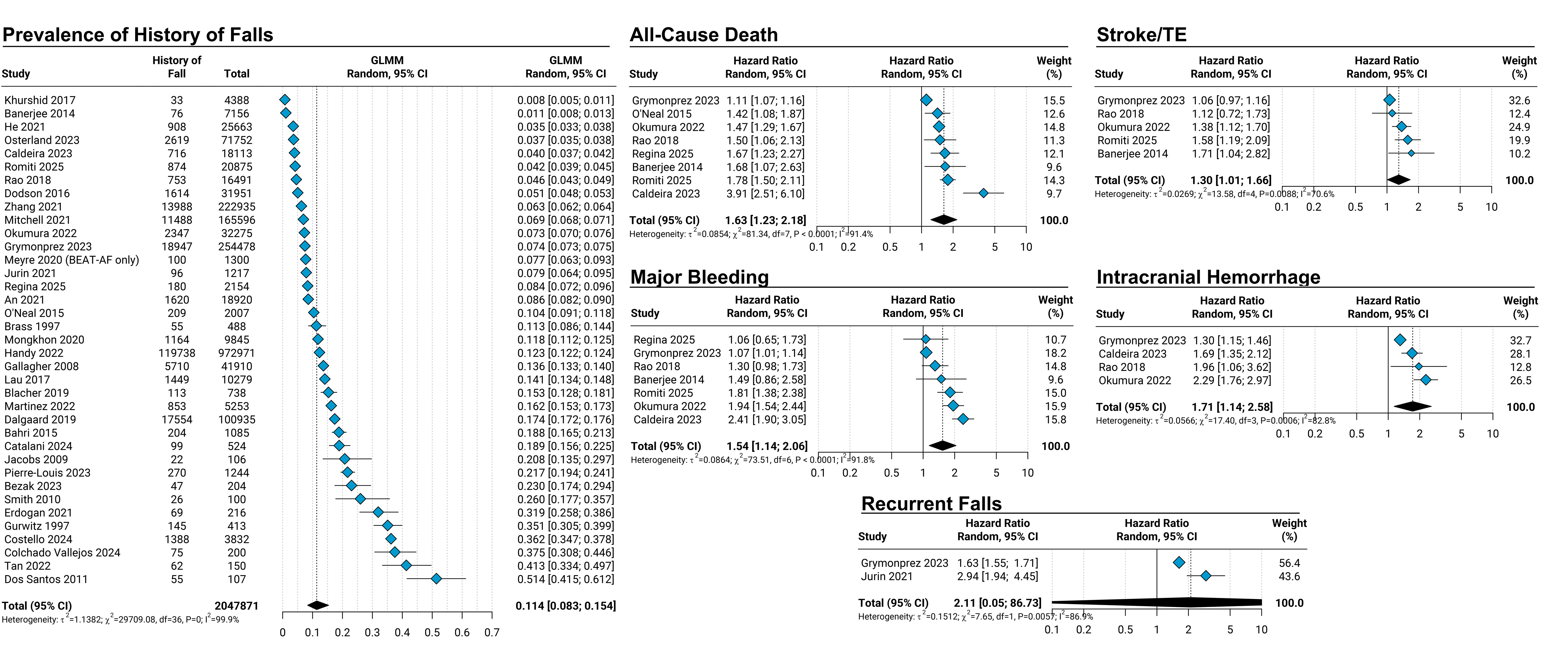
Results. 4,357 studies were found through literature search; after duplicates removal, screening of records, and cross-reference search, 37 studies were included, with over 2 million patients with AF. The pooled prevalence of history of falls was 11.4% (95%CI: 8.3-15.4%), with substantial heterogeneity observed across studies (I2=99.9%; Figure 1, left panel). History of falls was associated with lower odds of receiving OAC (OR: 0.57; 95%CI: 0.39-0.83 across 14 studies; I2=98.6%); prevalence of male sex, and higher uptake of direct oral anticoagulants were associated with higher odds of receiving OAC at meta-regression analysis. History of falls was associated with a higher risk of long-term outcomes (Figure 1, right panel), including all-cause mortality (HR 1.63, 95%CI: 1.23-2.18, I2=91.4%), stroke/TE (HR: 1.30, 95%CI: 1.01-1.66, I2=70.6%), major bleeding (HR: 1.54, 95%CI: 1.14-2.06, I2=91.8%) and ICH (HR: 1.71, 95%CI: 1.14-2.58, I2=82.8%). only 2 studies reported data on recurrent falls, both showing an increased risk in patients with previous falls, although without statistical significance at pooled analysis. Results were consistent at subgroup analyses and meta-regressions.
Conclusions. A history of previous falls is frequently found in patients with AF. Previous falls lead to lower use of OAC and are associated with a higher risk of all AF-related long-term outcomes. These patients require further efforts and dedicated approach to improve thromboembolic risk prevention, and to improve their prognosis.
Downloads
Download data is not yet available.
Citations




How to Cite
1.
Speziale AP. PO140 | HISTORY OF FALLS IN PATIENTS WITH ATRIAL FIBRILLATION: A SYSTEMATIC REVIEW AND META-ANALYSIS: A.P. Speziale1, G. Buoninfante1, A. Ronca2|4, B. Corica3, V. Trapani1, M. Moretti1, G. Annecchini1, R. Cangemi1, V. Raparelli1, M. Proietti2|4, S. Basili1, G.F. Romiti5 | 1Department of Translational and Precision Medicine, Sapienza University of Roma, Roma, Italy; 2Department of Clinical Sciences and Community Health, University of Milano, Milano, Italy; 3University of Modena and Reggio Emilia, Modena, Italy; 4Division of Subacute Care, IRCCS Istituti Clinici Scientifici Maugeri, Milano, Italy; 5Department of Wellbeing, Health and Environmental Sustainability, Sapienza University of Roma, Rieti, Italy. Bleeding Thromb Vasc Biol [Internet]. 2026 Oct. 26 [cited 2026 Oct. 28];5(s3). Available from: https://www.btvb.org/btvb/article/view/956
Copyright (c) 2026 The Author(s)


This work is licensed under a Creative Commons Attribution-NonCommercial 4.0 International License.



