

Oral Communications and Posters
Vol. 5 No. s3 (2026): Abstracts of the XXIX National Congress of the Italian Society for the Study of Hemostasis and Thrombosis, 2026

PO139 | PFO-LIKE INTRACARDIAC FLOW IS SUFFICIENT TO INDUCE A PROTHROMBOTIC PLATELET PHENOTYPE: EVIDENCE FROM A MICROFLUIDIC MODEL OF PATENT FORAMEN OVALE
M. Conti1, V. Guadagno2, D. Trabattoni1, A. Becchetti1, F. Morelli2, L. Fusini1, M. Brambilla1, S. Bozzi2, A. Redaelli2, M. Camera1|3 | 1Centro Cardiologico Monzino IRCCS, Milano, Italy; 2Politecnico di Milano, Department of Electronics, Informatics and Bioengineering (DEIB), Milano, Italy; 3Università degli Studi di Milano, Department of Pharmaceutical Sciences, Milano, Italy
Publisher's note
All claims expressed in this article are solely those of the authors and do not necessarily represent those of their affiliated organizations, or those of the publisher, the editors and the reviewers. Any product that may be evaluated in this article or claim that may be made by its manufacturer is not guaranteed or endorsed by the publisher.
All claims expressed in this article are solely those of the authors and do not necessarily represent those of their affiliated organizations, or those of the publisher, the editors and the reviewers. Any product that may be evaluated in this article or claim that may be made by its manufacturer is not guaranteed or endorsed by the publisher.
Published: 26 October 2026
67
Views
40
Downloads
Authors
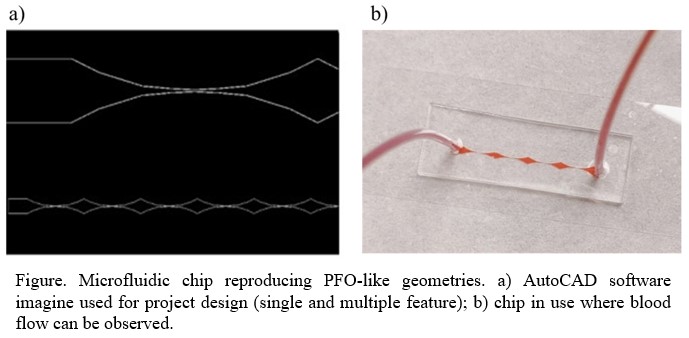
Methods. Platelet phenotype was first analyzed in PFO patients before percutaneous closure and after a 6-month follow-up, and compared with healthy subjects (HS) by flow cytometry. Platelet activation was assessed by measuring TF exposure and reactive oxygen species (ROS) generation. To investigate the mechanistic contribution of altered flow, a microfluidic platform reproducing the geometry and hemodynamic conditions of a PFO tunnel was developed based on computational fluid dynamics simulations (Figure). Whole blood from HS was perfused through the PFO-mimicking chip or through a linear physiological-flow chip used as control. Platelet TF expression, P-selectin exposure, activated GPIIbIIIa (aGPIIbIIIa) and ROS generation were analyzed by flow cytometry. In selected experiments, blood was pre-incubated with aspirin or a P2Y12 inhibitor (ARMX) before perfusion.
Results. PFO patients showed a significantly enhanced platelet prothrombotic phenotype, characterized by increased TF-positive platelets and ROS production compared with HS, which significantly decreased after PFO closure, supporting a direct link between PFO and systemic platelet activation. Perfusion of whole blood from HS through the PFO-mimicking chip was sufficient to reproduce this phenotype ex vivo. Passage through the PFO chip induced a significant increase in platelet TF expression, ROS production and P-selectin exposure (2-fold vs linear chip), whereas linear flow conditions did not significantly modify these parameters. In contrast, aGPIIbIIIa showed only a non-significant increase. Pre-incubation with the ARMX significantly reduced TF expression and ROS generation induced by PFO-like flow, whereas aspirin mainly reduced ROS.
Conclusions. These findings provide mechanistic evidence that abnormal PFO-associated intracardiac flow is sufficient, per se, to induce a prothrombotic platelet phenotype characterized by TF exposure. The ability of the microfluidic PFO model to recapitulate the platelet phenotype observed in vivo supports a direct causal role of hemodynamic stress in PFO-related thromboinflammation. This model may represent a valuable translational platform to dissect mechanisms of platelet activation in PFO and to test targeted antithrombotic strategies. Funding: M6C2I2.1_PNRR_NEXT_GENERATION_EU, PNRR-MAD-2022-12376277, CUP-B43C22001110008 Clinical trial: NCT06046508
Downloads
Download data is not yet available.
Citations




How to Cite
1.
Conti M. PO139 | PFO-LIKE INTRACARDIAC FLOW IS SUFFICIENT TO INDUCE A PROTHROMBOTIC PLATELET PHENOTYPE: EVIDENCE FROM A MICROFLUIDIC MODEL OF PATENT FORAMEN OVALE: M. Conti1, V. Guadagno2, D. Trabattoni1, A. Becchetti1, F. Morelli2, L. Fusini1, M. Brambilla1, S. Bozzi2, A. Redaelli2, M. Camera1|3 | 1Centro Cardiologico Monzino IRCCS, Milano, Italy; 2Politecnico di Milano, Department of Electronics, Informatics and Bioengineering (DEIB), Milano, Italy; 3Università degli Studi di Milano, Department of Pharmaceutical Sciences, Milano, Italy. Bleeding Thromb Vasc Biol [Internet]. 2026 Oct. 26 [cited 2026 Nov. 22];5(s3). Available from: https://www.btvb.org/btvb/article/view/955
Copyright (c) 2026 The Author(s)


This work is licensed under a Creative Commons Attribution-NonCommercial 4.0 International License.



