

Oral Communications and Posters
Vol. 5 No. s3 (2026): Abstracts of the XXIX National Congress of the Italian Society for the Study of Hemostasis and Thrombosis, 2026

PO136 | PHENOTYPE CHARACTERIZATION OF PATIENTS HOSPITALIZED FOR ACUTE SARS-COV2 INFECTION WITH AND WITHOUT ACUTE CEREBRAL ISCHEMIA
P. Agosti1|2, R. Gualtierotti1|2, C. Suffritti1, L. Valenti2|3, M. Morena2, M. Tettamanti4, A. Nobili4, A. Bandera2|5, F. Peyvandi1|2 | 1Fondazione IRCCS Ca' Granda Ospedale Maggiore Policlinico, Angelo Bianchi Bonomi Hemophilia and Thrombosis Center, Milano, Italy; 2Università degli Studi di Milano, Department of Pathophysiology and Transplantation, Milano, Italy; 3Department of Transfusion Medicine and Biological Resource Center, Fondazione IRCCS Ca' Granda Ospedale Maggiore Policlinico, Milano, Italy; 4Department of Health Policy, Istituto di Ricerche Farmacologiche Mario Negri IRCCS, Milano, Italy; 5Department of Infectious Diseases, Fondazione IRCCS Ca’ Granda, Ospedale Maggiore Policlinico, Milano, Italy
Publisher's note
All claims expressed in this article are solely those of the authors and do not necessarily represent those of their affiliated organizations, or those of the publisher, the editors and the reviewers. Any product that may be evaluated in this article or claim that may be made by its manufacturer is not guaranteed or endorsed by the publisher.
All claims expressed in this article are solely those of the authors and do not necessarily represent those of their affiliated organizations, or those of the publisher, the editors and the reviewers. Any product that may be evaluated in this article or claim that may be made by its manufacturer is not guaranteed or endorsed by the publisher.
Published: 26 October 2026
0
Views
0
Downloads
Authors
Methods. All patients included in the frame of the COVID-19 Network with available information on the primary endpoint (cerebral ischemia yes/no) were enrolled. The Registry, started from March 2020, included all consecutive adults (aged ≥18 years) with a positive RT-PCR result for SARS-CoV-2 at the time of hospital admission. All the Register-related details are reported elsewhere (doi: 10.1016/j.cmi.2020.06.028).
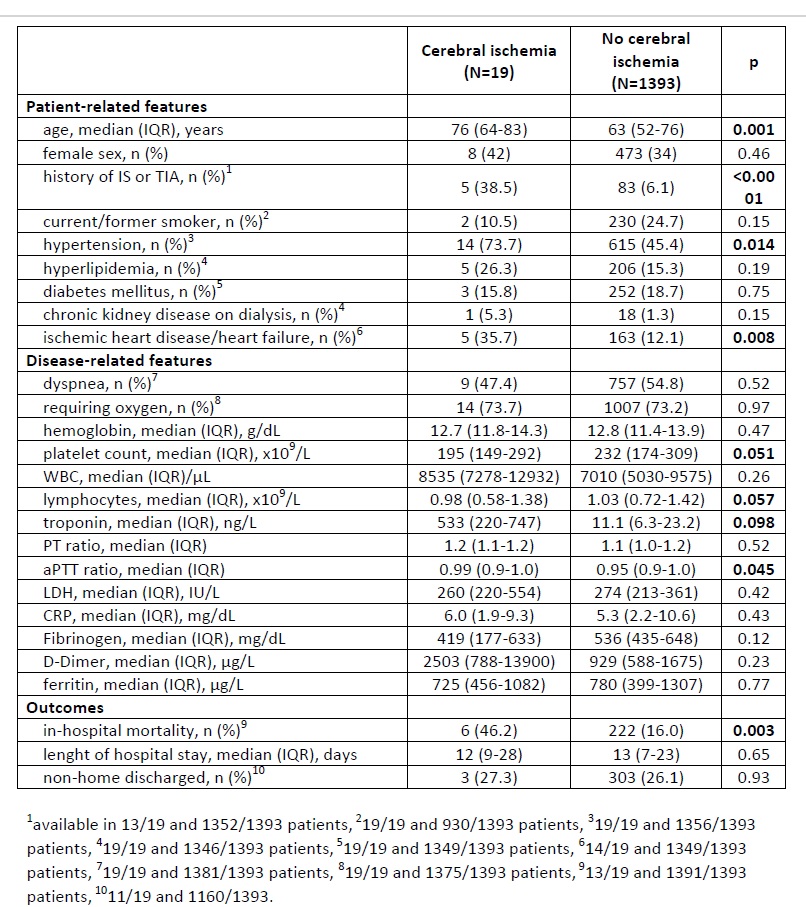
Results. Among 1412 patients hospitalized for acute Sars-CoV2 infection, we observed 19 cases with acute cerebral ischemia, including 11 imaging-proven ischemic stroke (IS) and 8 transient ischemic attack (TIA). Patients with acute cerebral ischemia (TIA or IS) were older compared with patients without, with a higher proportion of hypertension, ischemic heart disease/heart failure and history of IS/TIA. As regards laboratory parameters, we observed higher troponin levels and lower platelet and lymphocyte counts in patients with acute cerebral ischemia. Routine hemostatic and inflammatory laboratory parameters were comparable and within normal range in both groups. In-hospital mortality was significantly higher in patients with acute cerebral ischemia during acute SARS-CoV2 infection (Table). Consistently, reservoir mask was used more in these patients (18.8% vs 3.5 %, p=0.001).
Conclusions. In a large cohort of patients hospitalized for acute Sars-CoV2 infection (n=1412), we found an incidence proportion of 1.3% of acute cerebral ischemia, 0.8% of IS. Specific patient-related features (age, hypertension, history of IS/TIA, ischemic heart disease/heart failure) seemed to influence the risk of acute cerebral ischemia during acute SARS-CoV-2 infection. In these patients, the early detection of IS/TIA is very important considering its impact on in-hospital mortality risk. Monitoring specific laboratory parameters of disease severity (platelet count, lymphocytes and tropinin level) could be useful.
Downloads
Download data is not yet available.
Citations




How to Cite
1.
Agosti P. PO136 | PHENOTYPE CHARACTERIZATION OF PATIENTS HOSPITALIZED FOR ACUTE SARS-COV2 INFECTION WITH AND WITHOUT ACUTE CEREBRAL ISCHEMIA: P. Agosti1|2, R. Gualtierotti1|2, C. Suffritti1, L. Valenti2|3, M. Morena2, M. Tettamanti4, A. Nobili4, A. Bandera2|5, F. Peyvandi1|2 | 1Fondazione IRCCS Ca’ Granda Ospedale Maggiore Policlinico, Angelo Bianchi Bonomi Hemophilia and Thrombosis Center, Milano, Italy; 2Università degli Studi di Milano, Department of Pathophysiology and Transplantation, Milano, Italy; 3Department of Transfusion Medicine and Biological Resource Center, Fondazione IRCCS Ca’ Granda Ospedale Maggiore Policlinico, Milano, Italy; 4Department of Health Policy, Istituto di Ricerche Farmacologiche Mario Negri IRCCS, Milano, Italy; 5Department of Infectious Diseases, Fondazione IRCCS Ca’ Granda, Ospedale Maggiore Policlinico, Milano, Italy. Bleeding Thromb Vasc Biol [Internet]. 2026 Oct. 26 [cited 2026 Oct. 28];5(s3). Available from: https://www.btvb.org/btvb/article/view/952
Copyright (c) 2026 The Author(s)


This work is licensed under a Creative Commons Attribution-NonCommercial 4.0 International License.



