

Oral Communications and Posters
Vol. 5 No. s3 (2026): Abstracts of the XXIX National Congress of the Italian Society for the Study of Hemostasis and Thrombosis, 2026

PO135 | CHRONIC ERYTHROCYTE REMODELING AND IMPAIRED RHEOLOGICAL FUNCTION IN PATIENTS WITH PATENT FORAMEN OVALE
M. Conti1, D. Trabattoni1, T. Congiu2, A. Becchetti1, P. Della Valle1, M. Brambilla1, K. Nallio1, L.V. Renna3, R. Cardani3, M. Chessa3, V. Fanos4, M. Camera1|5 | 1Centro Cardiologico Monzino IRCCS, Milano, Italy; 2Università degli Studi di Cagliari, Cagliari, Italy; 3IRCCS Policlinico San Donato, San Donato, Milano, Italy; 4University Hospital of Cagliari, Monserrato, Cagliari, Italy; 5Università degli Studi di Milano, Department of Pharmaceutical Sciences, Milano, Italy
Publisher's note
All claims expressed in this article are solely those of the authors and do not necessarily represent those of their affiliated organizations, or those of the publisher, the editors and the reviewers. Any product that may be evaluated in this article or claim that may be made by its manufacturer is not guaranteed or endorsed by the publisher.
All claims expressed in this article are solely those of the authors and do not necessarily represent those of their affiliated organizations, or those of the publisher, the editors and the reviewers. Any product that may be evaluated in this article or claim that may be made by its manufacturer is not guaranteed or endorsed by the publisher.
Published: 26 October 2026
7
Views
2
Downloads
Authors
Methods. Sixty-seven patients with PFO were evaluated before closure (T0) and at 6-month follow-up after closure (T1), and compared with 28 healthy subjects (HS). Standard hematological parameters, including erythrocyte count and red cell distribution width (RDW-CV), were assessed by automated blood count. Erythrocyte ultrastructure was evaluated by scanning electron microscopy (SEM). Functional erythrocyte properties, including deformability under shear stress and aggregation behavior, were analyzed using LoRRca.
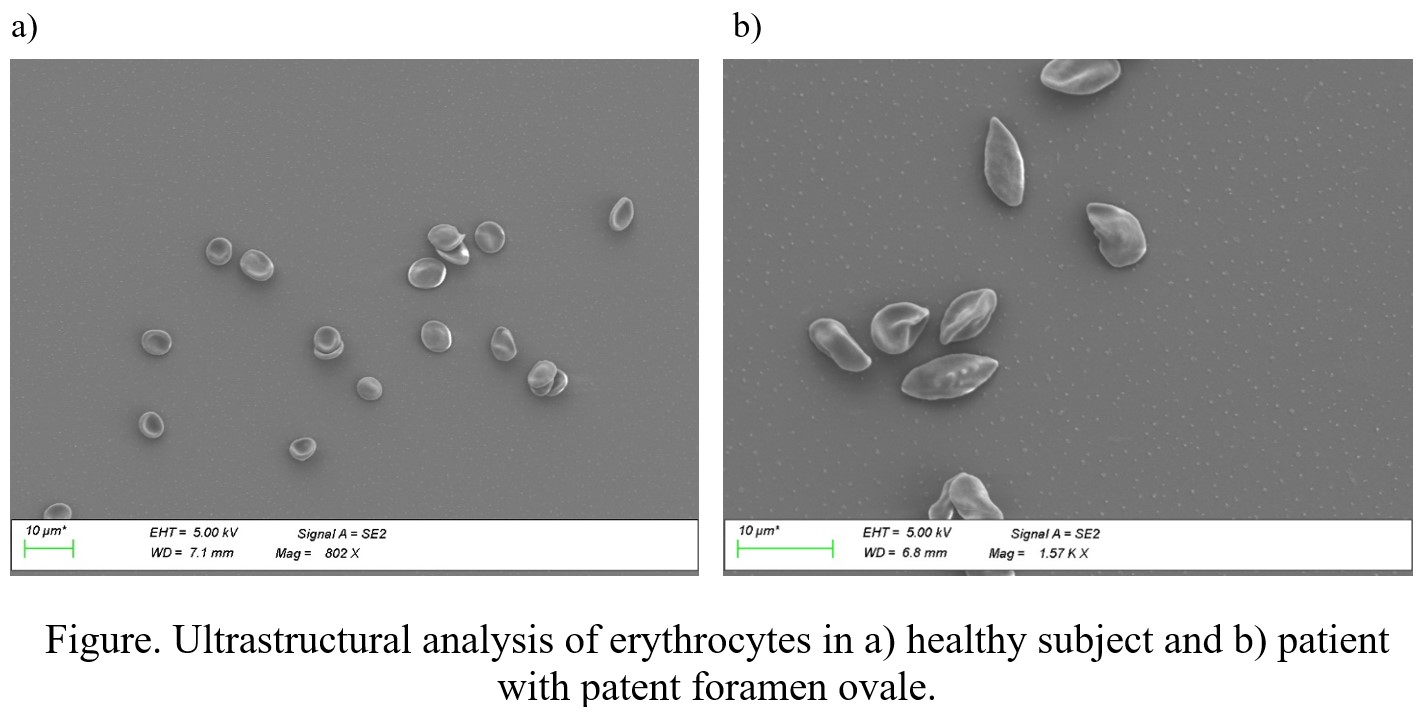
Results. Patients with PFO displayed evidence of erythrocyte structural remodeling. RDW-CV was significantly increased compared with HS (13.43% ± 1.36 vs 12.44% ± 0.53; p = 0.0011), indicating greater heterogeneity in erythrocyte size, and remained elevated at 6-month follow-up after closure (13.82% ± 1.75), suggesting persistence of long-lived structural alterations. SEM revealed morphological heterogeneity in PFO patients. In addition to biconcave RBCs, a “shield-shaped” erythrocyte phenotype was observed in PFO samples but not in HS, identifying a previously undescribed RBC morphological signature associated with PFO (Figure). Functional analysis showed that in PFO patients RBC deformability under prolonged shear stress was significantly reduced at baseline compared with post-closure values, indicating increased membrane rigidity and reduced mechanical resilience (elongation index 0.18 ± 0.03 vs 0.20 ± 0.04; p=0.019). Conversely, erythrocyte aggregability was significantly increased before PFO closure and improved after closure (amplitude 36.45 ± 3.66 vs 34.07 ± 3.36; p=0.0002), suggesting partial restoration of physiological rheological behavior after elimination of abnormal intracardiac flow. These findings are consistent with a model of chronic mechanical conditioning of erythrocytes in PFO, resulting in persistent structural remodeling and altered functional behavior.
Conclusions. PFO is associated with a distinct erythrocyte phenotype characterized by structural heterogeneity, abnormal morphology, impaired deformability, and increased aggregability. These alterations are consistent with chronic erythrocyte remodeling induced by prolonged exposure to abnormal hemodynamic stress. Partial recovery after PFO closure supports a causal relationship between PFO-related flow disturbance and erythrocyte dysfunction. Given the role of RBC rheology in vascular homeostasis and thrombosis, erythrocyte alterations may represent an additional contributor to the thromboinflammatory burden associated with PFO. Funding: M6C2I2.1_PNRR_NEXT_GENERATION_EU, PNRR-MAD-2022-12376277, CUP-B43C22001110008 Clinical trial: NCT06046508
Downloads
Download data is not yet available.
Citations




How to Cite
1.
Conti M. PO135 | CHRONIC ERYTHROCYTE REMODELING AND IMPAIRED RHEOLOGICAL FUNCTION IN PATIENTS WITH PATENT FORAMEN OVALE: M. Conti1, D. Trabattoni1, T. Congiu2, A. Becchetti1, P. Della Valle1, M. Brambilla1, K. Nallio1, L.V. Renna3, R. Cardani3, M. Chessa3, V. Fanos4, M. Camera1|5 | 1Centro Cardiologico Monzino IRCCS, Milano, Italy; 2Università degli Studi di Cagliari, Cagliari, Italy; 3IRCCS Policlinico San Donato, San Donato, Milano, Italy; 4University Hospital of Cagliari, Monserrato, Cagliari, Italy; 5Università degli Studi di Milano, Department of Pharmaceutical Sciences, Milano, Italy. Bleeding Thromb Vasc Biol [Internet]. 2026 Oct. 26 [cited 2026 Oct. 29];5(s3). Available from: https://www.btvb.org/btvb/article/view/951
Copyright (c) 2026 The Author(s)


This work is licensed under a Creative Commons Attribution-NonCommercial 4.0 International License.



