

Oral Communications and Posters
Vol. 5 No. s3 (2026): Abstracts of the XXIX National Congress of the Italian Society for the Study of Hemostasis and Thrombosis, 2026

PO130 | HEMORRHAGIC AND THROMBOTIC COMPLICATIONS DURING DOACS TREATMENT: THE IMPORTANCE OF A REGULAR AND PROLONGED FOLLOW-UP
D. Barcellona1|2, A. Mameli2, S. Cornacchini2, P. Schirru2, L. Fenu2, V. Casu2, F. Marongiu1|2 | 1University of Cagliari, Italy; 2Haemostasis and Thrombosis Unit, Azienda Ospedaliero-Universitaria di Cagliari, Italy
Publisher's note
All claims expressed in this article are solely those of the authors and do not necessarily represent those of their affiliated organizations, or those of the publisher, the editors and the reviewers. Any product that may be evaluated in this article or claim that may be made by its manufacturer is not guaranteed or endorsed by the publisher.
All claims expressed in this article are solely those of the authors and do not necessarily represent those of their affiliated organizations, or those of the publisher, the editors and the reviewers. Any product that may be evaluated in this article or claim that may be made by its manufacturer is not guaranteed or endorsed by the publisher.
Published: 26 October 2026
92
Views
23
Downloads
Authors
Methods. A total of 570 patients (256 women and 314 men, median age 78, range 65-95 years) with AF have been regularly followed for a median follow-up of 5 years (range 0.5-12 years, 2741 patient/years). The DOACs employed were: apixaban (n=357, 62.6%), Rivaroxaban (n=67, 11.7%), Edoxaban (n=79, 13.8%), and dabigatran (n=67, 11.7%). The DOAC regimen was given at either the recommended full or reduced dose. All bleeding episodes and thrombotic events have been documented by objective evidence. Each follow-up visit has been made on clinical grounds, with laboratory tests including Hb, platelet count, estimated glomerular filtration rate, and liver function tests. Non-parametric ANOVA was utilized to compare the clinical events across all DOACs.
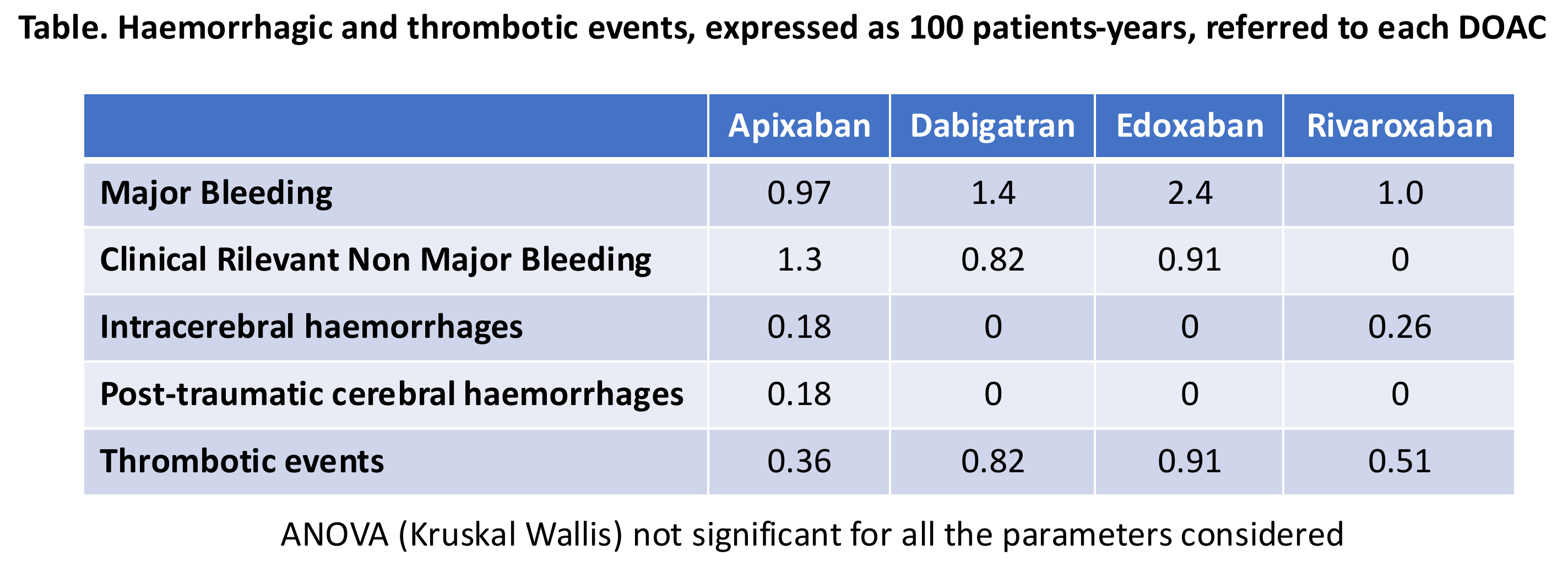
Results. Major bleeding events was 33 (1.2x100/patients/year), spontaneous intracerebral hemorrhages were 4 (0.15 x 100 patients-years), while post-traumatic cerebral hemorrhages were 3 (2 subdural and 1 subarachnoid) (0.11 x 100 patients-years). Clinically relevant non-major bleeding episodes were 28 (0.2 x 100 patients-years). Thrombotic events were as follows: ischemic strokes (n=9), upper right embolic event (n=1), atrial thrombosis (n=1), transient ischemic attacks (n=4) (0.55 x 100 patients-years). No differences were found when all these clinical adverse events were compared among all four DOACs (Table).
Conclusions. This prospective study demonstrates that all DOACs perform well when patients with AF are regularly followed and monitored in a Hemostasis and Thrombosis Unit over an extended follow-up period. The results are significantly better than those achieved in the registrative trials, underscoring the importance of periodic follow-up for these patients. The role of the Hemostasis and Thrombosis Unit is crucial in managing therapy, which often faces adherence issues when patients are left to manage their treatment independently after the initial prescription.
Downloads
Download data is not yet available.
Citations




How to Cite
1.
Barcellona D. PO130 | HEMORRHAGIC AND THROMBOTIC COMPLICATIONS DURING DOACS TREATMENT: THE IMPORTANCE OF A REGULAR AND PROLONGED FOLLOW-UP: D. Barcellona1|2, A. Mameli2, S. Cornacchini2, P. Schirru2, L. Fenu2, V. Casu2, F. Marongiu1|2 | 1University of Cagliari, Italy; 2Haemostasis and Thrombosis Unit, Azienda Ospedaliero-Universitaria di Cagliari, Italy. Bleeding Thromb Vasc Biol [Internet]. 2026 Oct. 26 [cited 2026 Nov. 19];5(s3). Available from: https://www.btvb.org/btvb/article/view/946
Copyright (c) 2026 The Author(s)


This work is licensed under a Creative Commons Attribution-NonCommercial 4.0 International License.



