

Oral Communications and Posters
Vol. 5 No. s3 (2026): Abstracts of the XXIX National Congress of the Italian Society for the Study of Hemostasis and Thrombosis, 2026

PO128 | FROM SEVERE THROMBOSIS TO SUCCESSFUL PREGNANCIES: ORTHOTOPIC LIVER TRANSPLANTATION IN INHERITED AFIBRINOGENEMIA WITH BUDD–CHIARI SYNDROME
G. Murante1|2|6, S. Bergonzi1|2|6, M. Capetta1|2|6, F. Valeri1|2, C. Dainese1|2, A. Valpreda4, R. Pastorino1|6, F. Bocchi1|6, R. Romagnoli5, S. Martini3, B. Bruno2|6, A. Borchiellini1|2 | 1Regional Centre for Hemorrhagic and Thrombotic Diseases; 2Division of Hematology; 3SSD Hepatic insufficiency and Liver Transplant; 4Central Lab. Baldi and Riberi; 5General Surgery 2U - Liver Transplant Center, Molinette Hospital, AOU Città della Salute e della Scienza di Torino, Italy; 6Dep. of Molecular Biotechnology and Health Sciences, University of Turin, Italy
Publisher's note
All claims expressed in this article are solely those of the authors and do not necessarily represent those of their affiliated organizations, or those of the publisher, the editors and the reviewers. Any product that may be evaluated in this article or claim that may be made by its manufacturer is not guaranteed or endorsed by the publisher.
All claims expressed in this article are solely those of the authors and do not necessarily represent those of their affiliated organizations, or those of the publisher, the editors and the reviewers. Any product that may be evaluated in this article or claim that may be made by its manufacturer is not guaranteed or endorsed by the publisher.
Published: 26 October 2026
0
Views
0
Downloads
Authors
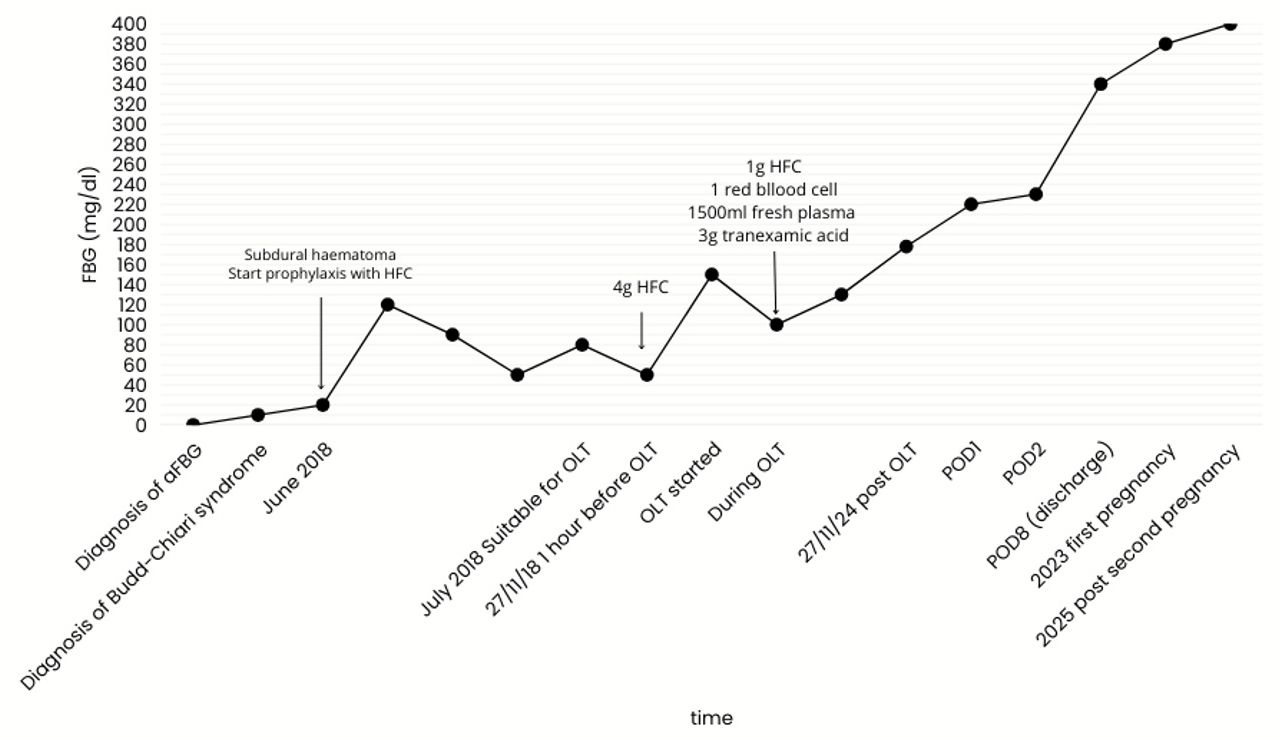
Case report. We report the case of a 30-year-old woman diagnosed with inherited aFBG during infancy following severe gingival bleeding that required treatment with fresh frozen plasma (FFP) and red blood cell (RBC) transfusions. Throughout childhood and adolescence, she experienced recurrent mucocutaneous bleeding episodes managed with on-demand replacement therapy. In adulthood, her clinical course was complicated by recurrent hemoperitoneum secondary to hemorrhagic corpus luteum rupture, requiring surgical intervention and transfusion support. Combined oral contraceptives were subsequently introduced to prevent recurrence. In January 2018, following a spontaneous haematoma of the abdominal wall treated with FFP, a CT scan revealed splenomegaly, an enlarged and distorted liver, caudate lobe hypertrophy, no visualization of the right suprahepatic vein, leading to a diagnosis of partial Budd–Chiari syndrome. In the absence of identifiable thrombophilic conditions, the event was attributed to a multifactorial prothrombotic state associated with aFBG, estrogen exposure, and repeated FFP administration. The progression to advanced chronic liver disease, with a Model for End-Stage Liver Disease (MELD) score of 30, prompted the indication for orthotopic liver transplantation (OLT). In June 2018, a chronic right subdural haematoma was incidentally discovered during a brain CT scan performed as part of pre-OLT screening. Taking into account the complex nature of the case, there was no indications for evacuation, and it was treated conservatively. Prophylaxis with HFC (4 grams, every 72 hours) was initiated with the aim of achieving a peak > 1.5 g/L. On 27 November 2018, OLT transplant was performed after infusion of 4 g 1 hour before surgery with the aim of achieving a peak > 1.5 g/L. Intraoperative management required intensive hemostatic support, including FFP, RBC transfusions, and tranexamic acid. The postoperative course was uneventful, with rapid normalization of FBG levels the same day of OLT. Thromboprophylaxis with low-molecular-weight heparin was initiated on the first postoperative day. During long-term follow-up, the patient remained free from both bleeding and thrombotic events. Notably, she successfully completed two pregnancies with favorable outcomes under appropriate antithrombotic prophylaxis, highlighting the restoration of effective hemostatic function following transplantation.
Conclusions. We report one of the few cases of inherited aFBG, complicated with Budd-Chiari syndrome successfully treated with OLT.
Downloads
Download data is not yet available.
Citations




How to Cite
1.
Murante G. PO128 | FROM SEVERE THROMBOSIS TO SUCCESSFUL PREGNANCIES: ORTHOTOPIC LIVER TRANSPLANTATION IN INHERITED AFIBRINOGENEMIA WITH BUDD–CHIARI SYNDROME: G. Murante1|2|6, S. Bergonzi1|2|6, M. Capetta1|2|6, F. Valeri1|2, C. Dainese1|2, A. Valpreda4, R. Pastorino1|6, F. Bocchi1|6, R. Romagnoli5, S. Martini3, B. Bruno2|6, A. Borchiellini1|2 | 1Regional Centre for Hemorrhagic and Thrombotic Diseases; 2Division of Hematology; 3SSD Hepatic insufficiency and Liver Transplant; 4Central Lab. Baldi and Riberi; 5General Surgery 2U - Liver Transplant Center, Molinette Hospital, AOU Città della Salute e della Scienza di Torino, Italy; 6Dep. of Molecular Biotechnology and Health Sciences, University of Turin, Italy. Bleeding Thromb Vasc Biol [Internet]. 2026 Oct. 26 [cited 2026 Oct. 28];5(s3). Available from: https://www.btvb.org/btvb/article/view/944
Copyright (c) 2026 The Author(s)


This work is licensed under a Creative Commons Attribution-NonCommercial 4.0 International License.



