

Oral Communications and Posters
Vol. 5 No. s3 (2026): Abstracts of the XXIX National Congress of the Italian Society for the Study of Hemostasis and Thrombosis, 2026

PO124 | BLEEDING COMPLICATIONS DURING ANTICOAGULATION WITH DOACS FOR NVAF AND THEIR MOST COMMON RISK FACTORS
A. delle Femine, P. Di Micco, P. Sommese, M. Di Napoli, A. Di Salvatore, M. Galdiero, A. Lobasso, R. Serpico, V. Brunelli, A. Di Fusco, C. di Gennaro | U.O.C. Medicina Interna, Osp. Santa Maria delle Grazie, Pozzuoli, Italy
Publisher's note
All claims expressed in this article are solely those of the authors and do not necessarily represent those of their affiliated organizations, or those of the publisher, the editors and the reviewers. Any product that may be evaluated in this article or claim that may be made by its manufacturer is not guaranteed or endorsed by the publisher.
All claims expressed in this article are solely those of the authors and do not necessarily represent those of their affiliated organizations, or those of the publisher, the editors and the reviewers. Any product that may be evaluated in this article or claim that may be made by its manufacturer is not guaranteed or endorsed by the publisher.
Published: 26 October 2026
6
Views
2
Downloads
Authors
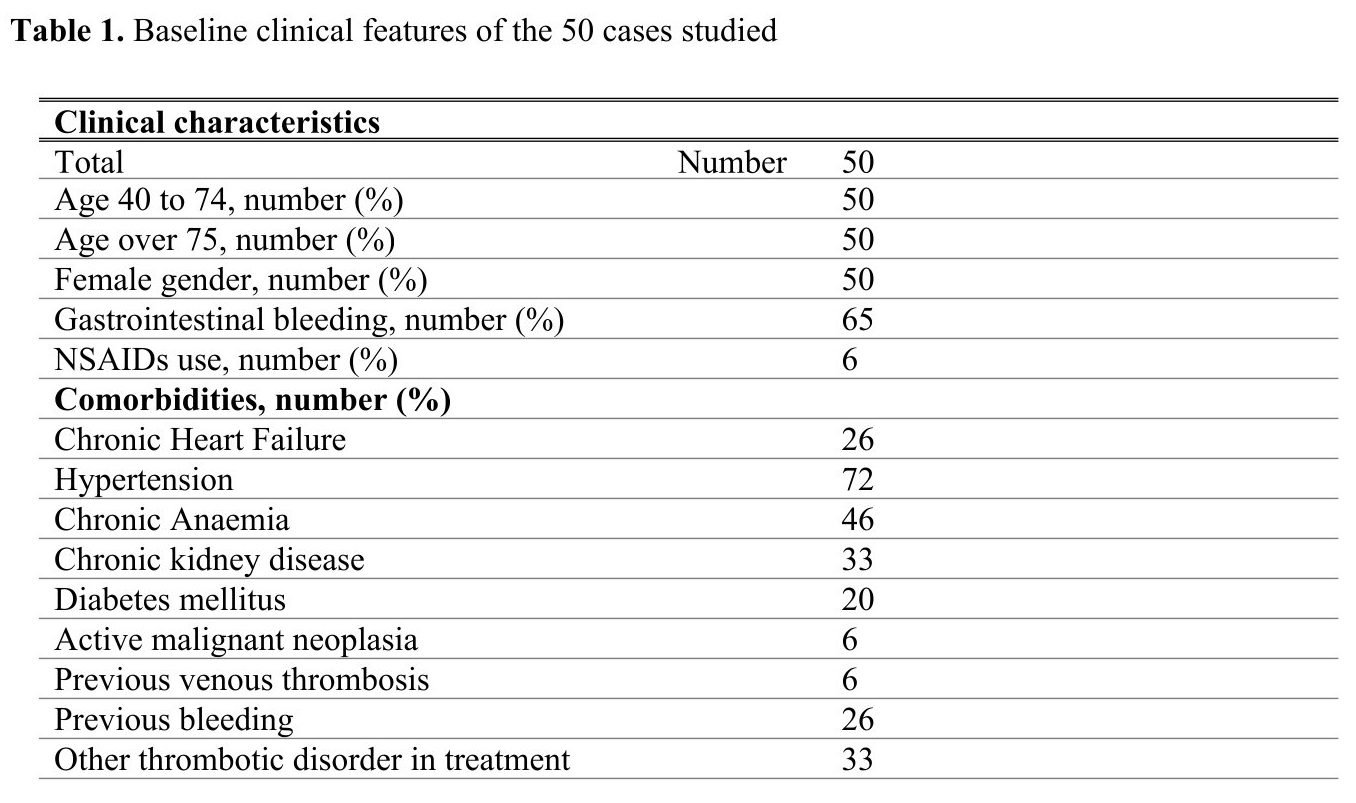
Methods. We retrospectively analyzed bleeding risk factors in patients hospitalized in internal medicine ongoing DOACs for any reason. We included in our analysis items presents in two different score as RIETE score for anticoagulated patients after a venous thromboembolism and as CHADS2VASC. Furthermore, we included the chronic use of NSAIDs for any reasons. Items evaluated as bleeding risk factors are summarized in table 1.
Results. Type of bleeding, previous bleeding, ongoing heart failure, kidney failure, ongoing cancer, female sex, age 40-74 years, age ≥75 years, chronic use (not abuse) of NSAIDs, chronic anaemia, previous venous thrombosis, diabetes, hypertension, other thrombosis in secondary prevention were the items retrospectively analyzed; all of them extracted by two different scores as CHADS[2]VASc and RIETE. Sex distribution and age ≥75 years were equally distributed in the population. Gastrointestinal bleeding was the most common bleeding complication. Hypertension and diabetes were greatly represented in the cohort as far as in the general population. Chronic anaemia, previous bleeding, kidney failure, other thrombotic disease in secondary prevention and heart failure are frequently present in patients with bleedings during anticoagulation with DOACs for NVAF.
Conclusions. Phase III clinical trial gave us the chance to understand that cardioembolic stroke prophylaxis with DOACs were not associated to bleedings in particular intracranial hemorrhage. However, in our daily clinical management we noted an increased rate of gastrointestinal bleeding. This difference with phase III clinical trial was probably due to the long-term administration of DOACs in real life compared to the clinical observation of trials (i.e. shorter than 24 months). For these reasons we tried to identify items present in hemorrhagic risk score used in clinical practice hoping to identify a possible major bleeding risk factor. Therefore our cross analysis with items present in RIETE score (a score validated for bleeding risk during anticoagulation) and CHADS[2]VASc (a score used to start anticoagulation for thrombotic risk in NVAF but also associated to bleeding prediction) we find that chronic anaemia, previous bleeding, kidney failure, other thrombotic disease in secondary prevention and heart failure are the most common risk factors in patients hospitalized in internal medicine with bleedings during anticoagulation with DOACs. Further studies on larger cohorts are warranted to confirm our findings, but seems that the complexity of patients is more frequent of a single common risk factor in the bleeding complication during long term anticoagulation for DOACs.
Downloads
Download data is not yet available.
Citations




How to Cite
1.
Delle Femine A. PO124 | BLEEDING COMPLICATIONS DURING ANTICOAGULATION WITH DOACS FOR NVAF AND THEIR MOST COMMON RISK FACTORS: A. delle Femine, P. Di Micco, P. Sommese, M. Di Napoli, A. Di Salvatore, M. Galdiero, A. Lobasso, R. Serpico, V. Brunelli, A. Di Fusco, C. di Gennaro | U.O.C. Medicina Interna, Osp. Santa Maria delle Grazie, Pozzuoli, Italy. Bleeding Thromb Vasc Biol [Internet]. 2026 Oct. 26 [cited 2026 Oct. 29];5(s3). Available from: https://www.btvb.org/btvb/article/view/940
Copyright (c) 2026 The Author(s)


This work is licensed under a Creative Commons Attribution-NonCommercial 4.0 International License.



