

Oral Communications and Posters
Vol. 5 No. s3 (2026): Abstracts of the XXIX National Congress of the Italian Society for the Study of Hemostasis and Thrombosis, 2026

PO123 | PERIOPERATIVE MANAGEMENT OF FEMORAL FRACTURE SURGERY IN AN ELDERLY PATIENT WITH ACQUIRED HEMOPHILIA A RECEIVING EMICIZUMAB
C. Simion, E. Zanon, B. Stocco, G. Saggiorato, F. Sartorello, C. Bulato, P. Simioni | Department of Medicine, University of Padova, Italy
Publisher's note
All claims expressed in this article are solely those of the authors and do not necessarily represent those of their affiliated organizations, or those of the publisher, the editors and the reviewers. Any product that may be evaluated in this article or claim that may be made by its manufacturer is not guaranteed or endorsed by the publisher.
All claims expressed in this article are solely those of the authors and do not necessarily represent those of their affiliated organizations, or those of the publisher, the editors and the reviewers. Any product that may be evaluated in this article or claim that may be made by its manufacturer is not guaranteed or endorsed by the publisher.
Published: 26 October 2026
5
Views
1
Downloads
Authors
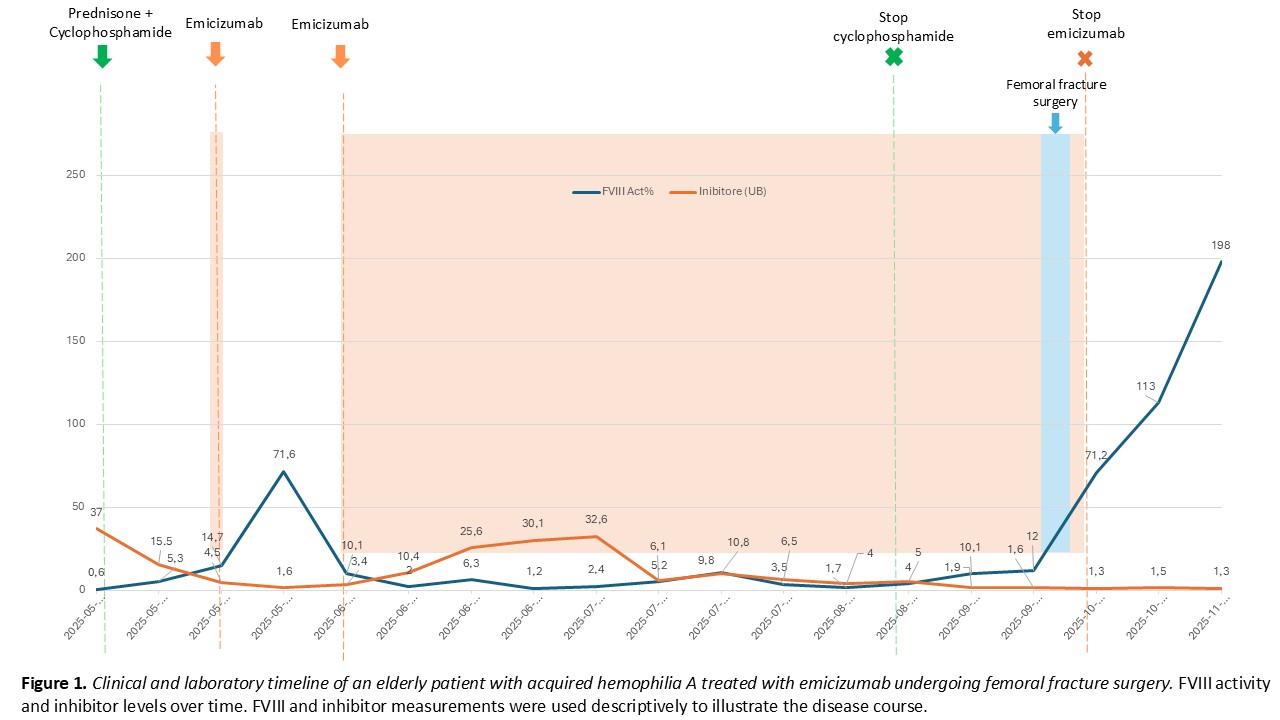
Case report. We report the case of an 80 years old woman with AHA complicated by a high-titer factor VIII inhibitor and marked clinical frailty. The disease course was characterized by recurrent bleeding episodes and fluctuating factor VIII levels despite immunosuppressive therapy with corticosteroids and cyclophosphamide. Following a severe relapse, emicizumab prophylaxis was initiated, leading to clinical stabilization. In September 2025, the patient sustained a femoral fracture requiring urgent orthopedic surgery. Perioperative hemostatic management was based on continuation of emicizumab prophylaxis combined with recombinant activated factor VII (rFVIIa, eptacog alfa), administered at tapering doses over a total of seven days, together with adjunctive tranexamic acid. Surgery was successfully performed. A postoperative hemoglobin decrease required transfusion support, but the patient remained hemodynamically stable, with no major bleeding or thrombotic complications. In the postoperative period, a partial remission of acquired hemophilia A was observed, with factor VIII activity rising above 30%, allowing discontinuation of emicizumab prophylaxis (Figure 1).
Conclusions. To our knowledge, this is the first reported case of femoral fracture surgery in an elderly patient with AHA receiving emicizumab prophylaxis. This case demonstrates that major orthopedic surgery can be successfully managed in selected AHA patients under emicizumab using a structured perioperative approach with rFVIIa. The absence of specific recommendations for this setting highlights the importance of shared clinical experience and structured reporting to support decision-making in this high-risk population.
Downloads
Download data is not yet available.
Citations




How to Cite
1.
Simion C. PO123 | PERIOPERATIVE MANAGEMENT OF FEMORAL FRACTURE SURGERY IN AN ELDERLY PATIENT WITH ACQUIRED HEMOPHILIA A RECEIVING EMICIZUMAB: C. Simion, E. Zanon, B. Stocco, G. Saggiorato, F. Sartorello, C. Bulato, P. Simioni | Department of Medicine, University of Padova, Italy. Bleeding Thromb Vasc Biol [Internet]. 2026 Oct. 26 [cited 2026 Oct. 29];5(s3). Available from: https://www.btvb.org/btvb/article/view/939
Copyright (c) 2026 The Author(s)


This work is licensed under a Creative Commons Attribution-NonCommercial 4.0 International License.



