

Oral Communications and Posters
Vol. 5 No. s3 (2026): Abstracts of the XXIX National Congress of the Italian Society for the Study of Hemostasis and Thrombosis, 2026

PO119 | BARTONELLA HENSELAE INFECTION ASSOCIATED WITH A MULTISYSTEMIC THROMBO-INFLAMMATORY SYNDROME IN AN IMMUNOCOMPETENT ADULT
G. Gobbo1|2, M. Zacchia1|2, F. Nalesso1|3, M. Fedrigo1|4, S. Da Pozzo5, L. Frison7, F. Vianello1|6, A. Angelini1|4, P. Simioni1|2, A. Hoxha1|2 | 1Department of Medicine - DIMED, University of Padua, Italy; 2Internal Medicine Unit, Thrombotic and Bleeding Disorder Center; 3Nephrology Unit; 4Pathology Unit; 5Radiology Unit; 6Hematology Unit, University-Hospital of Padua, Italy; 7Hematology Unit, Ospedale dell’Angelo, Mestre, Italy
Publisher's note
All claims expressed in this article are solely those of the authors and do not necessarily represent those of their affiliated organizations, or those of the publisher, the editors and the reviewers. Any product that may be evaluated in this article or claim that may be made by its manufacturer is not guaranteed or endorsed by the publisher.
All claims expressed in this article are solely those of the authors and do not necessarily represent those of their affiliated organizations, or those of the publisher, the editors and the reviewers. Any product that may be evaluated in this article or claim that may be made by its manufacturer is not guaranteed or endorsed by the publisher.
Published: 26 October 2026
7
Views
2
Downloads
Authors
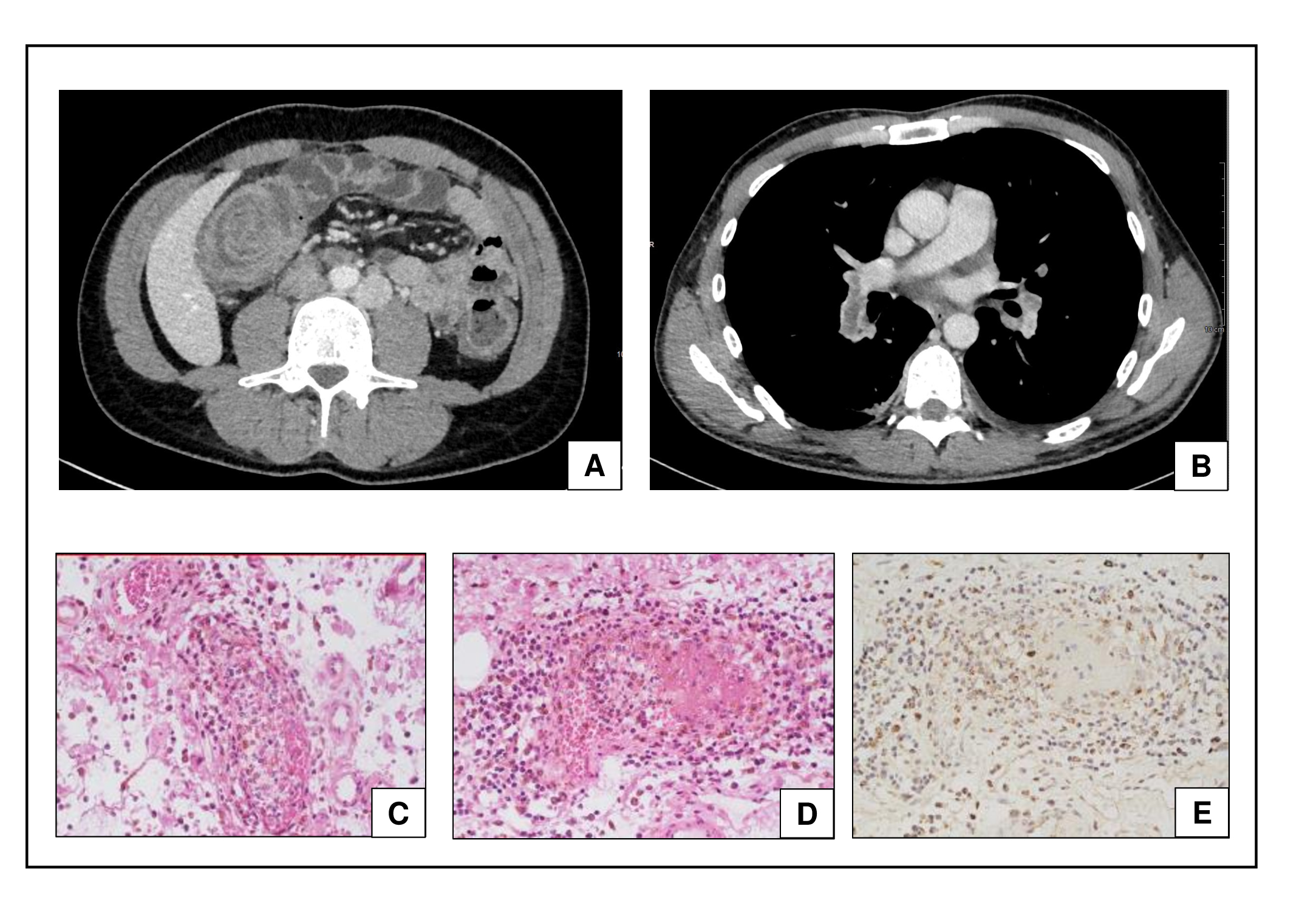
Case reports. Here we report, a previously healthy 43-year-old man presented in Emergency Department on April 2023 with abdominal pain, rectal bleeding, low-grade fever, and severe thrombocytopenia (19×10⁹/L). Abdominal CT revealed ileocolic intussusception, splenic ischemic lesions, hepatomegaly, and retroperitoneal lymphadenopathy (Fig. 1A), leading to urgent right hemicolectomy. Six days later, a CT scan performed as diagnostic workup showed pulmonary embolism with deep vein thrombosis (Fig. 1B). Treatment with intravenous immunoglobulin and corticosteroids resulted in partial platelet recovery. A vena cava filter was placed, and anticoagulation with apixaban was initiated. In May 2023, the patient experienced recurrent fever and migratory arthritis and was treated with a two-week course of prednisone and antibiotics, with improvement. Four weeks later, arthritis recurred and blood tests showed acute kidney injury with nephrotic-range proteinuria and recurrent thrombocytopenia. Physical examination showed mild bilateral exophthalmos and ocular motility impairment. A brain MRI demonstrated multiple microembolic ischemic lesions. Fluorescein angiography and Optical coherence tomography showed abnormalities, suggestive of secondary serous retinal detachment. Laboratory testing revealed elevated inflammatory markers and lupus anticoagulant positivity, while autoimmune screening, ADAMTS-13 activity, and extensive infectious work-up were initially negative. Complement levels were within the normal range. The patient received prednisone and was then transferred to a tertiary center. There, he recalled a recent exposure to purulent material from an infected pet dog. Expanded microbiological testing detected Bartonella henselae DNA by whole-blood PCR. Retrospective histopathological review of the surgical showed small-vessel endothelial inflammation and thrombosis compatible with infection-associated microangiopathy (Fig. 1C-E). Cardiac MRI demonstrated inflammatory cardiomyopathy, and renal MRI showed inflammatory renal injury. Targeted antimicrobial therapy with doxycycline was initiated and extended to five weeks due to persistent PCR positivity. Corticosteroids were gradually tapered and anticoagulation was maintained. Clinical improvement followed antimicrobial therapy, with normalization of platelet counts, stabilization of renal function, regression of thrombotic manifestations, and, eventually, PCR negativity. Lupus anticoagulant testing at 12 weeks was negative. The patient remained asymptomatic at the latest follow-up visit on March 2026.
Conclusions. This case describes a severe multisystem thrombo-inflammatory syndrome associated with B. henselae infection in an immunocompetent adult. The clinical picture initially suggested CAPS or other primary TMAs. However, available laboratory findings did not support a diagnosis of overt microangiopathic hemolysis. Bartonella species exhibit endothelial tropism and may promote vascular inflammation and prothrombotic phenomena. Bartonella infection should be considered in patients with unexplained TMA-like presentations, particularly when routine investigations remain inconclusive.
Downloads
Download data is not yet available.
Citations




How to Cite
1.
Gobbo G. PO119 | BARTONELLA HENSELAE INFECTION ASSOCIATED WITH A MULTISYSTEMIC THROMBO-INFLAMMATORY SYNDROME IN AN IMMUNOCOMPETENT ADULT: G. Gobbo1|2, M. Zacchia1|2, F. Nalesso1|3, M. Fedrigo1|4, S. Da Pozzo5, L. Frison7, F. Vianello1|6, A. Angelini1|4, P. Simioni1|2, A. Hoxha1|2 | 1Department of Medicine - DIMED, University of Padua, Italy; 2Internal Medicine Unit, Thrombotic and Bleeding Disorder Center; 3Nephrology Unit; 4Pathology Unit; 5Radiology Unit; 6Hematology Unit, University-Hospital of Padua, Italy; 7Hematology Unit, Ospedale dell’Angelo, Mestre, Italy. Bleeding Thromb Vasc Biol [Internet]. 2026 Oct. 26 [cited 2026 Oct. 29];5(s3). Available from: https://www.btvb.org/btvb/article/view/935
Copyright (c) 2026 The Author(s)


This work is licensed under a Creative Commons Attribution-NonCommercial 4.0 International License.



