

Oral Communications and Posters
Vol. 5 No. s3 (2026): Abstracts of the XXIX National Congress of the Italian Society for the Study of Hemostasis and Thrombosis, 2026

PO106 | INTERACTIONS BETWEEN DIRECT ORAL ANTICOAGULANTS AND ANTIEPILEPTIC DRUGS (INTER-DOAC): A PROSPECTIVE OBSERVATIONAL STUDY
A. Rafanelli1, C. Pizzanelli3, M. Biagini1, P. Chiarugi4, M. Casini4, P. Capozza5, G. Guarini5, L. Malloggi4, G. Siciliano3, R. De Caterina5|6, L. Carrozzi1|2, F. Pistelli1|2, L. Marconi2, A. Celi1|2, R. Pancani2 | 1Pulmonary Division, Dep. of Surgical, Medical and Molecular Pathology and Critical Care Medicine, University of Pisa, Pisa, Italy; 2Pulmonary Unit, Cardiothoracic and Vascular Dep., University Hospital of Pisa, Pisa, Italy; 3Neurology Unit, Dep. of Clinical and Experimental Medicine, University of Pisa, Pisa, Italy; 4Clinical Chemistry Laboratory, Dep. of Laboratory Medicine, University Hospital of Pisa, Pisa, Italy; 5Cardiology Unit, Cardiothoracic and Vascular Dep., University Hospital of Pisa, Pisa, Italy; 6Cardiology Division, Dep. of Surgical, Medical and Molecular Pathology and Critical Care Medicine, University of Pisa, Pisa, Italy
Publisher's note
All claims expressed in this article are solely those of the authors and do not necessarily represent those of their affiliated organizations, or those of the publisher, the editors and the reviewers. Any product that may be evaluated in this article or claim that may be made by its manufacturer is not guaranteed or endorsed by the publisher.
All claims expressed in this article are solely those of the authors and do not necessarily represent those of their affiliated organizations, or those of the publisher, the editors and the reviewers. Any product that may be evaluated in this article or claim that may be made by its manufacturer is not guaranteed or endorsed by the publisher.
Published: 26 October 2026
53
Views
28
Downloads
Authors
Methods. In this observational, prospective study, approved by the Italian Ethic Committee (CET03/2023 of 27 July 2023), we enrolled outpatients with non-valvular AF or pulmonary embolism (PE) and an indication for AED attending the Respiratory, Cardiology and Neurology Units in Pisa, Italy. Anthropometric parameters, comorbidities, repeated plasma DOAC and AED levels and clinical events (arterial/venous thrombosis, seizure, major or non-major clinically relevant bleeding, death) were recorded. For each DOAC plasma level we calculated the z-score based on data from 967 patients at the local laboratory, upon verification of their normal distribution. In the absence of universally accepted reference values, we defined the therapeutic range (TR) for DOAC as that corresponding to a z-score between -1.64 and 1.64. For AED, the TR was calculated based on the range provided by the local laboratory.
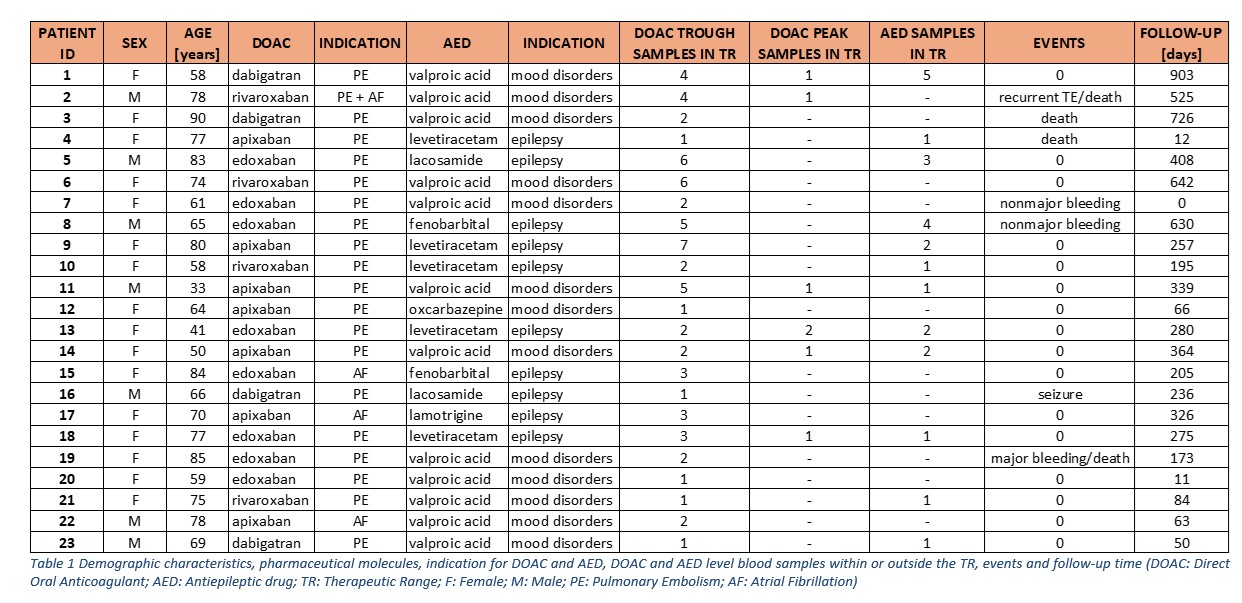
Results. Baseline characteristics of the study population (n=23), pharmaceutical molecules, DOAC and AED blood level within or outside the TR, events and follow-up time are listed in the table. A total of 136 blood tests were performed from September 2023 to March 2026. Each patient was followed up by the relevant specialist clinically. In 66 out of 68 (97%) trough samples and 7 out of 9 (78%) peak samples, respectively, plasma levels of DOAC were within the TR. In 24 out of 63 (38%) samples in patients with an indication for AED as antiepileptic therapy or mood stabilization, AED levels were within the TR. During follow-up (mean 294 days) we recorded a recurrent thromboembolic event, 2 non-major clinically relevant bleedings, a major bleeding and 2 episodes of seizure (in the same patient). Four patients died during the follow-up period, one of whom as a consequence of intracranial bleeding, one for neoplastic cachexia, one for respiratory failure in severe pulmonary emphysema and one for natural causes associated with advanced age. With the limit of the small sample size, we found no significant correlation between z-scores calculated for each DOAC or AED plasma levels and clinical events.
Conclusions. This study suggests that co-administration of AED and DOAC both in AF and PE patients results in DOAC acceptable blood values in a relevant percentage of cases; recurrences of venous thromboembolism or major bleeding appear to be manageable over a two and a half-year follow-up.
Downloads
Download data is not yet available.
Citations




How to Cite
1.
Rafanelli A. PO106 | INTERACTIONS BETWEEN DIRECT ORAL ANTICOAGULANTS AND ANTIEPILEPTIC DRUGS (INTER-DOAC): A PROSPECTIVE OBSERVATIONAL STUDY: A. Rafanelli1, C. Pizzanelli3, M. Biagini1, P. Chiarugi4, M. Casini4, P. Capozza5, G. Guarini5, L. Malloggi4, G. Siciliano3, R. De Caterina5|6, L. Carrozzi1|2, F. Pistelli1|2, L. Marconi2, A. Celi1|2, R. Pancani2 | 1Pulmonary Division, Dep. of Surgical, Medical and Molecular Pathology and Critical Care Medicine, University of Pisa, Pisa, Italy; 2Pulmonary Unit, Cardiothoracic and Vascular Dep., University Hospital of Pisa, Pisa, Italy; 3Neurology Unit, Dep. of Clinical and Experimental Medicine, University of Pisa, Pisa, Italy; 4Clinical Chemistry Laboratory, Dep. of Laboratory Medicine, University Hospital of Pisa, Pisa, Italy; 5Cardiology Unit, Cardiothoracic and Vascular Dep., University Hospital of Pisa, Pisa, Italy; 6Cardiology Division, Dep. of Surgical, Medical and Molecular Pathology and Critical Care Medicine, University of Pisa, Pisa, Italy. Bleeding Thromb Vasc Biol [Internet]. 2026 Oct. 26 [cited 2026 Nov. 19];5(s3). Available from: https://www.btvb.org/btvb/article/view/922
Copyright (c) 2026 The Author(s)


This work is licensed under a Creative Commons Attribution-NonCommercial 4.0 International License.



