

Oral Communications and Posters
Vol. 5 No. s3 (2026): Abstracts of the XXIX National Congress of the Italian Society for the Study of Hemostasis and Thrombosis, 2026

PO104 | BLEEDING AND THROMBOTIC OUTCOMES DURING EXTENDED DIRECT ORAL ANTICOAGULANT THERAPY: AN EIGHT YEAR RETROSPECTIVE ANALYSIS
G. Sottilotta1, G. Praticò1, S. Cuzzocrea1, D. Megalizzi1, F. Luise2 | 1UOSD Microcitemie - Emostasi e Trombosi. Grande Ospedale Metropolitano di Reggio Calabria, Italy; 2Laboratorio Analisi. Grande Ospedale Metropolitano di Reggio Calabria, Italy
Publisher's note
All claims expressed in this article are solely those of the authors and do not necessarily represent those of their affiliated organizations, or those of the publisher, the editors and the reviewers. Any product that may be evaluated in this article or claim that may be made by its manufacturer is not guaranteed or endorsed by the publisher.
All claims expressed in this article are solely those of the authors and do not necessarily represent those of their affiliated organizations, or those of the publisher, the editors and the reviewers. Any product that may be evaluated in this article or claim that may be made by its manufacturer is not guaranteed or endorsed by the publisher.
Published: 26 October 2026
6
Views
2
Downloads
Authors
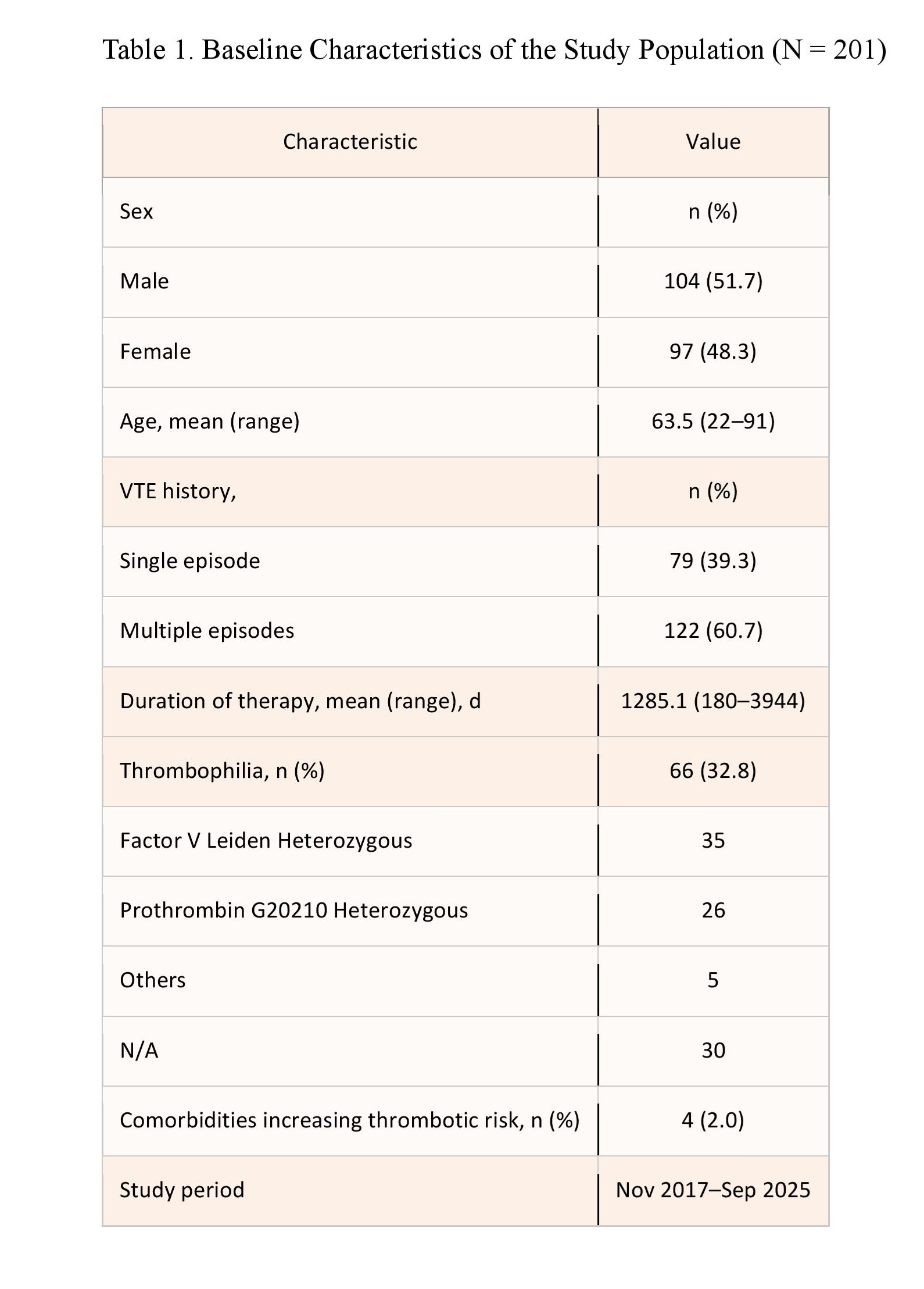
Methods. We retrospectively analyzed clinical data from 201 patients (104 males, 97 females; mean age 63.5 years, range 22–91) managed at our center between November 2017 and September 2025. The mean duration of anticoagulant therapy was 1285.1 days (range 180–3944). All patients were treated for secondary prevention of lower‑limb venous thrombosis; 79 had experienced a single VTE episode, while 122 had a history of multiple events. A total of 66 patients had either congenital or acquired thrombophilia, and 4 had comorbidities associated with increased thrombotic risk. Demographic and clinical characteristics are summarized in Table 1.
Results. During follow‑up, 9 bleeding events were recorded, including 8 minor episodes (2 epistaxis, 2 rectal bleeding, 2 menorrhagia, 1 gingival bleeding, and 1 microscopic hematuria) and 1 major event (vitreous hemorrhage), which led to discontinuation of anticoagulation. Four cases of superficial thrombophlebitis occurred, prompting escalation from prophylactic to therapeutic DOAC dosing. The cumulative incidence of bleeding events was 4.5% (9/201), while thrombotic events occurred in 2.0% (4/201). When expressed as incidence rates per person‑time, bleeding events occurred at 1.27 per 100 patient‑years and thrombotic events at 0.57 per 100 patient‑years.
Conclusions. In this real‑world cohort, extended anticoagulation well beyond the conventional 3–6‑month period was associated with a low incidence of both thrombotic and hemorrhagic complications in patients considered at elevated risk of recurrence. Although bleeding events were numerically more frequent than thrombotic events, the absolute rates of both outcomes remained low. Interpretation should consider the limited number of events and the resulting wide confidence intervals. Future comparative analyses involving patients treated with DOACs lacking dedicated prophylactic dosing, as well as those maintained on vitamin K antagonists, may help clarify the relative safety and effectiveness of different long‑term anticoagulation strategies.
Downloads
Download data is not yet available.
Citations




How to Cite
1.
Sottilotta G. PO104 | BLEEDING AND THROMBOTIC OUTCOMES DURING EXTENDED DIRECT ORAL ANTICOAGULANT THERAPY: AN EIGHT YEAR RETROSPECTIVE ANALYSIS: G. Sottilotta1, G. Praticò1, S. Cuzzocrea1, D. Megalizzi1, F. Luise2 | 1UOSD Microcitemie - Emostasi e Trombosi. Grande Ospedale Metropolitano di Reggio Calabria, Italy; 2Laboratorio Analisi. Grande Ospedale Metropolitano di Reggio Calabria, Italy. Bleeding Thromb Vasc Biol [Internet]. 2026 Oct. 26 [cited 2026 Oct. 29];5(s3). Available from: https://www.btvb.org/btvb/article/view/920
Copyright (c) 2026 The Author(s)


This work is licensed under a Creative Commons Attribution-NonCommercial 4.0 International License.



