

Oral Communications and Posters
Vol. 5 No. s3 (2026): Abstracts of the XXIX National Congress of the Italian Society for the Study of Hemostasis and Thrombosis, 2026

PO100 | PREVALENCE OF CODING-REGION VARIANTS IN THE PROC GENE IN A SINGLE-CENTER COHORT OF PC-DEFICIENT SUBJECTS
F. Ramundo, T. Malara, M. Rossi, T. Za, AM. Ciminello, S. Betti, F. Bartolomei, F. Di Landro, P. Arcuri, P. Chiusolo, V. De Stefano, E. Rossi | Catholic University, Fondazione Policlinico A.Gemelli IRCCS, Italy
Publisher's note
All claims expressed in this article are solely those of the authors and do not necessarily represent those of their affiliated organizations, or those of the publisher, the editors and the reviewers. Any product that may be evaluated in this article or claim that may be made by its manufacturer is not guaranteed or endorsed by the publisher.
All claims expressed in this article are solely those of the authors and do not necessarily represent those of their affiliated organizations, or those of the publisher, the editors and the reviewers. Any product that may be evaluated in this article or claim that may be made by its manufacturer is not guaranteed or endorsed by the publisher.
Published: 26 October 2026
6
Views
2
Downloads
Authors
Methods. Forty patients (M/F 18/22) with persistently low PC levels and no known acquired causes of deficiency were included. Baseline demographics, PC activity, and detailed personal and family histories of thrombosis were collected. The PROC gene was analyzed from peripheral blood DNA using next-generation sequencing (NGS) to identify coding region germline variants. Variants were annotated, classified by established criteria, and correlated with biochemical and clinical data.
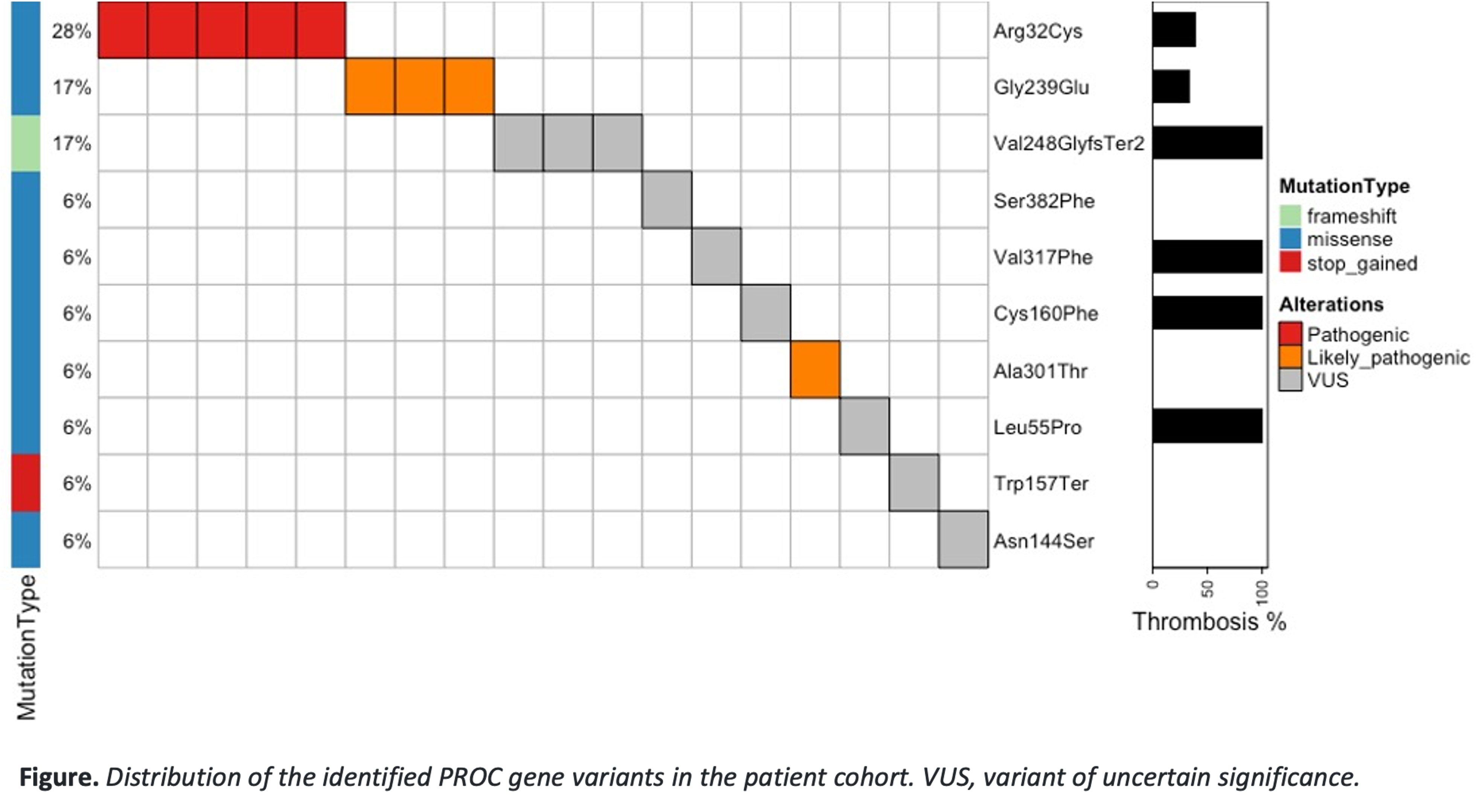
Results. Thromboembolic events occurred in 15 patients (38%), including 13 venous and 2 arterial cases. Four patients (10%) experienced recurrent episodes. The median age at first event was 28 years (range 17-68). A family history of both PC deficiency and VTE was present in 27.5% of patients, while 20% had a family history of VTE alone and 20% had a family history of PC deficiency without VTE. The median PC activity was 58% (range 38-68%) and did not differ significantly between patients with and without thrombosis (48.5% vs 60%, p=0.0783). NGS identified germline PROC variants in 18 patients (45%), including 8 (20%) with prior VTE and 10 (25%) with a family history of VTE. Missense variants were most common (n=14, 77.8%), including Arg32Cys (n=5, three unrelated families), Gly239Glu (n=3, two families), and Ser382Phe, Val317Phe, Cys160Phe, Leu55Pro, and Asn144Ser (each n=1). One patient had a stop-gained variant (Trp157Ter), and three siblings had a frameshift variant (Val248GlyfsTer2) (Figure). PC activity differed significantly by genotype (Kruskal–Wallis p=0.0003), with higher median values in patients without variants (62.5%, range 49-68%) compared to those with missense (47%, range 38-65%), frameshift (47%, range 41-48%), or stop-gained variants (44%). Five of 22 patients without variants developed VTE. The VTE rate did not differ significantly between patients with and without variants (22.7% vs 20%, p = 0.14).
Conclusions. Approximately 45% of patients carried PROC variants, mainly missense. Patients with variants had lower median PC levels than those without, but mutation type did not affect deficiency severity. Notably, patients without detected variants had a VTE rate similar to those with variants, suggesting the presence of non-coding mutations or copy number variations affecting PROC expression.
Downloads
Download data is not yet available.
Citations




How to Cite
1.
Ramundo F. PO100 | PREVALENCE OF CODING-REGION VARIANTS IN THE PROC GENE IN A SINGLE-CENTER COHORT OF PC-DEFICIENT SUBJECTS: F. Ramundo, T. Malara, M. Rossi, T. Za, AM. Ciminello, S. Betti, F. Bartolomei, F. Di Landro, P. Arcuri, P. Chiusolo, V. De Stefano, E. Rossi | Catholic University, Fondazione Policlinico A.Gemelli IRCCS, Italy. Bleeding Thromb Vasc Biol [Internet]. 2026 Oct. 26 [cited 2026 Oct. 29];5(s3). Available from: https://www.btvb.org/btvb/article/view/916
Copyright (c) 2026 The Author(s)


This work is licensed under a Creative Commons Attribution-NonCommercial 4.0 International License.



