

Oral Communications and Posters
Vol. 5 No. s3 (2026): Abstracts of the XXIX National Congress of the Italian Society for the Study of Hemostasis and Thrombosis, 2026

PO091 | RESPONSE AND CARDIOVASCULAR SAFETY OF FOSTAMATINIB IN CHRONIC IMMUNE THROMBOCYTOPENIA: A REAL WORLD ANALYSIS
C. Giubbilei, G. Giustini, A. Baffioni, V. Carrai | SOD Ematologia, Azienda Universitaria Ospedaliera Careggi, Firenze, Italy
Publisher's note
All claims expressed in this article are solely those of the authors and do not necessarily represent those of their affiliated organizations, or those of the publisher, the editors and the reviewers. Any product that may be evaluated in this article or claim that may be made by its manufacturer is not guaranteed or endorsed by the publisher.
All claims expressed in this article are solely those of the authors and do not necessarily represent those of their affiliated organizations, or those of the publisher, the editors and the reviewers. Any product that may be evaluated in this article or claim that may be made by its manufacturer is not guaranteed or endorsed by the publisher.
Published: 26 October 2026
60
Views
30
Downloads
Authors
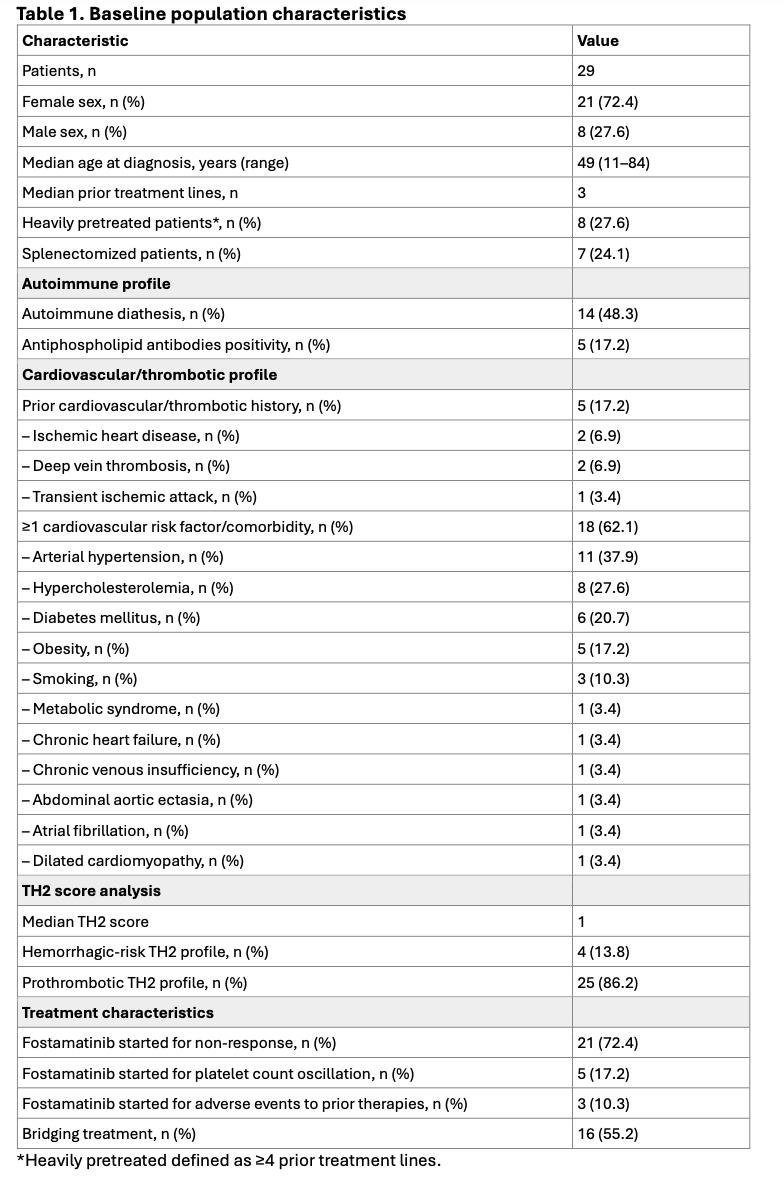
Methods. We retrospectively evaluated 29 patients with chronic ITP treated with FST in a real-world setting, with data cut-off on April 12, 2026. Outcomes of interest included overall response rate, time to response, treatment exposure, and cardiovascular safety. We also explored whether earlier response was associated with longer treatment exposure. Baseline patient and treatment characteristics are reported in Table 1.
Results. Baseline characteristics are summarized in Table 1. Briefly, the cohort showed a median TH2 score of 1, with only 4/29 patients (13.8%) displaying a hemorrhagic-risk profile, while the remainder had a prothrombotic profile; moreover, 18/29 patients (62.1%) had at least one cardiovascular risk factor. Overall response rate was 75.9% (22/29), including 15 complete responses and 7 partial responses, while 7 patients were non-responders. Among responders, median time to response was 15.5 days (IQR 10–42.5; range 3–409), with a median platelet count at response of 160×10^3/mmc. In heavily pretreated patients, overall response rate was 62.5% (5/8). At cut-off, 16 patients were still on treatment, with a median platelet count of 170×10^3/mmc (range 65–328); response was maintained in all but 2 patients who shifted from complete to partial response. No significant association was observed between shorter time to response and longer treatment exposure (Spearman rho=0.37, p=0.091). No new cardiovascular events were observed.
Conclusions. In this real-world chronic ITP cohort, fostamatinib showed high response rates and rapid activity, including in heavily pretreated patients. Outcomes were consistent with published real-world evidence. While early response did not predict longer treatment exposure, fostamatinib delivered meaningful and sustained benefit across this real-world cohort. Particularly reassuring was the absence of new cardiovascular events in a population enriched for cardiovascular risk factors.
Downloads
Download data is not yet available.
Citations




How to Cite
1.
Giubbilei C. PO091 | RESPONSE AND CARDIOVASCULAR SAFETY OF FOSTAMATINIB IN CHRONIC IMMUNE THROMBOCYTOPENIA: A REAL WORLD ANALYSIS: C. Giubbilei, G. Giustini, A. Baffioni, V. Carrai | SOD Ematologia, Azienda Universitaria Ospedaliera Careggi, Firenze, Italy. Bleeding Thromb Vasc Biol [Internet]. 2026 Oct. 26 [cited 2026 Nov. 22];5(s3). Available from: https://www.btvb.org/btvb/article/view/907
Copyright (c) 2026 The Author(s)


This work is licensed under a Creative Commons Attribution-NonCommercial 4.0 International License.



