

Oral Communications and Posters
Vol. 5 No. s3 (2026): Abstracts of the XXIX National Congress of the Italian Society for the Study of Hemostasis and Thrombosis, 2026

PO087 | BEYOND POSITIVITY: THE HIERARCHICAL ROLE OF IMMUNOASSAYS IN HEPARIN INDUCED THROMBOCYTOPENIA
G. Murante1|2|3, S. Bergonzi1|2|3, M. Capetta1|2|3, F. Valeri1|2, C. Dainese1|2, A. Valpreda4, R. Pastorino1|3, F. Bocchi1|3, A. Porreca5, B. Bruno2|3, A. Borchiellini1|2 | 1Regional Centre for Hemorrhagic and Thrombotic Diseases, AOU Città della Salute e della Scienza di Torino, Italy; 2Division of Hematology, AOU Città della Salute e della Scienza, Università di Torino, Italy; 3Dep. of Molecular Biotechnology and Health Sciences, University of Turin, Italy; 4Central Lab. Baldi and Riberi, AOU Città della Salute e della Scienza di Torino, Italy; 5Dep. of Human Sciences and Quality of Life Promotion, Clinical and Molecular Epidemiology, IRCCS San Raffaele Roma, Italy
Publisher's note
All claims expressed in this article are solely those of the authors and do not necessarily represent those of their affiliated organizations, or those of the publisher, the editors and the reviewers. Any product that may be evaluated in this article or claim that may be made by its manufacturer is not guaranteed or endorsed by the publisher.
All claims expressed in this article are solely those of the authors and do not necessarily represent those of their affiliated organizations, or those of the publisher, the editors and the reviewers. Any product that may be evaluated in this article or claim that may be made by its manufacturer is not guaranteed or endorsed by the publisher.
Published: 26 October 2026
71
Views
31
Downloads
Authors
Methods. We conducted a retrospective analysis, from 2020 to 2026, of 103 patients from Azienda Ospedaliera Molinette with suspected HIT. For each case, the pre-test clinical probability was assessed using the 4Ts score. Laboratory evaluation included immunoassays (ELISA, CLIA, and LIA) and a functional assay (HIPA), used as the reference standard. Agreement between assays was evaluated using concordance rates, and diagnostic performance was assessed by calculating positive predictive value (PPV) and negative predictive value (NPV).
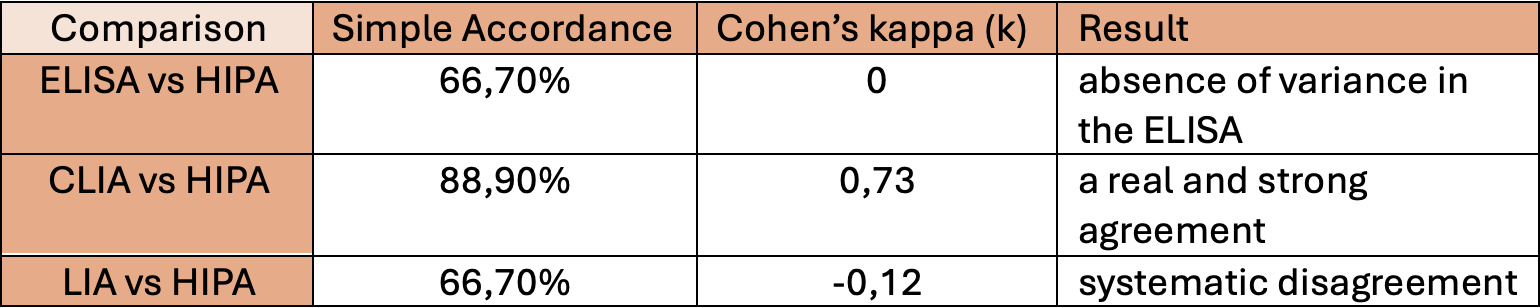
Results. 33 patients out of 103 (32%) were positive to immunoassays. HIPA was performed on only 9 patients; for the remaining 24 patients, it was not possible to carry out HIPA due to a lack of sufficient samples. In the group of 24 patients, clinical management was based solely on the immunoassays results. In the group of 9 patients, the distribution of 4Ts scores showed a predominance of intermediate-risk cases (7), with some patients classified as high probability (2). In the same group Immunoassays demonstrated a higher rate of positivity compared to the functional assay (ELISA 100%, CLIA 78%, LIA 89%), with HIPA positive in approximately half of the cases (67%). Concordance with HIPA was highest for CLIA (88.9%), followed by ELISA and LIA (both 66.7%). CLIA showed a high PPV (85,7%) and a NPV 100%, indicating strong rule-out capability. In contrast, ELISA and LIA showed lower reliability in excluding HIT, with NPV values of 0%.
Conclusions. The results suggest a hierarchical role among immunoassays in HIT diagnosis, with variable diagnostic performance. The integration of immunoassays with an intermediate-to-high 4Ts score may support exclusion of HIT, potentially reducing the need for functional testing. However, functional assays remain essential in cases with discordant or uncertain results.
Downloads
Download data is not yet available.
Citations




How to Cite
1.
Murante G. PO087 | BEYOND POSITIVITY: THE HIERARCHICAL ROLE OF IMMUNOASSAYS IN HEPARIN INDUCED THROMBOCYTOPENIA: G. Murante1|2|3, S. Bergonzi1|2|3, M. Capetta1|2|3, F. Valeri1|2, C. Dainese1|2, A. Valpreda4, R. Pastorino1|3, F. Bocchi1|3, A. Porreca5, B. Bruno2|3, A. Borchiellini1|2 | 1Regional Centre for Hemorrhagic and Thrombotic Diseases, AOU Città della Salute e della Scienza di Torino, Italy; 2Division of Hematology, AOU Città della Salute e della Scienza, Università di Torino, Italy; 3Dep. of Molecular Biotechnology and Health Sciences, University of Turin, Italy; 4Central Lab. Baldi and Riberi, AOU Città della Salute e della Scienza di Torino, Italy; 5Dep. of Human Sciences and Quality of Life Promotion, Clinical and Molecular Epidemiology, IRCCS San Raffaele Roma, Italy. Bleeding Thromb Vasc Biol [Internet]. 2026 Oct. 26 [cited 2026 Nov. 22];5(s3). Available from: https://www.btvb.org/btvb/article/view/903
Copyright (c) 2026 The Author(s)


This work is licensed under a Creative Commons Attribution-NonCommercial 4.0 International License.



