

Oral Communications and Posters
Vol. 5 No. s3 (2026): Abstracts of the XXIX National Congress of the Italian Society for the Study of Hemostasis and Thrombosis, 2026

PO086 | INHERITED PLATELET GPIV DEFICIENCY: FIRST DESCRIPTION OF TWO PATIENTS WITH BLEEDING DIATHESIS
L. Bury1, S. Sorrentino2, E. Falcinelli1, G. Guglielmini1, V. Fazzi1, A. Ferretti2, P. Concolino3|4, F. Cirillo5, P. Gresele1, E. De Candia2|6 | 1Department of Medicine and Surgery, Section of Internal and Cardiovascular Medicine, University of Perugia, Perugia, Italy; 2Dipartimento di Medicina e Chirurgia Traslazionale, Università Cattolica del Sacro Cuore, Facoltà di Medicina, Roma, Italy; 3Departmental Unit of Molecular and Genomic Diagnostics, Fondazione Policlinico Gemelli IRCCS, Roma, Italy; 4Genomics Core Facility, G-STeP, Fondazione Policlinico Universitario Agostino Gemelli IRCCS, Roma, Italy; 5Department of Clinical Medicine and Surgery, Federico II University of Naples, Naples, Italy; 6Dipartimento di Scienze di Laboratorio ed Ematologiche, Policlinico Universitario A. Gemelli IRCCS, Roma, Italy. L. Bury first authorship, P. Gresele senior authorship
Publisher's note
All claims expressed in this article are solely those of the authors and do not necessarily represent those of their affiliated organizations, or those of the publisher, the editors and the reviewers. Any product that may be evaluated in this article or claim that may be made by its manufacturer is not guaranteed or endorsed by the publisher.
All claims expressed in this article are solely those of the authors and do not necessarily represent those of their affiliated organizations, or those of the publisher, the editors and the reviewers. Any product that may be evaluated in this article or claim that may be made by its manufacturer is not guaranteed or endorsed by the publisher.
Published: 26 October 2026
0
Views
0
Downloads
Authors
Methods. Platelet aggregation was evaluated by light transmission aggregometry, glycoprotein expression by flow cytometry, and α- and δ-granule content and release by P-selectin expression, β-TG release, mepacrine uptake/release, and ATP secretion by lumiaggregometry. Platelet adhesion to collagen under flow was assessed using a perfusion chamber. Clinical exome sequencing was performed using a capture-based NGS approach.
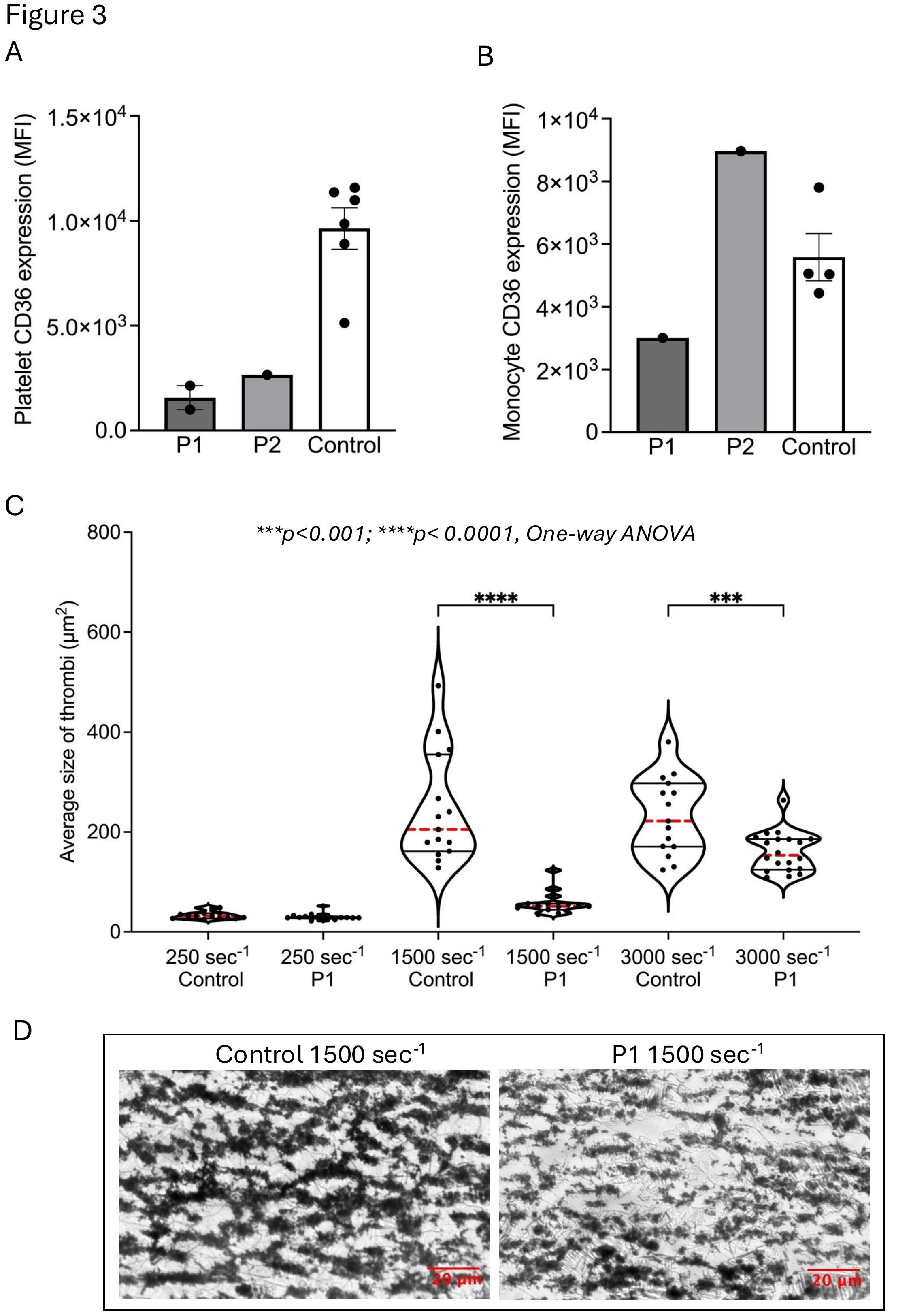
Results. Patient 1 (P1) was a 22-year-old woman with easy bruising and prolonged bleeding after dental extractions (ISTH-BAT score 5); she previously clinically diagnosed with joint hypermotility but no Ehlers–Danlos syndrome mutations were found. Patient 2 (P2) was a 50-year-old woman with lifelong mucocutaneous bleeding, gynecological bleeding and an ISTH-BAT score of 10; she also had bone-related abnormalities, including osteolipomas. Blood clotting assays, platelet number and volume, LTA and granule secretion were all normal in both patients, but PFA-100 closure time was prolonged in P1 and bleeding time in P2. Flow cytometric analysis showed markedly reduced expression of CD36 in platelets from both patients and also in monocytes from P1 suggesting type I CD36 deficiency in P1 and type II in P2 (Figure 1 A-B). Platelet adhesion to collagen under flow conditions at high shear rates was reduced (Figure 1C). Von Willebrand factor (VWF) values in P1 were slightly reduced (VWF:Ag 54%, normal values 61-152%; VWF:RCo 50%, normal values 58-175%; VWF:CBA 61%, normal values 50-400%) and moderately reduced in P2 (VWF:Ag 57-65%, VWF:RCo 48-61%). Clinical exome sequencing identified two heterozygous frameshift variants in the CD36 gene: the CD36 (NM_001001548.3):c.660_669del (p.Asn220Lysfs*4), Pathogenic, in P1 and the CD36 (NM_001001548.3):c.338_339del (p.Ser113Phefs*20), Likely Pathogenic, in P2. No variants in the VWF gene were observed.
Conclusions. These cases expand the clinical spectrum of inherited GPIV deficiency, suggesting that heterozygous CD36 variants may, in rare instances, be associated with mild to moderate bleeding. The associated collagen- and bone- related features are consistent with the role of CD36 in vascular integrity and skeletal homeostasis. Low levels of VWF in both patients are consistent with emerging genetic evidence showing that loss-of-function mutations in CD36 are associated with lower VWF levels in large population studies(5).
Downloads
Download data is not yet available.
Citations




1. Kevorkova et al, PLoS One 2013; 8: e77701.
2. Yamamoto et al, Br J Haematol 1992; 81: 86.
3. de Vries PS et al, Blood. 2024;143:1845.
How to Cite
1.
Bury L. PO086 | INHERITED PLATELET GPIV DEFICIENCY: FIRST DESCRIPTION OF TWO PATIENTS WITH BLEEDING DIATHESIS: L. Bury1, S. Sorrentino2, E. Falcinelli1, G. Guglielmini1, V. Fazzi1, A. Ferretti2, P. Concolino3|4, F. Cirillo5, P. Gresele1, E. De Candia2|6 | 1Department of Medicine and Surgery, Section of Internal and Cardiovascular Medicine, University of Perugia, Perugia, Italy; 2Dipartimento di Medicina e Chirurgia Traslazionale, Università Cattolica del Sacro Cuore, Facoltà di Medicina, Roma, Italy; 3Departmental Unit of Molecular and Genomic Diagnostics, Fondazione Policlinico Gemelli IRCCS, Roma, Italy; 4Genomics Core Facility, G-STeP, Fondazione Policlinico Universitario Agostino Gemelli IRCCS, Roma, Italy; 5Department of Clinical Medicine and Surgery, Federico II University of Naples, Naples, Italy; 6Dipartimento di Scienze di Laboratorio ed Ematologiche, Policlinico Universitario A. Gemelli IRCCS, Roma, Italy. L. Bury first authorship, P. Gresele senior authorship. Bleeding Thromb Vasc Biol [Internet]. 2026 Oct. 26 [cited 2026 Oct. 28];5(s3). Available from: https://www.btvb.org/btvb/article/view/902
Copyright (c) 2026 The Author(s)


This work is licensed under a Creative Commons Attribution-NonCommercial 4.0 International License.



