

Oral Communications and Posters
Vol. 5 No. s3 (2026): Abstracts of the XXIX National Congress of the Italian Society for the Study of Hemostasis and Thrombosis, 2026

PO083 | WOMEN AND HEMOPHILIA: ASSESSMENT OF THE BLEEDING PHENOTYPE – ANALYSIS OF THE BRESCIA COHORT
N. Portesi, S. Pontoglio, G. Carracchia, G. Albrici, E. Bertoni, G. Martini | ASST Spedali Civili di Brescia, Italy
Publisher's note
All claims expressed in this article are solely those of the authors and do not necessarily represent those of their affiliated organizations, or those of the publisher, the editors and the reviewers. Any product that may be evaluated in this article or claim that may be made by its manufacturer is not guaranteed or endorsed by the publisher.
All claims expressed in this article are solely those of the authors and do not necessarily represent those of their affiliated organizations, or those of the publisher, the editors and the reviewers. Any product that may be evaluated in this article or claim that may be made by its manufacturer is not guaranteed or endorsed by the publisher.
Published: 26 October 2026
0
Views
0
Downloads
Authors
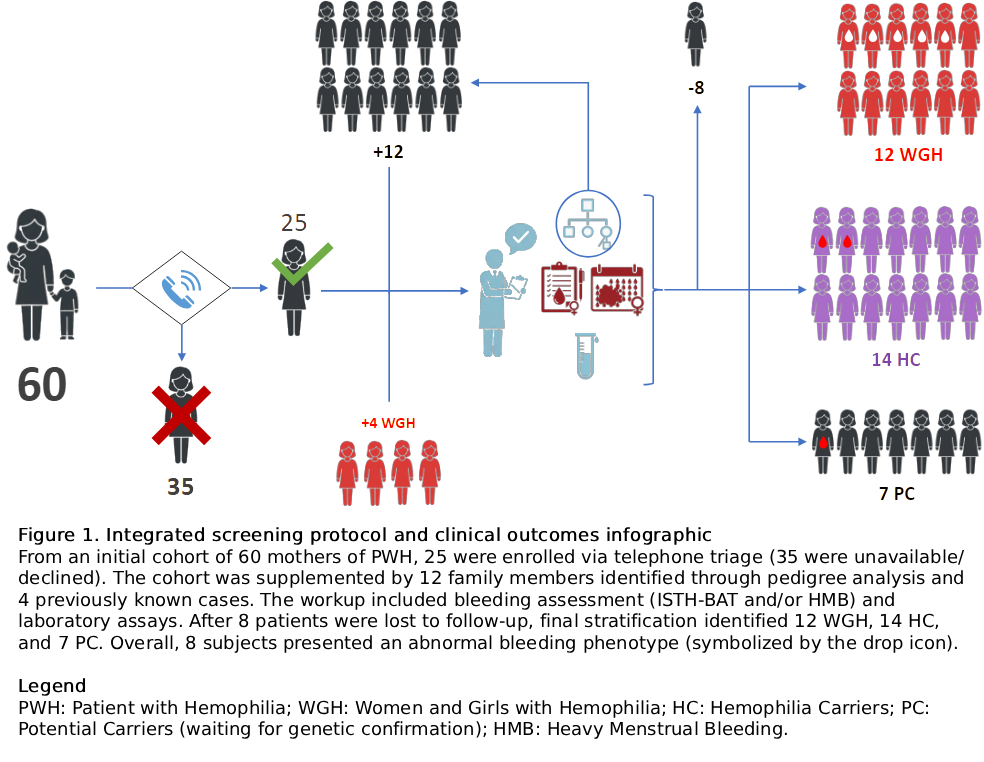
Methods. A screening protocol was established involving both the Pediatric and Adult HTCs in Brescia. The population (N=33) was stratified according to ISTH definitions into: Women and Girls with Hemophilia (WGH, N=12, factor levels <40 IU/dL) and Hemophilia Carriers (HC, N=14, factor levels ≥40 IU/dL); we added the category of Potential Carriers (PC, N=7), including women and girls who weren’t obligated genetic carriers and were waiting for genetic confirmation tests. The bleeding phenotype was assessed using the ISTH-Bleeding Assessment Tool (ISTH-BAT), with a specific focus on Heavy Menstrual Bleeding (HMB). Laboratory testing included coagulation factors VIII and IX (FVIII/FIX) levels determined via one-stage (OSA) and chromogenic substrate (CSA) assays, VWF assays (antigen and activity), an iron status evaluation (serum iron, serum ferritin) and routine hemocoagulative tests (complete blood count, prothrombin time, activated partial thromboplastin time, fibrinogen).
Results. The proactive screening successfully identified eight WGH (66% of the subgroup) previously unknown to the HTC, emphasizing the underdiagnosis of the condition even within known hemophilia families. An abnormal bleeding phenotype (pathological ISTH-BAT and/or HMB) was identified in 24.2% of the total cohort, with higher prevalence in WGH (41.6%) compared to HC (14.2%). Clinical data analysis confirmed that HMB is the most frequent and impactful symptom, accounting for 40% of the total ISTH-BAT variance – occasionally leading to chronic iron deficiency, even in cases with sub-pathological ISTH-BAT scores. In accordance with the published literature, no direct linear correlation was found between FVIII/FIX levels and bleeding severity, suggesting that other factors may influence the phenotype.
Conclusions. A significant percentage of symptomatic carriers remain unrecognized. The lack of a clear correlation between laboratory factor levels and clinical symptoms reinforces the necessity of adopting validated clinical tools like the ISTH-BAT and prioritizing menstrual history in the diagnostic workup. Our findings strengthen the importance of implementing proactive, family-based screening pathways – essential to ensure gender equity in hemophilia care and to prevent hemorrhagic complications during critical life events, such as surgery, menarche, childbirth, or the transition to perimenopause.
Downloads
Download data is not yet available.
Citations




How to Cite
1.
Portesi N. PO083 | WOMEN AND HEMOPHILIA: ASSESSMENT OF THE BLEEDING PHENOTYPE – ANALYSIS OF THE BRESCIA COHORT: N. Portesi, S. Pontoglio, G. Carracchia, G. Albrici, E. Bertoni, G. Martini | ASST Spedali Civili di Brescia, Italy. Bleeding Thromb Vasc Biol [Internet]. 2026 Oct. 26 [cited 2026 Oct. 28];5(s3). Available from: https://www.btvb.org/btvb/article/view/899
Copyright (c) 2026 The Author(s)


This work is licensed under a Creative Commons Attribution-NonCommercial 4.0 International License.



