

Oral Communications and Posters
Vol. 5 No. s3 (2026): Abstracts of the XXIX National Congress of the Italian Society for the Study of Hemostasis and Thrombosis, 2026

PO082 | HEMOPHILIA AND LOW BONE MINERAL DENSITY: AN OBSERVATIONAL STUDY
D. Fumarulo, R. Corrado, M. Canfora, M. Mazzetti, M. Littera, D. Prisco, C. Tamburini | Internal Medicine, Careggi Hospital, University of Florence, Firenze, Italy
Publisher's note
All claims expressed in this article are solely those of the authors and do not necessarily represent those of their affiliated organizations, or those of the publisher, the editors and the reviewers. Any product that may be evaluated in this article or claim that may be made by its manufacturer is not guaranteed or endorsed by the publisher.
All claims expressed in this article are solely those of the authors and do not necessarily represent those of their affiliated organizations, or those of the publisher, the editors and the reviewers. Any product that may be evaluated in this article or claim that may be made by its manufacturer is not guaranteed or endorsed by the publisher.
Published: 26 October 2026
8
Views
2
Downloads
Authors
Methods. In this prospective observational study we enrolled 30 hemophilic patients from October 2024 through March 2026, all men, with a mean age of 54. 26 had Hemophilia A, 77% severe (FVIII < 1%), 15% moderate (FVIII 1-5%) and 8% mild (FVIII > 5%). 4 patients had Hemophilia B (75% severe, 25% mild). All the patients except one had undergone to major orthopedic surgeries (25 knee replacements, 2 hip replacements, and 2 other types) and were admitted to our Internal Medicine department around the third post-operative day. The most significant comorbidities and risk factors in the study population were: smoking (25%), obesity (60%), sedentary lifestyle (according to the Global Physical Activity Questionnaire, 95%) and previous HCV infection (75%). The following blood tests were assessed in the entire sample: calcium, phosphorus, magnesium, 25OHVitD, Beta-CTX, total alkaline phosphatase (ALP) and bone alkaline phosphatase (BALP), parathyroid hormone, testosterone and urinary tests: calcium, phosphorus and 24-hour protein. Moreover, 23 and 17 patients in the cohort respectively underwent Dual-Energy X-Ray Absorptiometry (DXA) of the lumbar spine (L1-L4) and femoral bone.
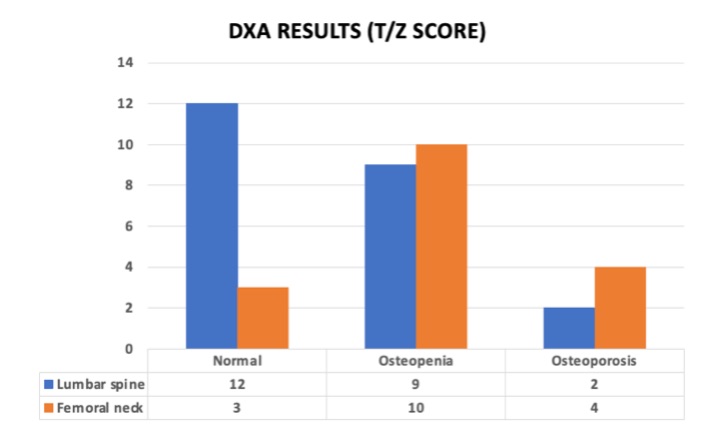
Results. A mean 25OHVitD level of 17 ng/dL was found, indicating severe hypovitaminosis D in 90% of the sample, despite 13% was already receiving supplementation. Age-standardized beta-CTX levels were at the upper limit (0.6 in the group older than 50 and 0.55 in the younger group) suggesting elevated bone turnover. Testosterone levels also showed unusual results, with a mean below the normal range (10 nmol/L), resulting in severe suppression in 60% of the sample. T/Z scores in 23 and 17 DXA respectively of the lumbar spine and femoral bone showed a high presence of osteopenia or osteoporosis in the study group. This finding appears to be more significant for the femoral bone than for the spine. In fact, reduced BMD with osteopenia/osteoporosis was present in 82% of the sample undergone to DXA of the femur compared to 47% of the sample undergone to DXA of the lumbar spine (Figure 1).
Conclusions. Studies show hemophilic patients have lower BMD than general population with a fivefold higher fracture risk. Causes include reduced physical activity, recurrent hemarthrosis and past HIV/HCV treatments. FVIII/FIX deficiency also impairs bone turnover by reducing thrombin and altering osteoclast/osteoblast activity, but also disrupting, together with the cytokine cascade triggered by chronic local inflammation, the RANK/RANKL/OPG pathway involved in bone resorption regulation. The study shows high rate of hypovitaminosis D associated with high bone turnover in this population. Also low testosterone levels contribute to bone loss, representing the main factor involved in osteoporosis in men. Finally, DXA results confirm increased bone fragility, mainly affecting cortical bone. In conclusion, early screening of bone metabolism in hemophilic patients is essential to reduce fracture risk, especially given increasing life expectancy.
Downloads
Download data is not yet available.
Citations




How to Cite
1.
Fumarulo D. PO082 | HEMOPHILIA AND LOW BONE MINERAL DENSITY: AN OBSERVATIONAL STUDY: D. Fumarulo, R. Corrado, M. Canfora, M. Mazzetti, M. Littera, D. Prisco, C. Tamburini | Internal Medicine, Careggi Hospital, University of Florence, Firenze, Italy. Bleeding Thromb Vasc Biol [Internet]. 2026 Oct. 26 [cited 2026 Oct. 29];5(s3). Available from: https://www.btvb.org/btvb/article/view/898
Copyright (c) 2026 The Author(s)


This work is licensed under a Creative Commons Attribution-NonCommercial 4.0 International License.



