

Oral Communications and Posters
Vol. 5 No. s3 (2026): Abstracts of the XXIX National Congress of the Italian Society for the Study of Hemostasis and Thrombosis, 2026

PO079 | PERIOPERATIVE MANAGEMENT OF MILD-TO-MODERATE HEMOPHILIA: A COMPARATIVE STUDY OF EXTENDED HALF-LIFE VERSUS STANDARD HALF-LIFE CONCENTRATES ON CLINICAL OUTCOMES AND FACTOR CONSUMPTION
M. Capetta1|2|3, F. Valeri1|2, C. Dainese1|2, S. Bergonzi1|2|3, G. Murante1|2|3, A. Valpreda4, R. Pastorino1|3, F. Bocchi1|3, B. Bruno2|3, A. Borchiellini1|2 | 1Regional Centre for Hemorrhagic and Thrombotic Diseases, AOU Città della Salute e della Scienza, Torino, Italy; 2Division of Hematology, AOU Città della Salute e della Scienza, Università di Torino, Torino, Italy; 3Department of Molecular Biotechnology and Health Sciences, University of Turin, Torino, Italy; 4Central Laboratory Baldi and Riberi, AOU Città della Salute e della Scienza, Università di Torino, Torino, Italy
Publisher's note
All claims expressed in this article are solely those of the authors and do not necessarily represent those of their affiliated organizations, or those of the publisher, the editors and the reviewers. Any product that may be evaluated in this article or claim that may be made by its manufacturer is not guaranteed or endorsed by the publisher.
All claims expressed in this article are solely those of the authors and do not necessarily represent those of their affiliated organizations, or those of the publisher, the editors and the reviewers. Any product that may be evaluated in this article or claim that may be made by its manufacturer is not guaranteed or endorsed by the publisher.
Published: 26 October 2026
62
Views
26
Downloads
Authors
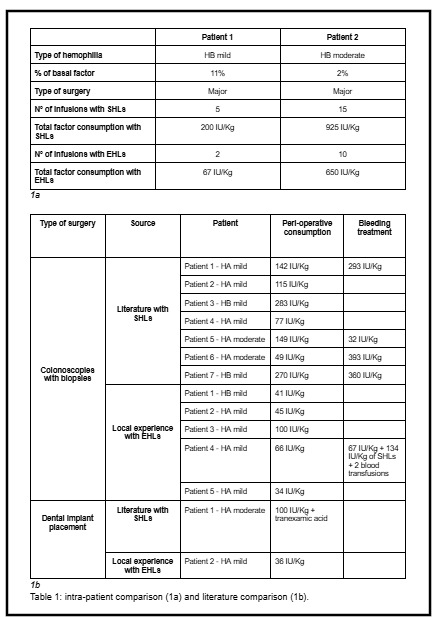
Methods. We retrospectively analyzed 191 patients with mild-to-moderate HA or HB and collected data from 27 EHLs-managed surgeries performed at our center in 22 patients from 2018 to 2026. Fourteen major (52%) and 13 minor (48%) surgeries were performed. Twenty patients (91%) had mild hemophilia and 2 (9%) had moderate hemophilia. Two patients had undergone the same surgery once with SHLs and once with EHLs allowing an intra-patient comparison. We also compared our data with published literature for the same procedures (direct comparison of major surgeries was not possible due to the lack of comparable literature data). Preoperative pharmacokinetic (PK) studies were conducted before 16 procedures (59%) to guide dosing strategies. Mean trough level of 55% (24h) and 31% (72h) were maintained. In two cases of major surgery, the emergency nature of the procedure precluded pharmacokinetic analysis. Regarding patients with HA, 11 procedures were performed using turoctocog alfa pegol, 4 with rurioctocog alfa pegol, 1 with damoctocog alfa pegol. Among patients with HB, nonacog beta pegol was utilized in 6 cases, eftrenonacog alfa and albutrepenonacog alfa in 2 cases each.
Results. In both comparisons we observed a reduction in the number of infusions (Table 1a) and total factor consumption (Table 1a, Table 1b). All 27 surgeries were managed with a single preoperative infusion. Postoperative infusions were administered once daily, whereas the literature reports twice-daily infusions when using SHLs. The sole exception in our cohort was a patient with mild HA undergoing cardiac surgery, who required more frequent infusions within the first 24 hours post-surgery before early transition to a single daily infusion. No patients developed inhibitors; a single bleeding event was due to poor hemostasis.
Conclusions. EHLs appear safe and effective for surgery in mild-to-moderate hemophilia, offering clinical advantages over SHLs across all analyzed populations, particularly in HB. While not statistically significant due to the limited cohort, these findings demonstrate a clinical advantage, despite the absence of baseline factor levels for literature-based cases. For HA, further improvements are expected with the advent of newer molecules.
Downloads
Download data is not yet available.
Citations




How to Cite
1.
Capetta M. PO079 | PERIOPERATIVE MANAGEMENT OF MILD-TO-MODERATE HEMOPHILIA: A COMPARATIVE STUDY OF EXTENDED HALF-LIFE VERSUS STANDARD HALF-LIFE CONCENTRATES ON CLINICAL OUTCOMES AND FACTOR CONSUMPTION: M. Capetta1|2|3, F. Valeri1|2, C. Dainese1|2, S. Bergonzi1|2|3, G. Murante1|2|3, A. Valpreda4, R. Pastorino1|3, F. Bocchi1|3, B. Bruno2|3, A. Borchiellini1|2 | 1Regional Centre for Hemorrhagic and Thrombotic Diseases, AOU Città della Salute e della Scienza, Torino, Italy; 2Division of Hematology, AOU Città della Salute e della Scienza, Università di Torino, Torino, Italy; 3Department of Molecular Biotechnology and Health Sciences, University of Turin, Torino, Italy; 4Central Laboratory Baldi and Riberi, AOU Città della Salute e della Scienza, Università di Torino, Torino, Italy. Bleeding Thromb Vasc Biol [Internet]. 2026 Oct. 26 [cited 2026 Nov. 20];5(s3). Available from: https://www.btvb.org/btvb/article/view/895
Copyright (c) 2026 The Author(s)


This work is licensed under a Creative Commons Attribution-NonCommercial 4.0 International License.



