

Oral Communications and Posters
Vol. 5 No. s3 (2026): Abstracts of the XXIX National Congress of the Italian Society for the Study of Hemostasis and Thrombosis, 2026

PO078 | CARDIOVASCULAR EVENTS AND SUBCLINICAL ATHEROSCLEROSIS IN HEMOPHILIA A AND B PATIENTS: A MULTICENTER COHORT STUDY
A. Napolitano, E. Zanon, L. Spiezia, G. Camporese, P. Scarinzi, F. Ahmad, G. Saggiorato, C. Bulato, S. Toffanin, S. Gavasso, P. Zerbinati, C. Simion, E. Campello, P. Simioni | Department of Medicine, University of Padova, Italy
Publisher's note
All claims expressed in this article are solely those of the authors and do not necessarily represent those of their affiliated organizations, or those of the publisher, the editors and the reviewers. Any product that may be evaluated in this article or claim that may be made by its manufacturer is not guaranteed or endorsed by the publisher.
All claims expressed in this article are solely those of the authors and do not necessarily represent those of their affiliated organizations, or those of the publisher, the editors and the reviewers. Any product that may be evaluated in this article or claim that may be made by its manufacturer is not guaranteed or endorsed by the publisher.
Published: 26 October 2026
5
Views
2
Downloads
Authors
Methods. We conducted a multicenter ambispective observational cohort study including 163 patients aged >40 years with hemophilia A or B (139 hemophilia A; 24 hemophilia B), followed at the Hemophilia Centers of Padua and Castelfranco Veneto, in North-East Italy. Patients were divided into two groups according to the occurrence of clinical events (myocardial infarction, stroke/TIA, and venous thrombosis). Demographic, clinical, laboratory, and treatment-related variables were collected. ROTEM and Multiplate assays were performed. All participants underwent carotid ultrasound, abdominal aorta diameter measurement, and ankle-brachial index (ABI) assessment. Associations with outcomes were evaluated using univariate analyses and multivariable logistic regression models.
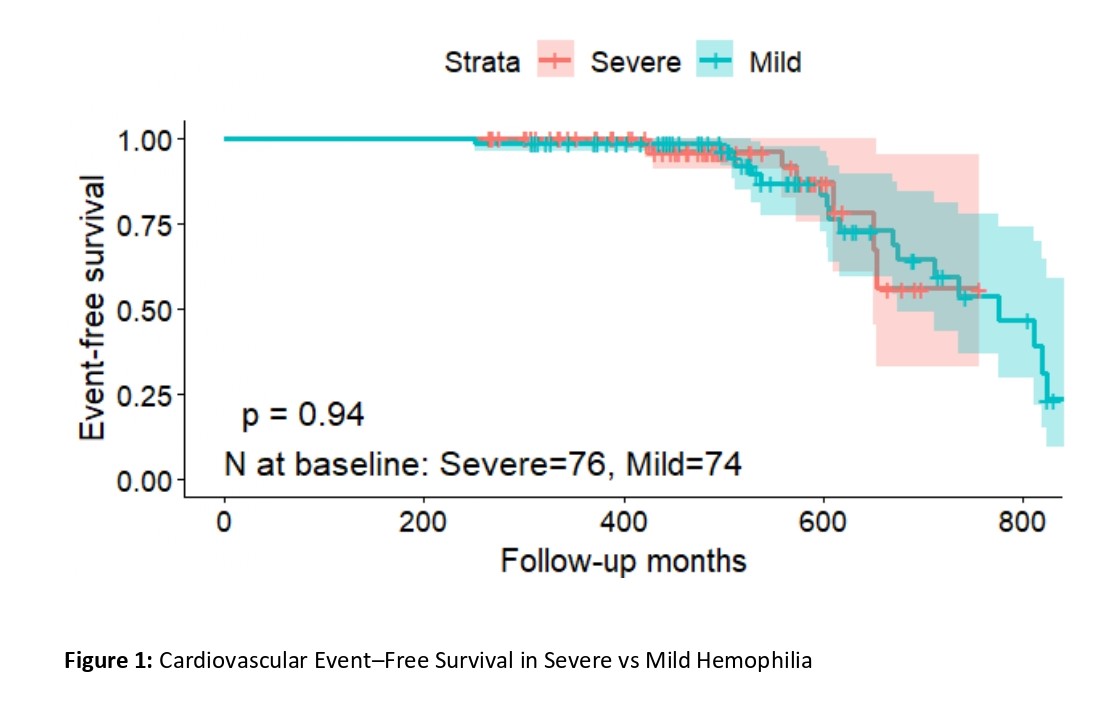
Results. A total of 16.6% of patients (27/163) experienced at least one event, which occurred more frequently in patients with mild compared to severe hemophilia (70.4% vs 40.4%; p = 0.0199), with no significant difference between hemophilia A and B (p = 0.545). Patients with events were significantly older than those without (67.8 ± 12.2 vs 55.7 ± 10.7 years; p = 0.001). Patients with events showed a higher prevalence of cardiovascular and metabolic comorbidities, including hypertension (66.6% vs 38.2%; p = 0.01), dyslipidemia (59.3% vs 38.2%; p = 0.04), and cancer (37% vs 13.2%; p = 0.004). In multivariable analysis, events were independently associated with HIV infection (OR 6.51; 95% CI 1.38–30.77), hypertension (OR 3.17; 95% CI 1.31–7.68), and dyslipidemia (OR 2.38; 95% CI 1.02–5.56). Imaging and vascular assessments showed greater carotid plaque thickness, larger abdominal aorta diameter, and a higher prevalence of abnormal ABI (<1) in patients with events (p = 0.006, p = 0.03, and p = 0.001, respectively).Laboratory analyses revealed significantly lower hemoglobin (p = 0.0076) and platelet counts (p = 0.0037) in patients with events. Renal function was also impaired, as indicated by higher creatinine levels (p = 0.0182). In addition, NT-proBNP (p = 0.02) and troponin I (p = 0.004) were significantly increased in patients with events. Thromboelastometry demonstrated a shorter INTEM clotting time in patients with events (p = 0.0037), while platelet function testing showed significantly reduced ASPI AUC (p = 0.03) and TRAP AUC (p = 0.002).Kaplan–Meier analysis showed no significant difference in event-free survival between patients with mild and severe hemophilia (p = 0.94) (Figure 1).
Conclusions. Thrombotic and cardiovascular events occurred in a minority of patients with hemophilia A and B and were more frequent among older individuals, patients with mild disease, and those with HIV infection. Events were associated with traditional cardiovascular risk factors and markers of subclinical atherosclerosis, emphasizing the importance of comprehensive cardiovascular evaluation in this population.
Downloads
Download data is not yet available.
Citations




How to Cite
1.
Napolitano A. PO078 | CARDIOVASCULAR EVENTS AND SUBCLINICAL ATHEROSCLEROSIS IN HEMOPHILIA A AND B PATIENTS: A MULTICENTER COHORT STUDY: A. Napolitano, E. Zanon, L. Spiezia, G. Camporese, P. Scarinzi, F. Ahmad, G. Saggiorato, C. Bulato, S. Toffanin, S. Gavasso, P. Zerbinati, C. Simion, E. Campello, P. Simioni | Department of Medicine, University of Padova, Italy. Bleeding Thromb Vasc Biol [Internet]. 2026 Oct. 26 [cited 2026 Oct. 29];5(s3). Available from: https://www.btvb.org/btvb/article/view/894
Copyright (c) 2026 The Author(s)


This work is licensed under a Creative Commons Attribution-NonCommercial 4.0 International License.



