

Oral Communications and Posters
Vol. 5 No. s3 (2026): Abstracts of the XXIX National Congress of the Italian Society for the Study of Hemostasis and Thrombosis, 2026

PO077 | BALANCING BLEEDING AND THROMBOSIS: SAFETY OF LOW-MOLECULAR-WEIGHT HEPARIN THROMBOPROPHYLAXIS IN PATIENTS WITH HEMOPHILIA UNDERGOING MAJOR SURGERY
S. Bergonzi1|2|3, G. Murante1|2|3, M. Capetta1|2|3, F. Valeri1|2, C. Dainese1|2, A. Valpreda3|4, R. Pastorino3|4, F. Bocchi3|4, B. Bruno2|3, A. Borchiellini1|2 | 1Regional Centre for Hemorrhagic and Thrombotic Diseases, AOU Città della Salute e della Scienza, Turin, Italy; 2Division of Hematology, AOU Città della Salute e della Scienza, Università di Torino, Italy; 3Department of Molecular Biotechnology and Health Sciences, University of Turin, Italy; 4Central Laboratory Baldi and Riberi, AOU Città della Salute e della Scienza, Università di Torino, Italy
Publisher's note
All claims expressed in this article are solely those of the authors and do not necessarily represent those of their affiliated organizations, or those of the publisher, the editors and the reviewers. Any product that may be evaluated in this article or claim that may be made by its manufacturer is not guaranteed or endorsed by the publisher.
All claims expressed in this article are solely those of the authors and do not necessarily represent those of their affiliated organizations, or those of the publisher, the editors and the reviewers. Any product that may be evaluated in this article or claim that may be made by its manufacturer is not guaranteed or endorsed by the publisher.
Published: 26 October 2026
0
Views
0
Downloads
Authors
Methods. Medical records of 105 patients with moderate/severe hemophilia A or B followed at our center were retrospectively reviewed. Among these, 12 patients undergoing a total of 18 major surgical procedures received postoperative LMWH thromboprophylaxis. Data were verified and integrated through comparison with the rare diseases registry.
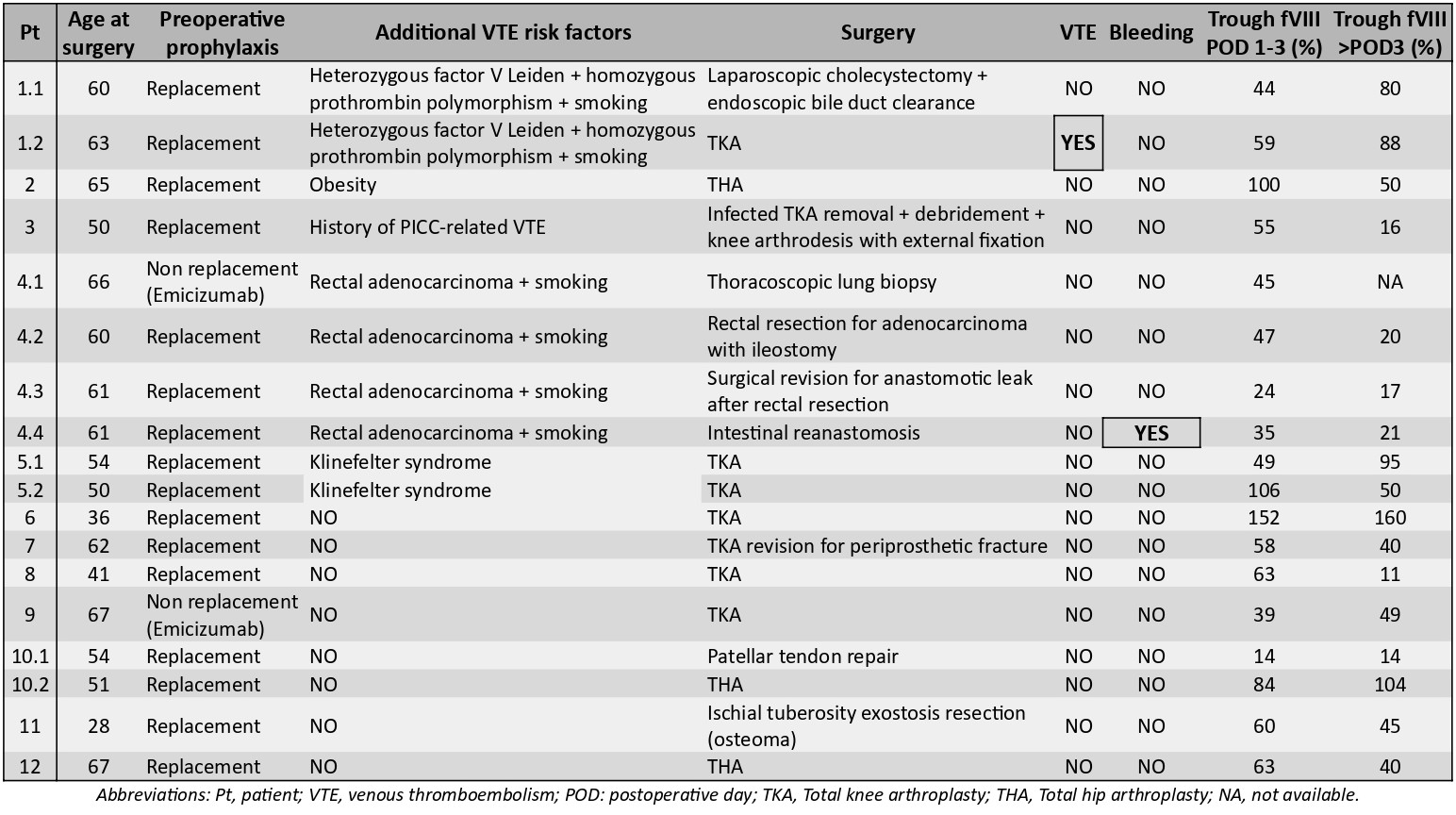
Results. All included patients had severe hemophilia A and received perioperative factor replacement therapy. Trough factor levels during the first three postoperative days were ≥14%, and ≥11% thereafter. Patient characteristics, type of surgery, and trough levels are reported in Table 1. A single bleeding event occurred in a patient undergoing intestinal reanastomosis for previous rectal adenocarcinoma (previously treated with LMWH prophylaxis without complications), who presented on postoperative day 4 with hematemesis and rectal bleeding, requiring LMWH discontinuation and transfusion support. No other major or minor bleeding events were observed. One patient developed a clinically evident VTE on postoperative day 8 despite LMWH thromboprophylaxis, in the presence of multiple risk factors (high-risk inherited thrombophilia and smoking). No additional clinically evident thromboembolic events were observed.
Conclusions. In a setting of limited and conflicting evidence, all patients underwent individualized assessment of thrombotic and bleeding risk. They received adequate factor replacement therapy and were monitored through factor levels. In this context, LMWH thromboprophylaxis appeared safe in the vast majority of cases. These findings support the feasibility of a personalized approach to pharmacological thromboprophylaxis in patients with hemophilia undergoing major surgery, although prospective studies are warranted to confirm its safety.
Downloads
Download data is not yet available.
Citations




How to Cite
1.
Bergonzi S. PO077 | BALANCING BLEEDING AND THROMBOSIS: SAFETY OF LOW-MOLECULAR-WEIGHT HEPARIN THROMBOPROPHYLAXIS IN PATIENTS WITH HEMOPHILIA UNDERGOING MAJOR SURGERY: S. Bergonzi1|2|3, G. Murante1|2|3, M. Capetta1|2|3, F. Valeri1|2, C. Dainese1|2, A. Valpreda3|4, R. Pastorino3|4, F. Bocchi3|4, B. Bruno2|3, A. Borchiellini1|2 | 1Regional Centre for Hemorrhagic and Thrombotic Diseases, AOU Città della Salute e della Scienza, Turin, Italy; 2Division of Hematology, AOU Città della Salute e della Scienza, Università di Torino, Italy; 3Department of Molecular Biotechnology and Health Sciences, University of Turin, Italy; 4Central Laboratory Baldi and Riberi, AOU Città della Salute e della Scienza, Università di Torino, Italy. Bleeding Thromb Vasc Biol [Internet]. 2026 Oct. 26 [cited 2026 Oct. 28];5(s3). Available from: https://www.btvb.org/btvb/article/view/893
Copyright (c) 2026 The Author(s)


This work is licensed under a Creative Commons Attribution-NonCommercial 4.0 International License.



