

Oral Communications and Posters
Vol. 5 No. s3 (2026): Abstracts of the XXIX National Congress of the Italian Society for the Study of Hemostasis and Thrombosis, 2026

PO067 | LONG‑TERM SAFETY AND EFFECTIVENESS OF VITAMIN K ANTAGONISTS IN PATIENTS WITH ANTIPHOSPHOLIPID ANTIBODIES: A RETROSPECTIVE COHORT ANALYSIS
G. Sottilotta1, G. Praticò1, D. Megalizzi1, F. Luise2 | 1UOSD Centro per le Microcitemie - Servizio Emostasi e Trombosi; 2Laboratorio Analisi, Grande Ospedale Metropolitano di Reggio Calabria, Italy
Publisher's note
All claims expressed in this article are solely those of the authors and do not necessarily represent those of their affiliated organizations, or those of the publisher, the editors and the reviewers. Any product that may be evaluated in this article or claim that may be made by its manufacturer is not guaranteed or endorsed by the publisher.
All claims expressed in this article are solely those of the authors and do not necessarily represent those of their affiliated organizations, or those of the publisher, the editors and the reviewers. Any product that may be evaluated in this article or claim that may be made by its manufacturer is not guaranteed or endorsed by the publisher.
Published: 26 October 2026
0
Views
0
Downloads
Authors
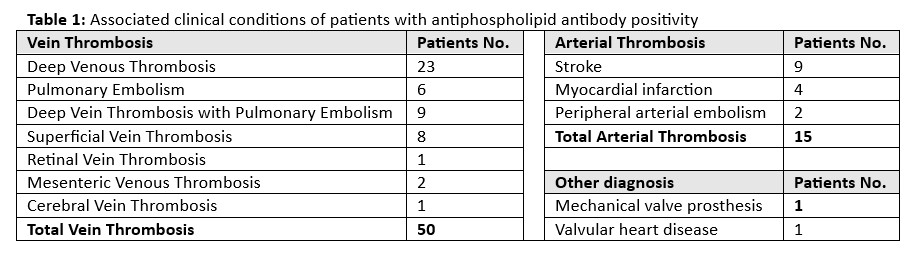
Methods. we retrospectively analyzed 67 patients (29 males, 38 females; mean age 58.1 years, range 29–87) receiving VKA therapy (Warfarin n=66, Acenocoumarol n=1). All were treated due to antiphospholipid antibody positivity and associated clinical conditions: 50 had venous thrombosis, 15 arterial thrombosis, and 2 were treated for non‑thrombotic disorders. Twenty‑seven patients had concomitant autoimmune diseases, and eight had genetic thrombophilia (4 were heterozygous for the prothrombin G20210A mutation and 4 were heterozygous for Factor V Leiden). Clinical characteristics are summarized in Table 1. The mean follow‑up duration was 2,744.9 days (range 155–10,882). The mean Time in Therapeutic Range (TTR) during the last six months was 68% (range 27–100%).
Results. a total of 10 complications occurred in 9 of 67 patients (13.4%): 3 thrombotic events (4.5%) (1 superficial and 2 deep vein thrombosis) and 7 hemorrhagic events (10.4%) (2 nosebleeds, 2 metrorrhagias, 1 muscle hematoma, and 1 hemoperitoneum). One patient experienced both event types. The annual incidence rate was 2 complications per 100 patient‑years. All events resolved without permanent sequelae; only one case (hemoperitoneum) required hospitalization. Temporary discontinuation of VKA therapy occurred in 7 of 10 events. No fatal outcomes were recorded.
Conclusions. the low annual complication rate, together with a mean TTR exceeding 66%, underscores the safety and effectiveness of VKA therapy when managed by specialized anticoagulation centers. Until direct oral anticoagulants with proven efficacy and safety in antiphospholipid‑positive patients become available, VKAs remain a reliable and well‑established option for the treatment and prevention of thromboembolism. We also observed that venous thrombosis was more than three times as frequent as arterial thrombosis, supporting routine screening for antiphospholipid antibodies in patients with otherwise unexplained venous thrombotic events.
Downloads
Download data is not yet available.
Citations




How to Cite
1.
Sottilotta G. PO067 | LONG‑TERM SAFETY AND EFFECTIVENESS OF VITAMIN K ANTAGONISTS IN PATIENTS WITH ANTIPHOSPHOLIPID ANTIBODIES: A RETROSPECTIVE COHORT ANALYSIS: G. Sottilotta1, G. Praticò1, D. Megalizzi1, F. Luise2 | 1UOSD Centro per le Microcitemie - Servizio Emostasi e Trombosi; 2Laboratorio Analisi, Grande Ospedale Metropolitano di Reggio Calabria, Italy. Bleeding Thromb Vasc Biol [Internet]. 2026 Oct. 26 [cited 2026 Oct. 28];5(s3). Available from: https://www.btvb.org/btvb/article/view/883
Copyright (c) 2026 The Author(s)


This work is licensed under a Creative Commons Attribution-NonCommercial 4.0 International License.



