

Oral Communications and Posters
Vol. 5 No. s3 (2026): Abstracts of the XXIX National Congress of the Italian Society for the Study of Hemostasis and Thrombosis, 2026

PO058 | IMMUNOMODULATORY EFFECTS OF FOSTAMATINIB IN A PATIENT WITH EVANS SYNDROME, TRIPLE-POSITIVE ANTIPHOSPHOLIPID ANTIBODIES AND RELATED COAGULATION ABNORMALITIES
S. Bergonzi1|2|4, G. Murante1|2|4, M. Capetta1|2|4, F. Valeri1|2, C. Dainese1|2, A. Valpreda3|4, R. Pastorino3|4, F. Bocchi3|4, B. Bruno2|4, A. Borchiellini1|2 | 1Regional Centre for Hemorrhagic and Thrombotic Diseases; 2Division of Hematology; 3Central Laboratory Baldi and Riberi, AOU Città della Salute e della Scienza, Università di Torino, Italy; 4Department of Molecular Biotechnology and Health Sciences, University of Turin, Italy
Publisher's note
All claims expressed in this article are solely those of the authors and do not necessarily represent those of their affiliated organizations, or those of the publisher, the editors and the reviewers. Any product that may be evaluated in this article or claim that may be made by its manufacturer is not guaranteed or endorsed by the publisher.
All claims expressed in this article are solely those of the authors and do not necessarily represent those of their affiliated organizations, or those of the publisher, the editors and the reviewers. Any product that may be evaluated in this article or claim that may be made by its manufacturer is not guaranteed or endorsed by the publisher.
Published: 26 October 2026
54
Views
31
Downloads
Authors
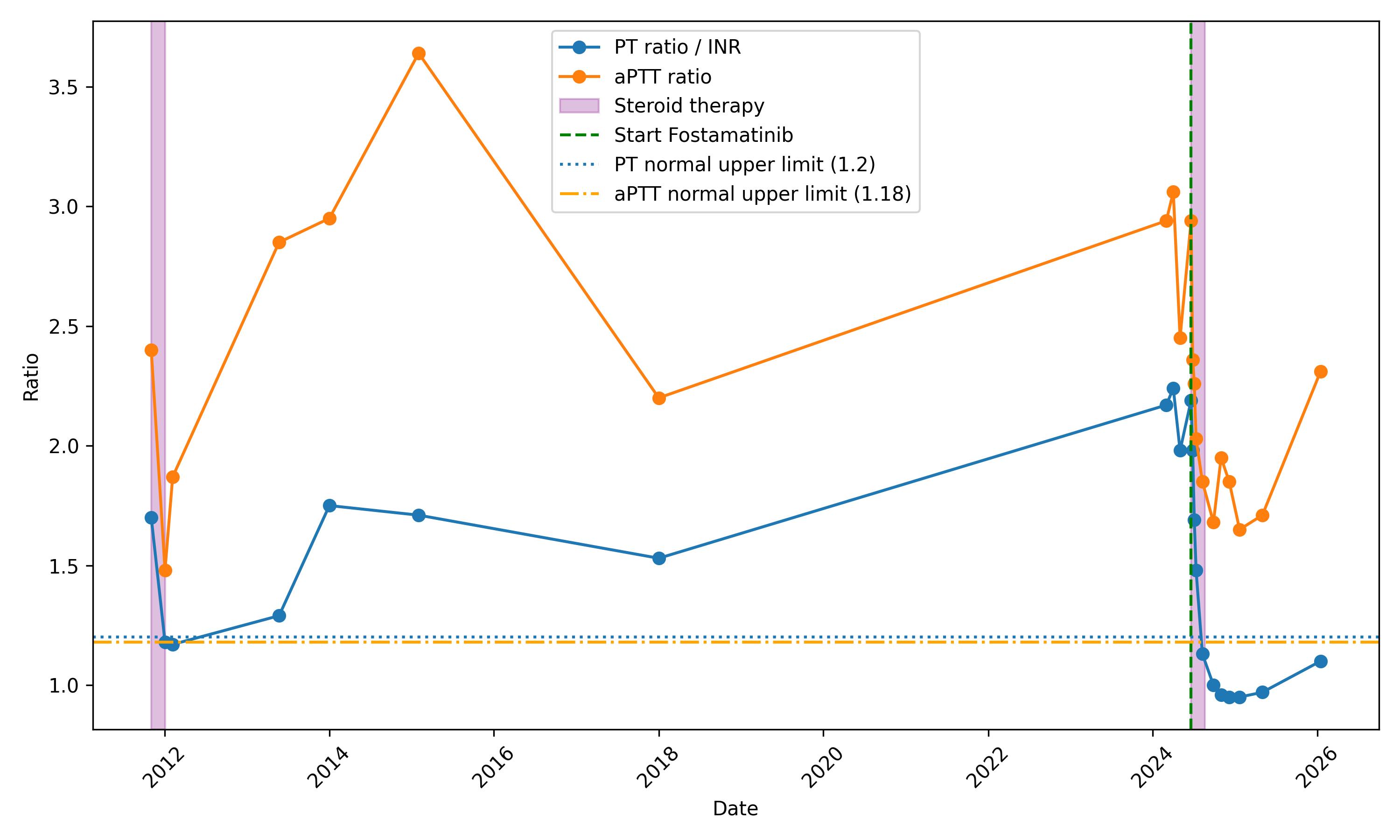
Case Report. A 32-year-old man who, in 2011, following an infectious episode, presented with prolonged PT and aPTT associated with Coombs-positive hemolytic anemia. Further investigations showed triple positivity for aPL (lupus anticoagulant, high-titer anticardiolipin and anti-β2GPI antibodies), medium-titer ANA, low C4 with normal C3; infectious screening was negative and past medical history was unremarkable. Steroid therapy was initiated, leading to complete resolution of hemolytic anemia and normalization of hemolysis markers, and was discontinued after two months. PT initially normalized and then showed progressive prolongation from 2013 onward. Concomitantly, thrombocytopenia was observed (nadir 69,000/mmc), along with mild splenomegaly and hilar lymphadenopathy. Bone marrow biopsy showed trilineage hyperplasia and features of hemophagocytosis; PET was negative, with a mild reduction in the CD4/CD8 ratio and no evidence of monoclonal gammopathy. Platelet count subsequently recovered spontaneously and remained stable (>100,000/mmc) for more than 10 years, with progressive normalization of spleen size. aPL remained persistently positive in the absence of thrombotic events; primary prophylaxis with low-dose aspirin was initiated in 2015. Given the persistent prolongation of PT and aPTT, coagulation factor assays showed a concordant reduction of intrinsic pathway factors (VIII, IX, XI, XII), with normal FVII levels. No clinically relevant bleeding events occurred. In 2024, progressive thrombocytopenia recurred, together with the detection of medium-titer anti-prothrombin IgG antibodies. At a platelet nadir of 31,000/mmc, a short course of steroids and fostamatinib was initiated, resulting in platelet recovery; steroids were subsequently discontinued while fostamatinib was continued. Concomitantly, stable normalization of PT, negativization of anti-prothrombin antibodies, and normalization of coagulation factor levels were observed. The temporal trend of coagulation parameters in relation to treatment is shown in Figure 1.
Conclusions. Fostamatinib is a spleen tyrosine kinase (Syk) inhibitor with immunomodulatory activity on autoantibody-mediated effector mechanisms. Its effect is predominantly functional rather than serological, as it modulates downstream signaling without directly eliminating autoantibodies. In this context, the present case suggests a potential role for Syk inhibition in modulating aPL-related coagulation abnormalities.
Downloads
Download data is not yet available.
Citations




How to Cite
1.
Bergonzi S. PO058 | IMMUNOMODULATORY EFFECTS OF FOSTAMATINIB IN A PATIENT WITH EVANS SYNDROME, TRIPLE-POSITIVE ANTIPHOSPHOLIPID ANTIBODIES AND RELATED COAGULATION ABNORMALITIES: S. Bergonzi1|2|4, G. Murante1|2|4, M. Capetta1|2|4, F. Valeri1|2, C. Dainese1|2, A. Valpreda3|4, R. Pastorino3|4, F. Bocchi3|4, B. Bruno2|4, A. Borchiellini1|2 | 1Regional Centre for Hemorrhagic and Thrombotic Diseases; 2Division of Hematology; 3Central Laboratory Baldi and Riberi, AOU Città della Salute e della Scienza, Università di Torino, Italy; 4Department of Molecular Biotechnology and Health Sciences, University of Turin, Italy. Bleeding Thromb Vasc Biol [Internet]. 2026 Oct. 26 [cited 2026 Nov. 20];5(s3). Available from: https://www.btvb.org/btvb/article/view/874
Copyright (c) 2026 The Author(s)


This work is licensed under a Creative Commons Attribution-NonCommercial 4.0 International License.



