

Oral Communications and Posters
Vol. 5 No. s3 (2026): Abstracts of the XXIX National Congress of the Italian Society for the Study of Hemostasis and Thrombosis, 2026

PO056 | SYNERGISTIC EFFECT OF RECOMBINANT FACTOR INFUSION ON THROMBIN GENERATION IN HEMOPHILIA PATIENTS UNDER EMICIZUMAB OR CONCIZUMAB PROPHYLAXIS
F. Bocchi1|2, R. Pastorino1|2, M. Capetta1|2|3, S. Bergonzi1|2|3, G. Murante1|2|3, F. Valeri2|3, C. Dainese2|3, A. Valpreda4, B. Bruno1|3, A. Borchiellini2|3 | 1Department of Molecular Biotechnology and Health Sciences, University of Turin, Italy; 2Regional Center for Thrombotic and Hemorrhagic Diseases; 3Division of Hematology; 4Central Lab Baldi and Riberi, AOU Città della Salute e della Scienza di Torino, Italy
Publisher's note
All claims expressed in this article are solely those of the authors and do not necessarily represent those of their affiliated organizations, or those of the publisher, the editors and the reviewers. Any product that may be evaluated in this article or claim that may be made by its manufacturer is not guaranteed or endorsed by the publisher.
All claims expressed in this article are solely those of the authors and do not necessarily represent those of their affiliated organizations, or those of the publisher, the editors and the reviewers. Any product that may be evaluated in this article or claim that may be made by its manufacturer is not guaranteed or endorsed by the publisher.
Published: 26 October 2026
67
Views
36
Downloads
Authors
Methods. A total of 23 patients (pts) were screened, comprising 21 on emicizumab and 2 on concizumab prophylaxis enrolled in Novo Nordisk study NCT04082429. Among them, only 4 required recombinant factor infusion for breakthrough bleeding or surgery and were thus eligible for this analysis. This subset was categorized by prophylaxis type as follows: Emicizumab Group (n=3): three pts (1 moderate-severe and 2 severe hemophilia A). Clinical indications for factor infusion included major surgery (n=2) and a bleeding event (n=1). Concizumab Group (n=1): one patient (pt) with severe hemophilia B, who was evaluated across three distinct bleeding episodes requiring factor treatment. For each pt, a blood sample was collected within 12 hours following the infusion of recombinant factor administered for the bleeding episode or surgery. TGA was tested in platelet-poor plasma using the ST Genesia® system (Stago, Asnieres-sur-Seine, France) using STG BleedScreen reagent. To establish a baseline for each pt, TGA results were obtained from follow-up samples previously collected and stored during routine monitoring, while the pts were receiving prophylaxis with the non-replacement drug alone.
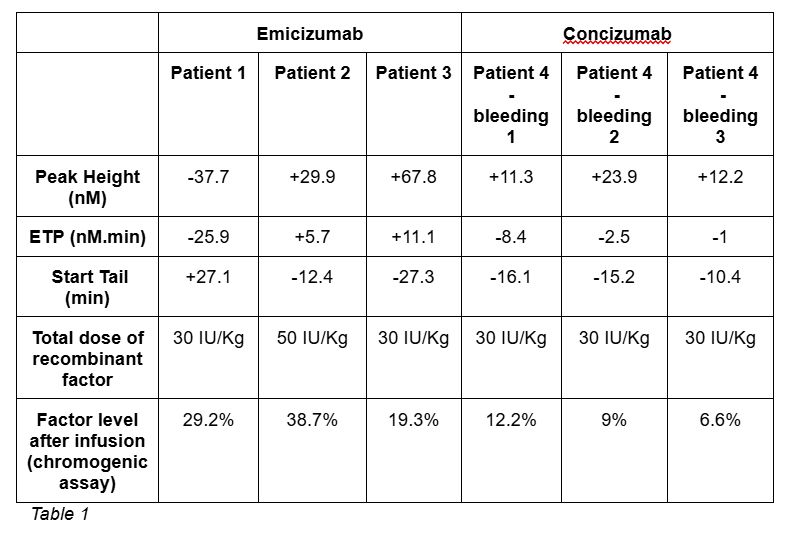
Results. The percentage changes in thrombin generation (TG) parameters following factor infusion exhibited a heterogeneous pattern in the emicizumab group (Table 1). Pts 2 and 3 showed the expected procoagulant shift, conversely, Pts 1 demonstrated a paradoxical decline in TG parameters accompanied by an elongation of the StartTail. Notably, in Pts 1, the attainment of a 29% FVIII plasma level post-infusion did not prevent this reduction in thrombin generation potential compared to baseline. Regarding the pt receiving concizumab, a consistent pattern was observed across all three bleeding events, characterized by a rise in Peak Height and a concomitant decrease in ETP and StartTail values.
Conclusions. TGA profiles revealed distinct kinetic patterns: concizumab was associated with a more immediate thrombin peak linked to massive thrombin generation followed by rapid degradation, whereas emicizumab displayed a more gradual upward slope consistent with the drug's mechanism of action. The paradoxical reduction in thrombin generation observed in Pts 1 (Table 1), despite the attainment of a 29% FVIII level, is of particular clinical interest. We hypothesize that this discrepancy could be related to clinical variables, such as the accelerated consumption of clotting factors during major surgery and the concomitant use of heparin, which acts to decelerate thrombin generation. This suggests that TGA provides a comprehensive global hemostatic profile, essential for tailoring personalized prophylaxis and optimizing management during bleeding or surgery. Future implementation of TGA in Platelet-Rich Plasma may further enhance clinical insights by better reflecting physiological conditions and in vivo cellular interactions.
Downloads
Download data is not yet available.
Citations




How to Cite
1.
Capetta M. PO056 | SYNERGISTIC EFFECT OF RECOMBINANT FACTOR INFUSION ON THROMBIN GENERATION IN HEMOPHILIA PATIENTS UNDER EMICIZUMAB OR CONCIZUMAB PROPHYLAXIS: F. Bocchi1|2, R. Pastorino1|2, M. Capetta1|2|3, S. Bergonzi1|2|3, G. Murante1|2|3, F. Valeri2|3, C. Dainese2|3, A. Valpreda4, B. Bruno1|3, A. Borchiellini2|3 | 1Department of Molecular Biotechnology and Health Sciences, University of Turin, Italy; 2Regional Center for Thrombotic and Hemorrhagic Diseases; 3Division of Hematology; 4Central Lab Baldi and Riberi, AOU Città della Salute e della Scienza di Torino, Italy. Bleeding Thromb Vasc Biol [Internet]. 2026 Oct. 26 [cited 2026 Nov. 22];5(s3). Available from: https://www.btvb.org/btvb/article/view/872
Copyright (c) 2026 The Author(s)


This work is licensed under a Creative Commons Attribution-NonCommercial 4.0 International License.



