

Oral Communications and Posters
Vol. 5 No. s3 (2026): Abstracts of the XXIX National Congress of the Italian Society for the Study of Hemostasis and Thrombosis, 2026

PO052 | VALIDATION OF THROMBIN GENERATION MEASUREMENT IN PLATELET- RICH-PLASMA: EVOLUTION IN THE ST GENESIA® SYSTEM
F. Bocchi1|2, R. Pastorino1|2, G. Murante1|2|3, S. Bergonzi1|2|3, M. Capetta1|2|3, F. Valeri2|3, C. Dainese2|3, A. Valpreda4, B. Bruno1|3, A. Borchiellini2|3 | 1Department of Molecular Biotechnology and Health Sciences, University of Turin, Torino, Italy; 2Regional Centre for Thrombotic and Hemorrhagic Diseases, AOU Città della salute e della Scienza di Torino, Torino, Italy; 3Division of Hematology, AOU Città della Salute e della Scienza, Università di Torino, Torino, Italy; 4Central Lab Baldi and Riberi, AOU Città della salute e della Scienza di Torino, Torino, Italy
Publisher's note
All claims expressed in this article are solely those of the authors and do not necessarily represent those of their affiliated organizations, or those of the publisher, the editors and the reviewers. Any product that may be evaluated in this article or claim that may be made by its manufacturer is not guaranteed or endorsed by the publisher.
All claims expressed in this article are solely those of the authors and do not necessarily represent those of their affiliated organizations, or those of the publisher, the editors and the reviewers. Any product that may be evaluated in this article or claim that may be made by its manufacturer is not guaranteed or endorsed by the publisher.
Published: 26 October 2026
8
Views
2
Downloads
Authors
Methods. The procedure required the following materials: PRP Reagent (CAT PRP-Reagent, Stago) that contains relipidated Tissue Factor that allows the initiation of reaction, a home made PPP reference plasma (RefPlasma) prepared from a pool of at least 20 healthy donors, used for result normalisation, analytical variability monitoring, and internal system calibration and the PRP samples under investigation. RefPlasma validation was performed by calculating the intra-run (≥10 replicates) and inter-run (≥3 days) coefficients of variation (CV%), alongside assessment of routine coagulation parameters (PT, aPTT, fibrinogen, AT). PRP sample stability was evaluated by performing TG measurements at three time points: T0 (baseline), T1 (1 hour post T0), and T2 (3 hours post T0).
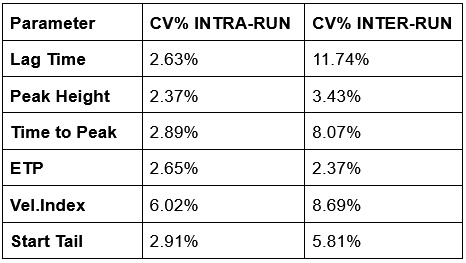
Results. RefPlasma validation demonstrated acceptable intra-run CV% (10 replicates within a single run) and Inter-run CV% (across 3 runs on separate days) described in Table 1. Routine coagulation parameters (PT, aPTT, fibrinogen, AT) were within normal reference ranges. PRP stability testing revealed a progressive decline in Peak Height, ETP, and Velocity Index from T0 through T2, accompanied by a corresponding increase in Lag Time, Time to Peak, and Start Tail.
Conclusions. With coefficients of variation predominantly below 10%, the RefPlasma demonstrated satisfactory reproducibility both within individual runs and across runs performed on different days. Regarding PRP stability, the progressive reduction of TG parameters (Peak Height, ETP) over time suggests that specimens should be analysed within 3 hours of collection to mitigate pre-analytical degradation. This finding warrants further investigation, particularly concerning the feasibility of test centralisation when processing samples received from external centres. In conclusion, this procedure represents a validated approach for TGA in PRP, enabling a more physiologically relevant evaluation when it is important to have a global assessment of drug-coagulation interactions.
Downloads
Download data is not yet available.
Citations




How to Cite
1.
Bocchi F. PO052 | VALIDATION OF THROMBIN GENERATION MEASUREMENT IN PLATELET- RICH-PLASMA: EVOLUTION IN THE ST GENESIA® SYSTEM: F. Bocchi1|2, R. Pastorino1|2, G. Murante1|2|3, S. Bergonzi1|2|3, M. Capetta1|2|3, F. Valeri2|3, C. Dainese2|3, A. Valpreda4, B. Bruno1|3, A. Borchiellini2|3 | 1Department of Molecular Biotechnology and Health Sciences, University of Turin, Torino, Italy; 2Regional Centre for Thrombotic and Hemorrhagic Diseases, AOU Città della salute e della Scienza di Torino, Torino, Italy; 3Division of Hematology, AOU Città della Salute e della Scienza, Università di Torino, Torino, Italy; 4Central Lab Baldi and Riberi, AOU Città della salute e della Scienza di Torino, Torino, Italy. Bleeding Thromb Vasc Biol [Internet]. 2026 Oct. 26 [cited 2026 Oct. 29];5(s3). Available from: https://www.btvb.org/btvb/article/view/868
Copyright (c) 2026 The Author(s)


This work is licensed under a Creative Commons Attribution-NonCommercial 4.0 International License.



