

Oral Communications and Posters
Vol. 5 No. s3 (2026): Abstracts of the XXIX National Congress of the Italian Society for the Study of Hemostasis and Thrombosis, 2026

PO040 | PHARMACODYNAMIC CHARACTERIZATION OF THROMBIN GENERATION IN SEVERE HEMOPHILIA A PATIENTS ON EMICIZUMAB PROPHYLAXIS: A REAL-WORLD LONGITUDINAL STUDY
M. Bergamaschi, A. Pallotta, M. Biglietto, S. Sorella, S. Ligia, E. Baldacci, A. Chistolini, C. Santoro, R. Mormile | Department of translational and precision Medicine, Sapienza, University of Rome, Italy
Publisher's note
All claims expressed in this article are solely those of the authors and do not necessarily represent those of their affiliated organizations, or those of the publisher, the editors and the reviewers. Any product that may be evaluated in this article or claim that may be made by its manufacturer is not guaranteed or endorsed by the publisher.
All claims expressed in this article are solely those of the authors and do not necessarily represent those of their affiliated organizations, or those of the publisher, the editors and the reviewers. Any product that may be evaluated in this article or claim that may be made by its manufacturer is not guaranteed or endorsed by the publisher.
Published: 26 October 2026
0
Views
0
Downloads
Authors
Methods. We studied a cohort of 15 patients with severe HA on Emicizumab, including 4 with high-titer inhibitors. TGA was performed during the loading phase and at steady state using the Calibrated Automated Thrombogram (CAT) on platelet-poor plasma spiked with PPP-Reagent (5 pM TF and 4 µM phospholipids); a dedicated Thrombin Calibrator was used to correct for inner filter effects. Data were compared with: 1) 11 untreated HA patients not receiving Emicizumab and 2) 11 healthy controls. Six kinetic-quantitative parameters (ETP, Peak, Lag Time, ttPeak, Velocity Index, and StartTail) were determined. Statistical analysis included the Wilcoxon signed-rank test for longitudinal comparisons, the Mann-Whitney U-test for independent groups, and Spearman’s rank correlation combined with logarithmic regression to model the dose-response relationship with plasma drug levels (measured via modified one-stage clotting assay).
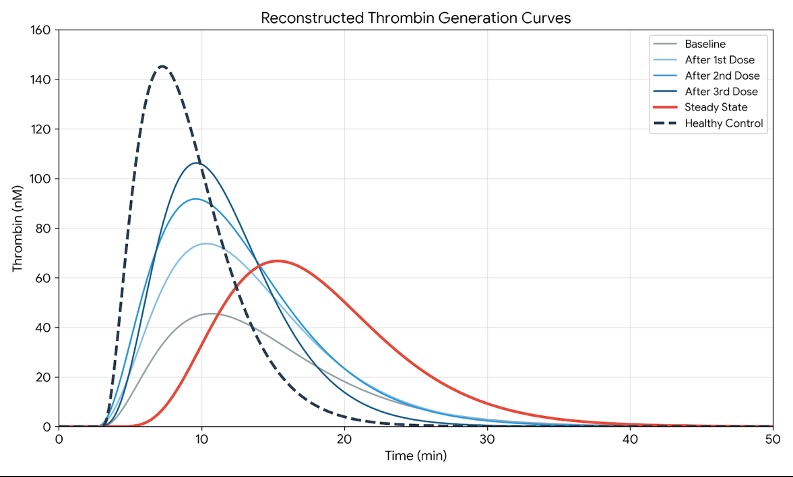
Results. The analysis demonstrates an immediate restoration of the hemostatic potential. Notably, ETP levels reached after the first loading dose were remarkably similar to those observed at steady state (915.41 vs. 936.23 nM·min, p=0.07), providing a laboratory-based rationale for the early discontinuation of FVIII replacement therapy. At steady state, ETP values were statistically comparable to healthy controls (936.23 vs. 1067.34 nM·min, p=0.33), showing a recovery from the severe baseline defect (613.08 nM·min, p<0.01). No significant differences were found between patients with and without inhibitors (p=0.57). A solid dose-response correlation was confirmed between Emicizumab levels and quantitative parameters: ETP (ρ=+0.205, p=0.025) and Peak (ρ=+0.246, p=0.007). Conversely, the kinetic profile remained altered, showing a significant and dosage-independent prolongation of Lag Time, ttPeak, and StartTail (p<0.02).
Conclusions. Emicizumab prophylaxis induces a stable remodeling of the coagulation profile in severe HA. Quantitative parameters, ETP and Peak, show a significant association with plasma drug concentrations, confirming their utility in evaluating the biological response to treatment. The rapid recovery of ETP after the first dose suggests the clinical feasibility of early FVIII replacement therapy discontinuation. Regarding coagulation kinetics, a unique signature with delayed initiation was observed; however, the clinical significance of this kinetic remodeling warrants further investigation. Overall, Emicizumab effectively bridges the native hemostatic gap, providing immediate and predictable protection, Figure 1 Longitudinal Thrombin Generation curves. Reconstructed median curves. Note the rapid ETP restoration after the 1st dose and the specific steady-state kinetic profile (delayed lag time/lower peak).
Downloads
Download data is not yet available.
Citations




How to Cite
1.
Bergamaschi M. PO040 | PHARMACODYNAMIC CHARACTERIZATION OF THROMBIN GENERATION IN SEVERE HEMOPHILIA A PATIENTS ON EMICIZUMAB PROPHYLAXIS: A REAL-WORLD LONGITUDINAL STUDY: M. Bergamaschi, A. Pallotta, M. Biglietto, S. Sorella, S. Ligia, E. Baldacci, A. Chistolini, C. Santoro, R. Mormile | Department of translational and precision Medicine, Sapienza, University of Rome, Italy. Bleeding Thromb Vasc Biol [Internet]. 2026 Oct. 26 [cited 2026 Oct. 28];5(s3). Available from: https://www.btvb.org/btvb/article/view/856
Copyright (c) 2026 The Author(s)


This work is licensed under a Creative Commons Attribution-NonCommercial 4.0 International License.



