

Oral Communications and Posters
Vol. 5 No. s3 (2026): Abstracts of the XXIX National Congress of the Italian Society for the Study of Hemostasis and Thrombosis, 2026

PO032 | INHIBITION OF PLATELET ACTIVATION BY SMALL MOLECULE SYNTHETIC AGONISTS OF THE BILE ACID RECEPTOR: A NOVEL APPROACH TO ANTIPLATELET THERAPY
L. Bury1, E. Falcinelli1, V. Fazzi1, C. Tili1, P. Gresele1, S. Fiorucci2 | 1Department of Medicine and Surgery, Section of Internal and Cardiovascular Medicine; 2Section of Gastroenterology, University of Perugia, Italy
Publisher's note
All claims expressed in this article are solely those of the authors and do not necessarily represent those of their affiliated organizations, or those of the publisher, the editors and the reviewers. Any product that may be evaluated in this article or claim that may be made by its manufacturer is not guaranteed or endorsed by the publisher.
All claims expressed in this article are solely those of the authors and do not necessarily represent those of their affiliated organizations, or those of the publisher, the editors and the reviewers. Any product that may be evaluated in this article or claim that may be made by its manufacturer is not guaranteed or endorsed by the publisher.
Published: 26 October 2026
2
Views
2
Downloads
Authors
Methods. Platelet rich plasma (PRP) from healthy controls was pre-incubated with DCA and the synthetic TGR5 agonists BAR501 and BAR502 (1 to 100 nM) for 30 minutes, then platelet activation was triggered by convulxin (CVX, 5 ng/ml), ADP (5 M) or TRAP-6 (20 M), and assessed by the measurement of P-selectin expression and αIIbβ3 activation by flow cytometry and platelet aggregation by light transmission aggregometry. Platelet spreading on fibrinogen was assessed by immunofluorescence. To investigate on the signaling involved, intracellular Ca²⁺ mobilization was assessed by flow cytometry.
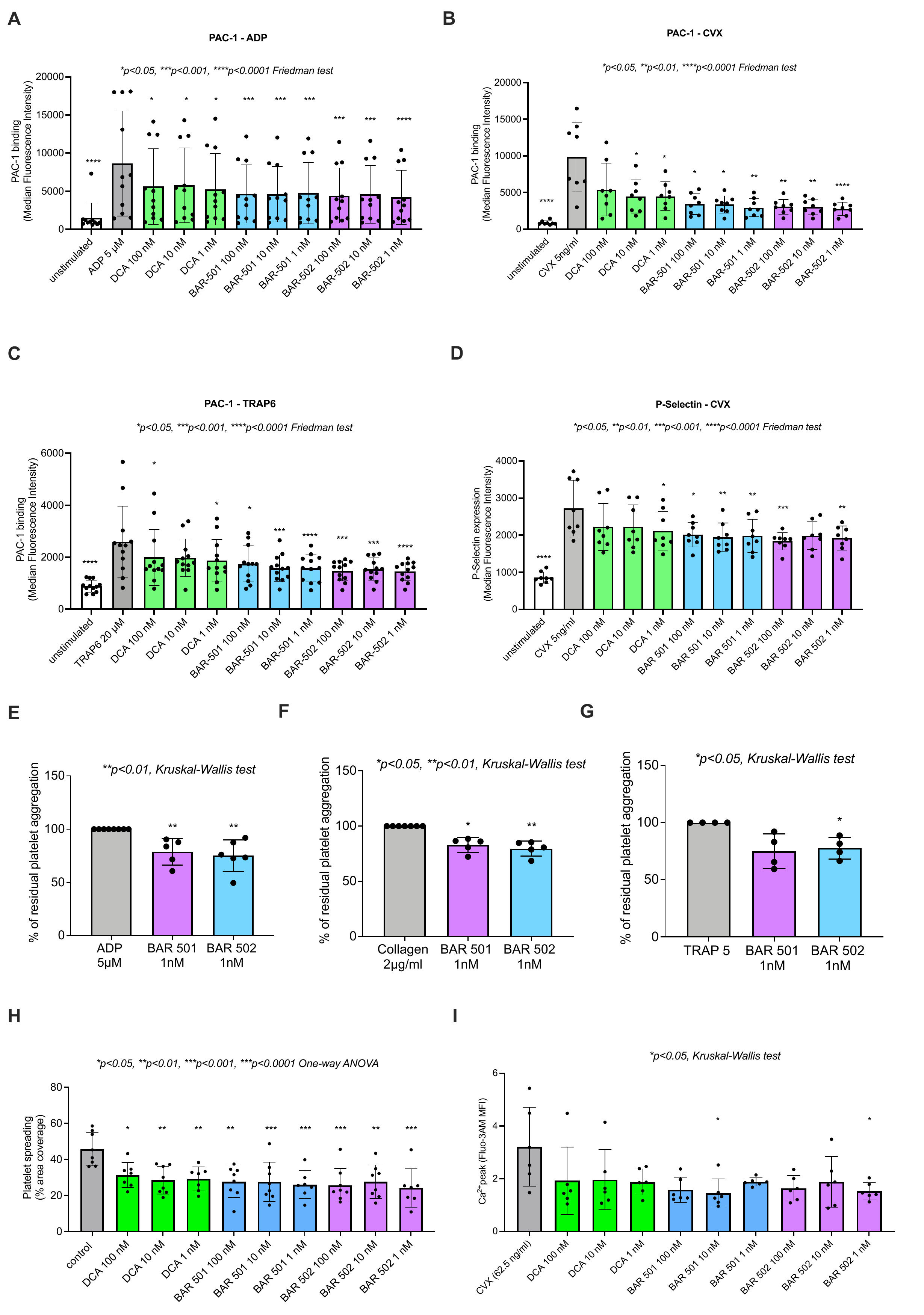
Results. αIIbβ3 activation in response to CVX, ADP and TRAP-6 was reduced by pre-incubation with the synthetic TGR5 agonists BAR501 and BAR502 as well as with the natural bile acid DCA (Figure 1 A-C). Also P-selectin expression in response to CVX was decreased by DCA, BAR501 and BAR502 (Figure 1 D). Accordingly, BAR501 and BAR502, at the dose of 1 nM, significantly reduced platelet aggregation in response to ADP, collagen and TRAP-6 (Figure 1 E-G). All these molecules also decreased platelet spreading on fibrinogen (Figure 1 H). Ca²⁺ mobilization was reduced upon incubation with BAR501 and BAR502 (Figure 1 I).
Conclusions. Activation of TGR5 by physiological concentrations of DCA or by the two synthetic agonists BAR501 and BAR502 at their EC50 markedly suppresses key platelet responses, including platelet activation, adhesion and aggregation. The mechanism of action involves the decreased intracellular Ca²⁺ increase upon agonist stimulation. Our findings highlight TGR5 as a novel pharmacological target for platelet inhibition and support the development of synthetic agonists, such as BAR501 and BAR502, as potential antiplatelet strategies for cardiovascular disease.
Downloads
Download data is not yet available.
Citations




How to Cite
1.
Bury L. PO032 | INHIBITION OF PLATELET ACTIVATION BY SMALL MOLECULE SYNTHETIC AGONISTS OF THE BILE ACID RECEPTOR: A NOVEL APPROACH TO ANTIPLATELET THERAPY: L. Bury1, E. Falcinelli1, V. Fazzi1, C. Tili1, P. Gresele1, S. Fiorucci2 | 1Department of Medicine and Surgery, Section of Internal and Cardiovascular Medicine; 2Section of Gastroenterology, University of Perugia, Italy. Bleeding Thromb Vasc Biol [Internet]. 2026 Oct. 26 [cited 2026 Oct. 29];5(s3). Available from: https://www.btvb.org/btvb/article/view/848
Copyright (c) 2026 The Author(s)


This work is licensed under a Creative Commons Attribution-NonCommercial 4.0 International License.



