

Oral Communications and Posters
Vol. 5 No. s3 (2026): Abstracts of the XXIX National Congress of the Italian Society for the Study of Hemostasis and Thrombosis, 2026

PO026 | AUTOSOMAL DOMINANT ITGA2B AND ITGB3 VARIANTS EXPAND THE PHENOTYPIC SPECTRUM OF ΑIIBΒ3-RELATED PLATELET DISORDERS
S. Ferrari, D. Regazzo, L. Onorati, A. Galbiati, L. Spiezia, A. Bertomoro, P. Simioni | Department of Medicine, University of Padova, Italy
Publisher's note
All claims expressed in this article are solely those of the authors and do not necessarily represent those of their affiliated organizations, or those of the publisher, the editors and the reviewers. Any product that may be evaluated in this article or claim that may be made by its manufacturer is not guaranteed or endorsed by the publisher.
All claims expressed in this article are solely those of the authors and do not necessarily represent those of their affiliated organizations, or those of the publisher, the editors and the reviewers. Any product that may be evaluated in this article or claim that may be made by its manufacturer is not guaranteed or endorsed by the publisher.
Published: 26 October 2026
8
Views
2
Downloads
Authors
Methods. Affected individuals underwent standardized bleeding assessment using ISTH Bleeding Assessment Tool (BAT), platelet count followed by aggregation studies, performed on platelet-rich plasma using the Born method (Chronolog). Flow cytometric analysis of αIIbβ3 expression was conducted assessing CD41a expression and PAC-1 binding following ADP stimulation. Genetic analysis was performed in the proband using targeted next-generation sequencing. Identified variants were validated and tested for segregation in available family members by Sanger sequencing. Variant pathogenicity was assessed according to ACMG criteria. Reference transcripts were NM_000419.5 (ITGA2B) and NM_000212.3 (ITGB3). Structural impact was evaluated by in silico modelling.
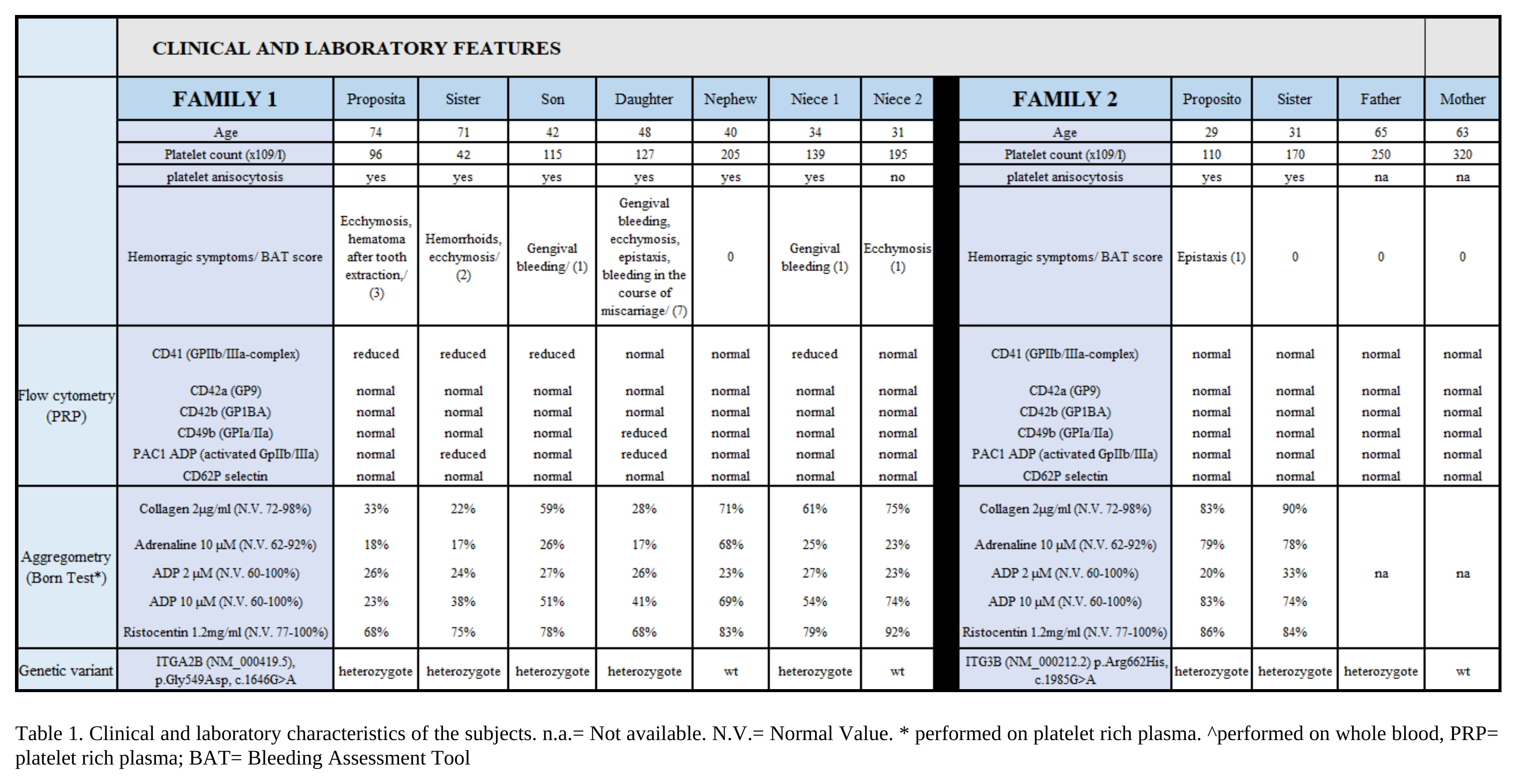
Results. Among Family 1 carriers (5/7 individuals), the heterozygous ITGA2B p.Gly549Asp (c.1646G>A) (Class 4) variant co-segregated with mild thrombocytopenia and mucocutaneous bleeding. The proband showed mildly reduced platelet count (~96×10⁹/L), anisocytosis, and occasional macrothrombocytes. BAT scores ranged from 1 to 7 among the carriers. Platelet aggregation was partially impaired, and above normal range in response to ADP, collagen, and epinephrine, while ristocetin-induced aggregation was preserved (Table 1). Flow cytometry revealed reduced CD41a expression and impaired PAC-1 activation after ADP stimulation. In silico structural modelling suggested destabilization of the extracellular αIIb domain (Table 1). In Family 2, the heterozygous ITGB3 p.Arg662His (c.1985G>A)(Class 4) variant, affecting the same residue as the Sra alloantigen, previously associated with neonatal alloimmune thrombocytopenia, was identified in the proband, his sister, and father (3/4 individuals). The proband exhibited mild thrombocytopenia (~100×10⁹/L), a BAT score of 1, normal platelet aggregation, and normal αIIbβ3 surface expression, consistent with a very mild or subclinical phenotype with variable expressivity.
Conclusions. These findings expand the spectrum of αIIbβ3-related autosomal dominant platelet disorders and highlight significant gene- and variant-specific phenotypic variability. Recognition of these often subtle and heterogeneous presentations is essential for accurate molecular diagnosis and appropriate genetic counselling. The contrasting phenotypes observed between the two families further suggest a continuum of disease severity ranging from functional impairment to near-normal platelet function despite thrombocytopenia depending on a variant-specific effect on αIIbβ3 expression and activation. These observations also underscore the importance of including ITGA2B and ITGB3 in diagnostic workflows for inherited thrombocytopenias, particularly in cases with mild or atypical phenotypes that may be misdiagnosed as other platelet disorders.
Downloads
Download data is not yet available.
Citations




How to Cite
1.
Ferrari S. PO026 | AUTOSOMAL DOMINANT ITGA2B AND ITGB3 VARIANTS EXPAND THE PHENOTYPIC SPECTRUM OF ΑIIBΒ3-RELATED PLATELET DISORDERS: S. Ferrari, D. Regazzo, L. Onorati, A. Galbiati, L. Spiezia, A. Bertomoro, P. Simioni | Department of Medicine, University of Padova, Italy. Bleeding Thromb Vasc Biol [Internet]. 2026 Oct. 26 [cited 2026 Oct. 29];5(s3). Available from: https://www.btvb.org/btvb/article/view/842
Copyright (c) 2026 The Author(s)


This work is licensed under a Creative Commons Attribution-NonCommercial 4.0 International License.



