

Oral Communications and Posters
Vol. 5 No. s3 (2026): Abstracts of the XXIX National Congress of the Italian Society for the Study of Hemostasis and Thrombosis, 2026

PO021 | PLATELETS MATTER: THROMBIN GENERATION IN PLATELET‐RICH PLASMA VERSUS PLATELET-POOR-PLASMA UNDER NON-REPLACEMENT THERAPIES IN HAEMOPHILIA
F. Bocchi1|2, R. Pastorino1|2, G. Murante1|2|3, S. Bergonzi1|2|3, M. Capetta1|2|3, F. Valeri2|3, C. Dainese2|3, A. Valpreda4, B. Bruno1|3, A. Borchiellini2|3 | 1Department of Molecular Biotechnology and Health Sciences, University of Turin, Torino, Italy; 2Regional Centre for Thrombotic and Hemorrhagic Diseases; 3Division of Hematology; 4Central Lab Baldi and Riberi, AOU Città della salute e della Scienza di Torino, Torino, Italy
Publisher's note
All claims expressed in this article are solely those of the authors and do not necessarily represent those of their affiliated organizations, or those of the publisher, the editors and the reviewers. Any product that may be evaluated in this article or claim that may be made by its manufacturer is not guaranteed or endorsed by the publisher.
All claims expressed in this article are solely those of the authors and do not necessarily represent those of their affiliated organizations, or those of the publisher, the editors and the reviewers. Any product that may be evaluated in this article or claim that may be made by its manufacturer is not guaranteed or endorsed by the publisher.
Published: 26 October 2026
7
Views
1
Downloads
Authors
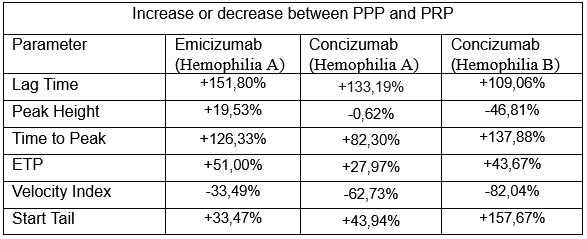
Methods. Among 21 patients on Emz prophylaxis and 2 patients on Concz prophylaxis (in Novo Nordisk study NCT04082429) followed at our Centre, blood sampling was obtained from 15 patients with severe HA, with and without inhibitors, on stable Emz prophylaxis, and 2 patients receiving Concz (one with severe HA and one with severe HB). Thrombin generation was evaluated in both PRP and PPP using the ST Genesia® (Stago, Asnières-sur-Seine, France): frozen PPP samples were analyzed using the standard protocol. PRP samples were analyzed within 2 hours of collection using an in-house validated protocol. The following parameters were recorded: Lag Time, Peak Height, Time to Peak, Endogenous Thrombin Potential (ETP), Velocity Index, and Start Tail. PRP and PPP results were compared to evaluate the impact of platelets on thrombin generation.
Results. Six samples were excluded due to instrument malfunction. A comparison of the results obtained in PRP and PPP in the 11 evaluable patients is shown in Table 1. A consistent trend was observed across all pts: in PRP, there was an increase in Lag Time, Time to Peak, ETP and Start Tail, and a decrease in Velocity Index; instead, Peak Height did not demonstrate a uniform trend across all pts. However, no appreciable differences in the thrombin generation profile were observed between patients treated with Concz and those treated with Emz.
Conclusions. A consistent difference between PPP- and PRP-based TGA was observed across all patients. Specifically, PRP curves exhibited a delayed onset of thrombin generation and a prolonged time to peak, alongside a higher total amount of thrombin generated and greater endogenous thrombin potential. These findings suggest that PRP-based TGA may provide a more comprehensive assessment of the hemostatic profile in patients receiving non-replacement therapies, capturing the contribution of platelet-dependent coagulation processes.
Downloads
Download data is not yet available.
Citations




How to Cite
1.
Bocchi F. PO021 | PLATELETS MATTER: THROMBIN GENERATION IN PLATELET‐RICH PLASMA VERSUS PLATELET-POOR-PLASMA UNDER NON-REPLACEMENT THERAPIES IN HAEMOPHILIA: F. Bocchi1|2, R. Pastorino1|2, G. Murante1|2|3, S. Bergonzi1|2|3, M. Capetta1|2|3, F. Valeri2|3, C. Dainese2|3, A. Valpreda4, B. Bruno1|3, A. Borchiellini2|3 | 1Department of Molecular Biotechnology and Health Sciences, University of Turin, Torino, Italy; 2Regional Centre for Thrombotic and Hemorrhagic Diseases; 3Division of Hematology; 4Central Lab Baldi and Riberi, AOU Città della salute e della Scienza di Torino, Torino, Italy. Bleeding Thromb Vasc Biol [Internet]. 2026 Oct. 26 [cited 2026 Oct. 29];5(s3). Available from: https://www.btvb.org/btvb/article/view/837
Copyright (c) 2026 The Author(s)


This work is licensed under a Creative Commons Attribution-NonCommercial 4.0 International License.



