

Oral Communications and Posters
Vol. 5 No. s3 (2026): Abstracts of the XXIX National Congress of the Italian Society for the Study of Hemostasis and Thrombosis, 2026

PO009 | THROMBOPHILIA AND ASSISTED REPRODUCTIVE TECHNOLOGY: PRELIMINARY RESULTS FROM A SINGLE CENTER RETROSPECTIVE COHORT STUDY
G. Burrei2, E. Malloggi1, S. Moruzzi1, L. Delfino1, F. Pizzolo1, L. Panepinto1, F. Presa1, C. Spillere1, A. Moschella1, F. Zoccatelli1, S. Friso1, N. Martinelli1, S. Suardi1 | 1Department of Medicine, University Hospital, Verona, Italy; 2General Medicine Unit, Magalini Hospital, Villafranca di Verona, Italy
Publisher's note
All claims expressed in this article are solely those of the authors and do not necessarily represent those of their affiliated organizations, or those of the publisher, the editors and the reviewers. Any product that may be evaluated in this article or claim that may be made by its manufacturer is not guaranteed or endorsed by the publisher.
All claims expressed in this article are solely those of the authors and do not necessarily represent those of their affiliated organizations, or those of the publisher, the editors and the reviewers. Any product that may be evaluated in this article or claim that may be made by its manufacturer is not guaranteed or endorsed by the publisher.
Published: 26 October 2026
7
Views
2
Downloads
Authors
Materials and Methods. A single-center retrospective cohort study was conducted on 22 women undergoing ART for infertility or recurrent pregnancy loss at the Internal Medicine B outpatient clinic of AOUI Verona between 2024 and 2025. Selective screening for inherited and acquired thrombophilia was performed. Patients received LMWH and/or ASA, or no antithrombotic therapy, starting from embryo transfer.
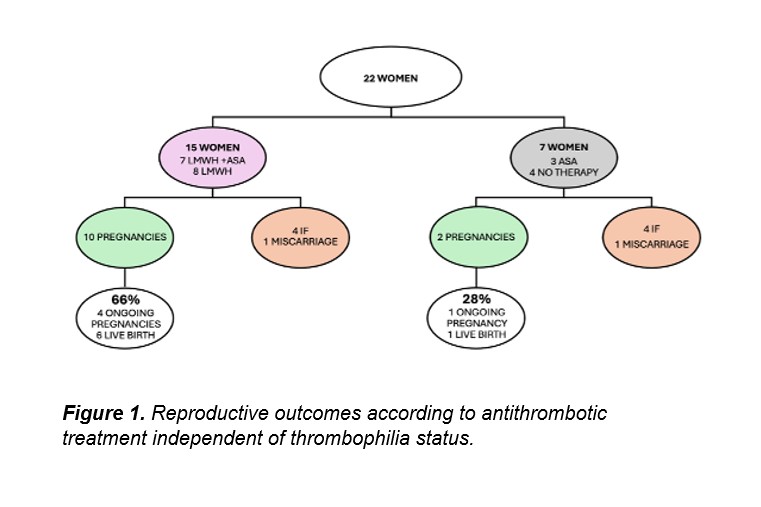
Results. The 22 women were stratified into 3 groups: Group A, negative thrombophilia screening or thrombophilia not assessed (n = 12); Group B, low-risk inherited thrombophilia (n = 6), including 3 women heterozygous for the Factor II (G20210A) mutation and 3 heterozygous for Factor V Leiden; and Group C, obstetric antiphospholipid syndrome (OAPS) (n = 4). In Group A, 6 women received LMWH alone or in combination with ASA, with favorable clinical outcomes (pregnancy or live birth) in 5 cases (83.3%). In Group B, 5 patients received LMWH alone or in combination with ASA, resulting in 2 pregnancies (40%). In Group C, all 4 women were treated with combined LMWH and ASA, with 3 pregnancies achieved (75%). Overall, 15 women received LMWH (alone or in combination with ASA), whereas 7 remained untreated(Figure 1). The best outcomes in terms of implantation, clinical pregnancy, and live birth rates were observed in patients treated with LMWH, with or without ASA, with an overall benefit in 66% of cases. In contrast, untreated patients or those receiving ASA alone predominantly experienced implantation failure or early pregnancy loss.
Conclusions. These findings are consistent with the literature, confirming a significant benefit of combined LMWH and ASA in patients with OAPS, with implantation, clinical pregnancy, and live birth rates of 75%. In low-risk inherited thrombophilia, the benefit appears limited (40% clinical pregnancy rate). The high success rate in thrombophilia-negative or untested patients treated with LMWH (± ASA) may be related to the pleiotropic and anti-inflammatory effects of heparin. Overall, anticoagulant therapy may be beneficial regardless of thrombophilia status, with favorable outcomes in 66% of cases. The main limitations of this study include the small sample size and the absence of high-risk inherited thrombophilia. Larger prospective studies are needed to confirm these findings and to better guide clinical management.
Downloads
Download data is not yet available.
Citations




How to Cite
1.
Burrei G. PO009 | THROMBOPHILIA AND ASSISTED REPRODUCTIVE TECHNOLOGY: PRELIMINARY RESULTS FROM A SINGLE CENTER RETROSPECTIVE COHORT STUDY: G. Burrei2, E. Malloggi1, S. Moruzzi1, L. Delfino1, F. Pizzolo1, L. Panepinto1, F. Presa1, C. Spillere1, A. Moschella1, F. Zoccatelli1, S. Friso1, N. Martinelli1, S. Suardi1 | 1Department of Medicine, University Hospital, Verona, Italy; 2General Medicine Unit, Magalini Hospital, Villafranca di Verona, Italy. Bleeding Thromb Vasc Biol [Internet]. 2026 Oct. 26 [cited 2026 Oct. 29];5(s3). Available from: https://www.btvb.org/btvb/article/view/825
Copyright (c) 2026 The Author(s)


This work is licensed under a Creative Commons Attribution-NonCommercial 4.0 International License.



