

Oral Communications and Posters
Vol. 5 No. s3 (2026): Abstracts of the XXIX National Congress of the Italian Society for the Study of Hemostasis and Thrombosis, 2026

PO008 | HISTORY OF CANCER IN VTE PATIENTS WITH AND WITHOUT HEREDITARY THROMBOPHILIA: A SINGLE CENTER COHORT STUDY
A. Napolitano, E. Campello, C. Simion, G. Furlan, S. Gavasso, C. Bulato, C. Samà, S. Toffanin, B. Serena, L. Spiezia, P. Simioni | Department of Medicine, University of Padova, Italy
Publisher's note
All claims expressed in this article are solely those of the authors and do not necessarily represent those of their affiliated organizations, or those of the publisher, the editors and the reviewers. Any product that may be evaluated in this article or claim that may be made by its manufacturer is not guaranteed or endorsed by the publisher.
All claims expressed in this article are solely those of the authors and do not necessarily represent those of their affiliated organizations, or those of the publisher, the editors and the reviewers. Any product that may be evaluated in this article or claim that may be made by its manufacturer is not guaranteed or endorsed by the publisher.
Published: 26 October 2026
65
Views
28
Downloads
Authors
Methods. Consecutive patients with a history of venous thromboembolism (VTE) who underwent hereditary thrombophilia testing were enrolled. Patients were classified into three groups: no thrombophilia, mild thrombophilia, and severe thrombophilia (n = 200 each). The primary outcome was a history of cancer, defined as any solid or hematological malignancy diagnosed at any time. Age at first VTE was used as age at inclusion. Prevalence ratios (PRs) for cancer were estimated using Poisson regression with a log link and robust standard errors, adjusted for age and sex. Incident post-VTE cancer was analyzed after excluding pre-VTE cancer cases, using Cox regression adjusted for age and sex.
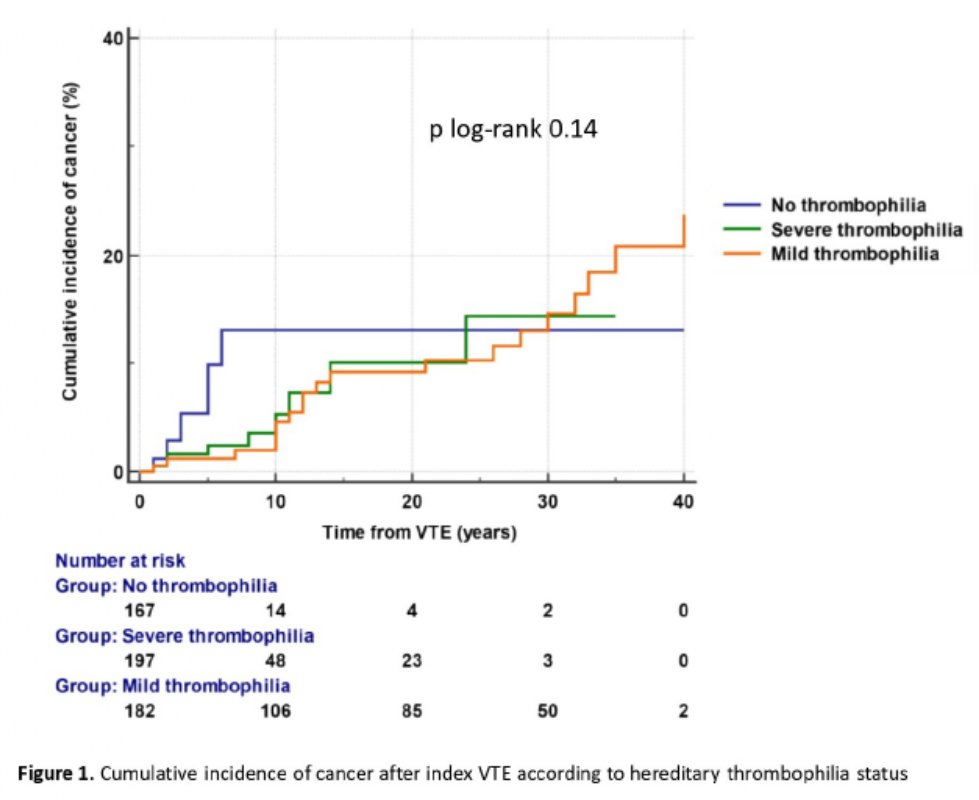
Results. Cancer prevalence was 12.5% (25/200) in patients without thrombophilia, 14.0% (28/200) in those with mild thrombophilia, and 11.0% (22/200) in those with severe thrombophilia. Adjusted Poisson regression showed no association between thrombophilia status and overall cancer prevalence (mild vs no thrombophilia: PR 1.31, 95% CI 0.74–2.32, p = 0.362; severe vs no thrombophilia: PR 1.06, 95% CI 0.59–1.91, p = 0.839), while increasing age was independently associated with cancer (p = 0.001). Pre-VTE cancer prevalence was 9.0% (18/200) in patients without thrombophilia, 2.5% (5/200) in mild thrombophilia, and 6.5% (13/200) in severe thrombophilia. However, thrombophilia was not independently associated with pre-VTE cancer after adjustment for age and sex (overall p = 0.212). In sensitivity analyses based on thrombophilia subtypes, an overall association between subtype and pre-VTE cancer was observed (p = 0.041), mainly driven by protein C deficiency (PR 2.19 vs no thrombophilia; p = 0.032). Median age at cancer diagnosis was 64.5 [54.0–73.0] years in patients without thrombophilia, 61.5 [53.5–69.0] in mild thrombophilia, and 58.0 [47.0–66.8] in severe thrombophilia. Incident cancer occurred in 6.9% (39/564) over 5,722 person-years (0.68 per 100 person-years, 95% CI 0.47–0.90), with no association with thrombophilia in adjusted Cox regression, while age remained an independent risk factor.
Conclusions. In VTE patients, hereditary thrombophilia was not independently associated with overall cancer prevalence. Cancer risk was mainly driven by age. Subtype analyses suggested a possible signal for protein C deficiency and pre-VTE cancer, but this finding requires confirmation.
Downloads
Download data is not yet available.
Citations




How to Cite
1.
Napolitano A. PO008 | HISTORY OF CANCER IN VTE PATIENTS WITH AND WITHOUT HEREDITARY THROMBOPHILIA: A SINGLE CENTER COHORT STUDY: A. Napolitano, E. Campello, C. Simion, G. Furlan, S. Gavasso, C. Bulato, C. Samà, S. Toffanin, B. Serena, L. Spiezia, P. Simioni | Department of Medicine, University of Padova, Italy. Bleeding Thromb Vasc Biol [Internet]. 2026 Oct. 26 [cited 2026 Nov. 20];5(s3). Available from: https://www.btvb.org/btvb/article/view/824
Copyright (c) 2026 The Author(s)


This work is licensed under a Creative Commons Attribution-NonCommercial 4.0 International License.



