

Oral Communications and Posters
Vol. 5 No. s3 (2026): Abstracts of the XXIX National Congress of the Italian Society for the Study of Hemostasis and Thrombosis, 2026

PO004 | SEX-RELATED DIFFERENCES AND PREDICTORS OF MORTALITY IN MAJOR ORTHOPEDIC SURGERY: INSIGHTS FROM THE ORTHO-START REGISTRY
A. de Laurenzo1, E. Antonucci2, C. Rostagno3, D. Barcellona4, D. Colaizzo1, G. di Rienzo5, F. Gorgoglione1, G. Maccagnano6, F. Marongiu2, M. Mastroianno1, M. Marzolo7, L. Mirabella6, B. Moretti8, A.M. Moretti9, A. Ostuni6, G. Palareti2, M. Margaglione6, E. Grandone1|6 | 1Fondazione I.R.C.C.S. “Casa Sollievo della Sofferenza”, S. Giovanni R. (Foggia), Italy; 2Fondazione Arianna, Bologna, Italy; 3Department of Internal and Postoperative Medicine, Careggi University Hospital, Firenze, Italy; 4Department of Medical Sciences and Public Health, University of Cagliari, Cagliari, Italy; 5UOC Patologia Clinica-Ospedale Altamura ASL Bari, Italy; 6University of Foggia, Policlinico Riuniti Foggia, Italy; 7Angiology Unit, Ospedale di Rovigo, Rovigo, Italy; 8School of Medicine, AOU Consorziale Policlinico, University of Bari "Aldo Moro", Italy; 9President of GISeG (Italian Group for Health and Gender), Bari, Italy
Publisher's note
All claims expressed in this article are solely those of the authors and do not necessarily represent those of their affiliated organizations, or those of the publisher, the editors and the reviewers. Any product that may be evaluated in this article or claim that may be made by its manufacturer is not guaranteed or endorsed by the publisher.
All claims expressed in this article are solely those of the authors and do not necessarily represent those of their affiliated organizations, or those of the publisher, the editors and the reviewers. Any product that may be evaluated in this article or claim that may be made by its manufacturer is not guaranteed or endorsed by the publisher.
Published: 26 October 2026
7
Views
2
Downloads
Authors
Aims. To investigate sex-related differences in clinical characteristics, peri-operative management, and postoperative outcomes.
Methods. The ORTHO-START registry is a prospective, multicenter study including 1,077 consecutive adults undergoing major orthopedic surgery (elective hip/knee arthroplasty or urgent hip fracture repair) across six Italian centers between July 2018 and March 2022. Baseline characteristics, perioperative complications, and antithrombotic therapy were collected. The primary outcome was all-cause mortality at 24 months; secondary outcomes were thromboembolic and bleeding events. Multivariable logistic regression identified predictors of mortality.
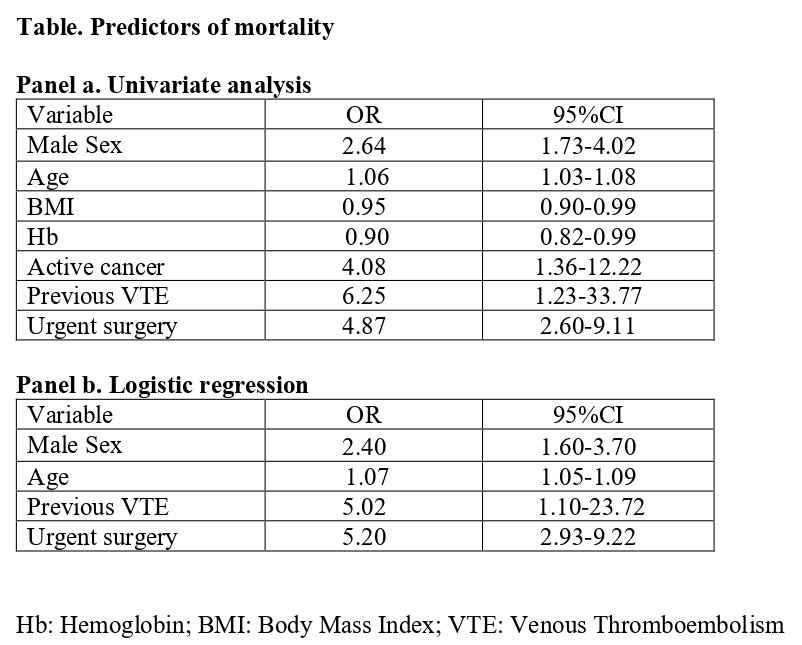
Results. Women represented 72.3% (n = 775) of the cohort and were older than men (80.6 ± 10.0 vs. 76.2 ± 13.0 years, p < 0.001). Urgent procedures comprised 65.6% (n = 706) of surgeries, predominantly involving women (n = 542). At 24 months, mortality was higher in men (31% vs. 18%, p = 0.018). Table shows factors predicting mortality at univariate analysis and multivariable logistic analysis. Independent predictors of mortality included male sex (OR 2.6, 95% CI 1.8–4.0), older age, lower BMI, urgent surgery (OR 7.2, 95% CI 4.1–12.4), and prior VTE (OR 5.7, 95% CI 1.4–23.9). Causes of death were known for 160/210 (76.2%): neurological complications were most frequent (25%), followed by cardiovascular disease (21.3%) and immobility-related causes (14.4%); pulmonary embolism accounted for 1.3% of deaths. Thrombotic and hemorrhagic events occurred in both sexes without significant differences.
Conclusions. Male sex and a history of VTE are independent predictors of long-term mortality following major orthopedic surgery. Incorporating these factors into preoperative risk assessment may improve management and postoperative outcomes.
Downloads
Download data is not yet available.
Citations




How to Cite
1.
Grandone E. PO004 | SEX-RELATED DIFFERENCES AND PREDICTORS OF MORTALITY IN MAJOR ORTHOPEDIC SURGERY: INSIGHTS FROM THE ORTHO-START REGISTRY: A. de Laurenzo1, E. Antonucci2, C. Rostagno3, D. Barcellona4, D. Colaizzo1, G. di Rienzo5, F. Gorgoglione1, G. Maccagnano6, F. Marongiu2, M. Mastroianno1, M. Marzolo7, L. Mirabella6, B. Moretti8, A.M. Moretti9, A. Ostuni6, G. Palareti2, M. Margaglione6, E. Grandone1|6 | 1Fondazione I.R.C.C.S. “Casa Sollievo della Sofferenza”, S. Giovanni R. (Foggia), Italy; 2Fondazione Arianna, Bologna, Italy; 3Department of Internal and Postoperative Medicine, Careggi University Hospital, Firenze, Italy; 4Department of Medical Sciences and Public Health, University of Cagliari, Cagliari, Italy; 5UOC Patologia Clinica-Ospedale Altamura ASL Bari, Italy; 6University of Foggia, Policlinico Riuniti Foggia, Italy; 7Angiology Unit, Ospedale di Rovigo, Rovigo, Italy; 8School of Medicine, AOU Consorziale Policlinico, University of Bari "Aldo Moro", Italy; 9President of GISeG (Italian Group for Health and Gender), Bari, Italy. Bleeding Thromb Vasc Biol [Internet]. 2026 Oct. 26 [cited 2026 Oct. 29];5(s3). Available from: https://www.btvb.org/btvb/article/view/820
Copyright (c) 2026 The Author(s)


This work is licensed under a Creative Commons Attribution-NonCommercial 4.0 International License.



