


CO112 | LIPOPROTEIN(a) PLASMA LEVELS AND COAGULATION BIOMARKERS: RESULTS FROM A COMPREHENSIVE LABORATORY ASSESSMENT IN AN ANGIOGRAPHICALLY-CONTROLLED CARDIOVASCULAR COHORT
N. Osti1, G. Musuraca1, M. Spizzo2, P. Pattini2, G. Poli3, C. Brocco1, C. Cemin1, A. Madaffari1, G. Mango2, F. Presa2, M. Grusse4, P. Van Dreden4, A. Anesi1, G. Lippi3, M. Del Greco1, A. Castagna2, S. Friso2, A. Ferro1, N. Martinelli2 | 1Azienda Sanitaria Universitaria Integrata del Trentino (ASUIT), Trento, Italy; 2U.O. Medicina Interna B, Dip. Medicina, Università di Verona, Italy; 3Sez. Biochimica Clinica, Università di Verona, Italy; 4Dep. Clinical Research, Diagnostica Stago, Gennevilliers, France
All claims expressed in this article are solely those of the authors and do not necessarily represent those of their affiliated organizations, or those of the publisher, the editors and the reviewers. Any product that may be evaluated in this article or claim that may be made by its manufacturer is not guaranteed or endorsed by the publisher.
Authors
Background and Aims. Lipoprotein(a) [Lp(a)] is a causal risk factor for coronary artery disease (CAD), with proposed prothrombotic properties in addition to its proatherogenic effects. However, the association between Lp(a) and coagulation remains controversial so far. This study examined this relationship in subjects with or without angiographically documented CAD.
Methods. Plasma levels of Lp(a) and coagulation biomarkers were assessed in clinically stable subjects undergoing elective coronary angiography. Subjects taking any anticoagulant therapy were excluded. The coagulation panel included coagulant activities of factors II, V, VII, VIII, IX, X, XI, and XII; von Willebrand Factor Antigen (vWF:Ag); factor VII-antithrombin (FVIIa-AT) complex; total Tissue Factor Pathway Inhibitor (TFPI); and thrombin generation assay (TGA). Lp(a) threshold values were defined according to the European Atherosclerosis Society consensus statement: normal <30 mg/dL, intermediate 30-50 mg/dL, and high >50 mg/dL.
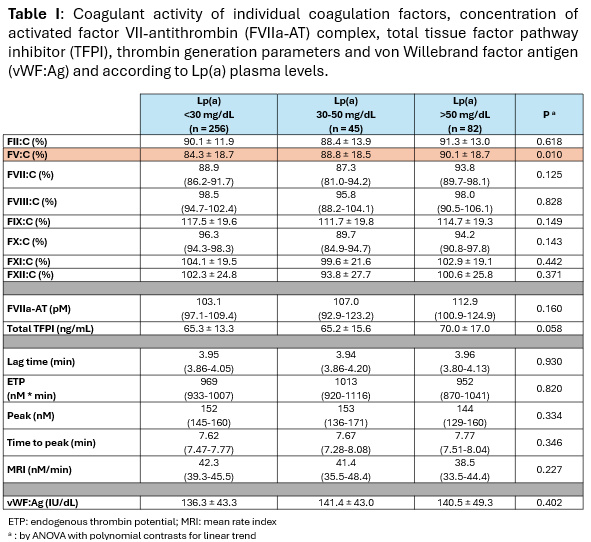
Results. Complete laboratory data were available for 383 subjects (males 75.3%; mean age 68.2±9.7 years): 65 subjects had normal coronary arteries (CAD-free group), 51 subjects had coronary lesions with stenosis <50% (CAD-borderline group), and 267 subjects had coronary lesions with stenosis ≥50% (CAD group). Only a modest yet significant increase in coagulant activity of FV (FV:C) from low to high Lp(a) plasma levels was found (Table I). In linear regression models, high Lp(a) levels remained significantly associated with FV:C after adjustment for potential confounders, including sex, age, CAD diagnosis, body mass index, renal function, ApoB, ApoA-I, triglycerides, and coagulant activities of the other coagulation factors. No difference was observed for all the other coagulant activities, neither vWF:Ag, the FVIIa-AT complex, total TFPI plasma levels, nor TGA parameters. FV:C showed a progressive increase from low to high Lp(a) plasma levels also within the CAD group (p=0.034) and, even if not statistically significant, presented the same trend also within the CAD-free group.
Conclusions. In this pilot study, no major contribution of Lp(a) plasma levels was detected in modulating coagulation phenotype. High Lp(a) plasma levels were associated with only a mild increase of FV:C.
Downloads
Citations




How to Cite

This work is licensed under a Creative Commons Attribution-NonCommercial 4.0 International License.



