


CO109 | THE ROLE OF SELECTED LDLR AND LRP1 VARIANTS IN MODULATING LDL AND FVIII LEVELS IN METABOLIC SYNDROME
P. Agosti1|2, A. Cairo2, S. Spena2, S. Pelusi3, F. Malvestiti1, D. Prati3, M. Clerici2, E. Scalambrino2, A. Tripodi1|2, V. La Mura1|2, L. Valenti1|3, F. Peyvandi1|2 | 1Università degli Studi di Milano, Department of Pathophysiology and Transplantation, Milano, Italy; 2Fondazione IRCCS Ca' Granda Ospedale Maggiore Policlinico, Angelo Bianchi Bonomi Hemophilia and Thrombosis Center, and Fondazione Luigi Villa, Milano, Italy; 3Biological Resource Center and Department of Transfusion Medicine, Fondazione IRCCS Ca' Granda Ospedale Maggiore Policlinico, Milano, Italy
All claims expressed in this article are solely those of the authors and do not necessarily represent those of their affiliated organizations, or those of the publisher, the editors and the reviewers. Any product that may be evaluated in this article or claim that may be made by its manufacturer is not guaranteed or endorsed by the publisher.
Authors
Background and Aims. Low-density lipoprotein receptor (LDLR) and LDLR-related protein 1 (LRP1) showed a synergistic activity in modulating the clearance of coagulation factor VIII (FVIII). As a result, high FVIII coagulant activity levels (FVIII:C>150 IU/dL) were observed in carriers of LDLR variants. The combination of high FVIII levels with high FVIII:C/Von Willebrand Factor antigen (VWF:Ag) ratio (>1.5) suggests a reduced FVIII clearance. To date, data on the effect of these variants in metabolic syndrome are scarce. This study aims to evaluate the impact of LDLR and LRP1 variants on plasma levels of (1) low-density lipoprotein-cholesterol (LDL-c) and (2) FVIII and FVIII:C/VWF:Ag in patients with metabolic syndrome.
Methods. Blood donors aged 40-65 with metabolic syndrome were consecutively enrolled from July 2019 to July 2021 in the frame of the Liver BIoBank Lombardia gEnomic (Liver-Bible) cohort. A list of 65 variants (61 in LDLR and 4 in LRP1) associated with cholesterol levels, coronary artery disease, or body mass index (BMI) was selected from the GWAS Catalog (https://www.ebi.ac.uk/gwas/). Among these, 54 variants were extracted from the Liver-Bible genome-wide association study. Linkage disequilibrium r² was calculated using Plink, and 28 tag variants were selected (r²>0.8). Association analyses were performed by linear regression models. Potential effect modifiers [e.g., age, sex, ABO blood group, C-reactive protein (CRP), BMI, and glycated hemoglobin (HbA1c)] have been taken into account.
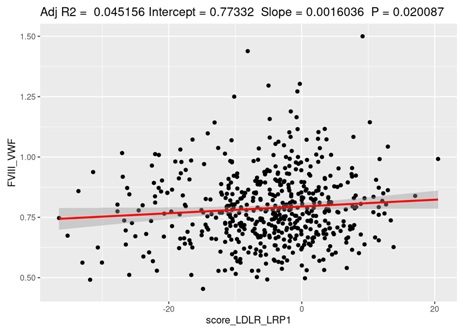
Results. A total of 1,190 subjects were eligible for aim (1) and 574 for aim (2). After adjusting for age, sex, and BMI, three variants (rs688, rs10422256, and rs6511721) were found associated with higher LDL-c levels. No association between analyzed variants and FVIII levels was found. The variant rs74257940 was associated with a higher FVIII:C/VWF:Ag ratio. A LDLR-LRP1 weighted polygenic score (PGS), calculated using the beta coefficients obtained from the association with LDL-c levels, correlated with a higher FVIII:C/VWF:Ag ratio (Figure).
Conclusions. Among the 28 analyzed LDLR and LRP1 variants, three LDLR variants (rs688, rs10422256, and rs6511721) were associated with increased LDL-c levels in a cohort of subjects with metabolic syndrome. The developed polygenic score resulted in being associated with a higher FVIII:C/VWF:Ag ratio, suggesting a potential role of the selected variants in reducing FVIII clearance.
Downloads
Citations




How to Cite

This work is licensed under a Creative Commons Attribution-NonCommercial 4.0 International License.



