


CO106 | ENDOTHELIAL DYSFUNCTION AS A POSSIBLE ADDITIONAL DRIVER OF BLEEDING IN HERMANSKY–PUDLAK SYNDROME
F. Tondi1, G. Purgatorio1, E. Giglio1, E. Petito1, E. Falcinelli1, G. Guglielmini1, P. Gresele1, C. Olgasi2, L. Bury1 | 1Dep. of Medicine and Surgery, Section of Internal and Cardiovascular Medicine, University of Perugia, Perugia, Italy; 2Dep. of Translational Medicine, School of Medicine, University of Piemonte Orientale, Novara, Italy
All claims expressed in this article are solely those of the authors and do not necessarily represent those of their affiliated organizations, or those of the publisher, the editors and the reviewers. Any product that may be evaluated in this article or claim that may be made by its manufacturer is not guaranteed or endorsed by the publisher.
Authors
Background and aims. Hermansky-Pudlak syndrome (HPS) is an inherited multisystem disorder caused by a defect of lysosome-related organelles, like delta granules in platelets and Weibel-Palade bodies (WPB) in endothelial cells (EC). All HPS subtypes manifest oculocutaneous albinism (OCA) and bleeding, while recurrent infections due to neutropenia and/or immunodeficiency may develop only in patients with HPS types 2, 9, or 10 and pulmonary fibrosis in patients with HPS types 1, 2, or 4 (PMID: 23171219). Additionally, patients with HPS-1 and HPS-4 may manifest granulomatous colitis (PMID: 40387003). Most of the studies exploring the molecular mechanisms involved in the pathogenesis of HPS investigated melanosomes, alveolar epithelial cells, and platelet delta granules, but little is known about ECs. We aimed to investigate endothelial function in different subtypes of HPS, specifically in HPS-1, HPS-2, HPS-3, and HPS-6; exploring the hypothesis that the bleeding phenotype of patients with HPS may not only be due to the well-known platelet defect but also to a defect of endothelial cells.
Methods. Endothelial colony-forming cells (ECFC) were generated from peripheral whole blood of one HPS patient from each subtype considered in the study (HPS-1, HPS-2, HPS-3, and HPS-6) and from four age- and sex-matched healthy controls. ECFC were characterized morphologically and for EC surface markers by flow cytometry. WPB were quantified by immunofluorescence. EC migration was assessed by the transwell migration assay towards 10% FBS, and results are reported as the fold change of the covered lower filter surface relative to the control. Angiogenesis was evaluated by the Matrigel tube formation assay and quantified as total tube length, total tube number, and total branching points. Apoptosis was assessed using the Caspase-Glo 3/7 assay.
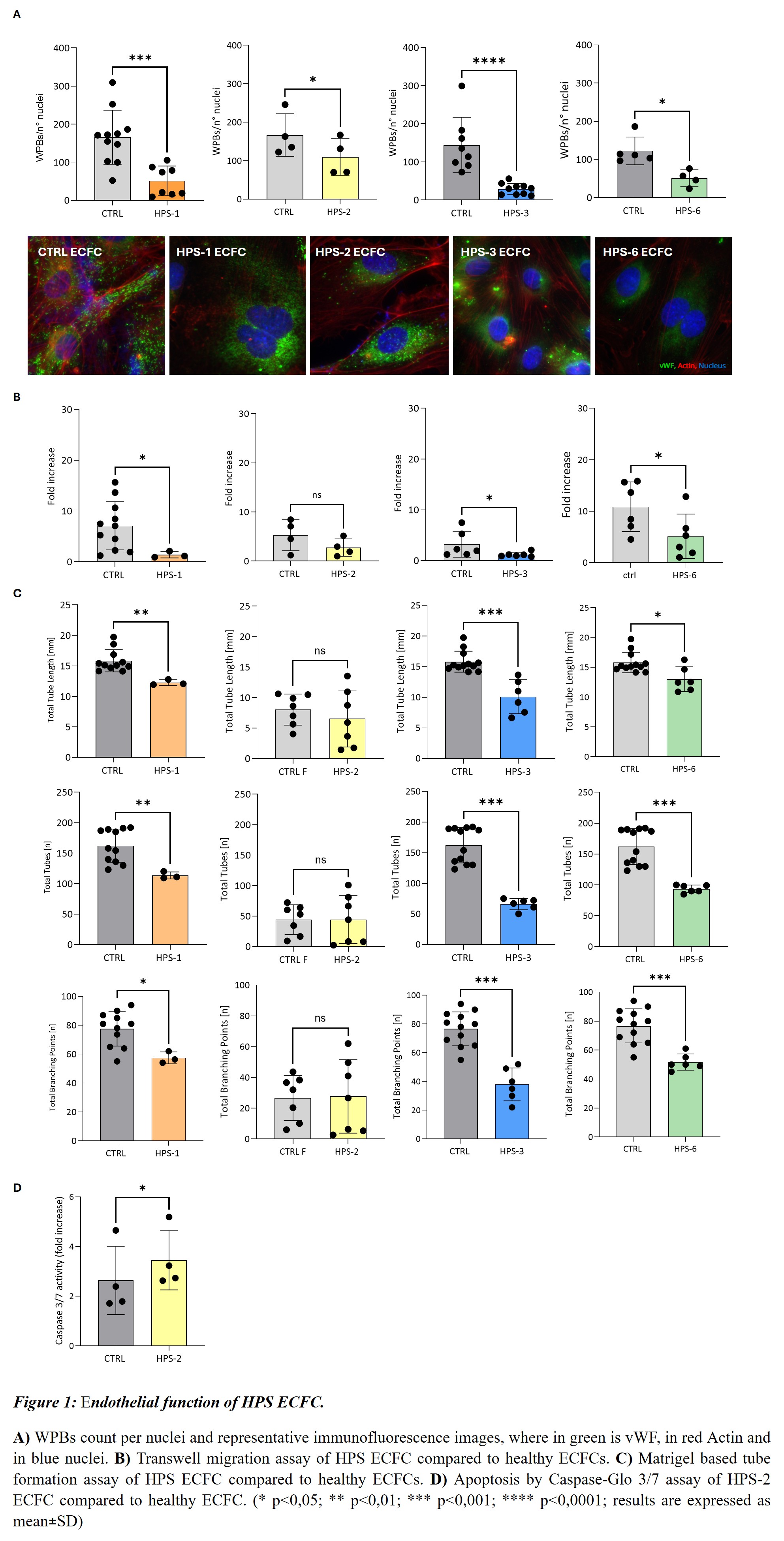
Results. ECFCs, from passage three, expressed all EC markers (CD31, CD309, and CD146) and were negative for leukocyte (CD45) and monocyte (CD14) markers. WPBs were significantly reduced in ECFCs from all HPS subtypes and showed a disorganized structure in all subtypes, except in HPS2, in which, although reduced, they maintained a normal structure (Fig. 1A). Impaired ECFC migration was observed in HPS-1, HPS-3, and HPS-6 but not in HPS-2 (Fig. 1B). Similarly, defective angiogenesis was observed with HPS-1, HPS-3, and HPS-6 ECFC, but not with HPS-2 ECFC (Fig. 1C). Finally, only HPS-2 ECFCs showed increased apoptosis (Fig. 1D).
Conclusions. ECFCs from all the HPS subtypes we studied showed a reduced number of WPB, while an altered structure was observed in HPS-1, HPS-3, and HPS-6 ECFCs. These results were associated with defective EC migration and angiogenetic activity in all subtypes, except HPS-2, which, however, showed increased apoptosis. Our results suggest that endothelial dysfunction may play a role in the bleeding phenotype of HPS patients. Further studies are warranted to explore possible endothelial drug targets for restoring endothelial function in HPS with the aim of attaining a personalized therapeutic approach.
Downloads
Citations




How to Cite

This work is licensed under a Creative Commons Attribution-NonCommercial 4.0 International License.



