


CO105 | THALIDOMIDE FOR RECURRENT GASTROINTESTINAL BLEEDING IN RARE BLEEDING DISORDERS AND VENOUS MALFORMATIONS: A MONOCENTRIC EXPERIENCE
M. De Siati1|2, F.G. Perretta1|2, F. Ricci1|2, A. Ferretti1, M. Comand1|2, S. Sorrentino1, L. D’Innocenzo1|2, D. Feliciani2, B. Funaro2, M.E. Riccioni3, A. Gasbarrini2|4, E. De Candia1|2 | 1UOSD Malattie Emorragiche e Trombotiche, Fondazione Policlinico Agostino Gemelli IRCCS, Roma 00168, Italy; 2Department of Translational Medicine and Surgery, Catholic University of the Sacred Heart, Roma, Italy; 3Digestive Endoscopy Unit, Fondazione Policlinico Universitario Agostino Gemelli, IRCCS, Università Cattolica del Sacro Cuore, Largo Agostino Gemelli, Roma 00168, Italy; 4Department of Medical and Surgical Sciences, Digestive Disease Center, Universitary Policlinic Agostino Gemelli Foundation IRCCS, Roma, Italy
All claims expressed in this article are solely those of the authors and do not necessarily represent those of their affiliated organizations, or those of the publisher, the editors and the reviewers. Any product that may be evaluated in this article or claim that may be made by its manufacturer is not guaranteed or endorsed by the publisher.
Authors
Background and Aims. Recurrent gastrointestinal (GI) bleeding due to angiodysplasia or venous malformations represents a major therapeutic challenge, particularly in patients with underlying congenital or acquired bleeding disorders. Endoscopic and haemostatic treatments often achieve only transient benefit, while long-term pharmacologic options remain limited. Thalidomide, an anti-angiogenic agent, has shown efficacy in refractory gastrointestinal angiodysplasia in randomized controlled trials and meta-analyses; however, these studies were conducted in patients without systemic bleeding disorders. Consequently, real-world data on the use of thalidomide in ultra-rare bleeding disorders associated with angiodysplasias remain scarce. To evaluate the efficacy, safety, and clinical patterns of response to thalidomide in a monocentric cohort of patients with recurrent GI bleeding associated with rare bleeding disorders and angiodysplasias or vascular malformations.
Methods. We retrospectively analyzed seven patients treated with oral thalidomide (50–150 mg/day) for recurrent GI bleeding unresponsive or only partially responsive to endoscopic therapy and standard hemostatic approaches. Diagnoses included acquired von Willebrand disease (AVWD), type 2B von Willebrand disease (vWD), Glanzmann thrombasthenia (GT), and Blue Rubber Bleb Nevus Syndrome (BRBNS). All patients had documented GI bleeding from angiodysplasias or from multiple venous malformations located mainly in the submucosa of the gastrointestinal tract (BRBNS). Outcomes included hemoglobin (Hb) stability, transfusion requirements, hospitalizations, recurrence of overt bleeding, treatment adherence, and adverse events.
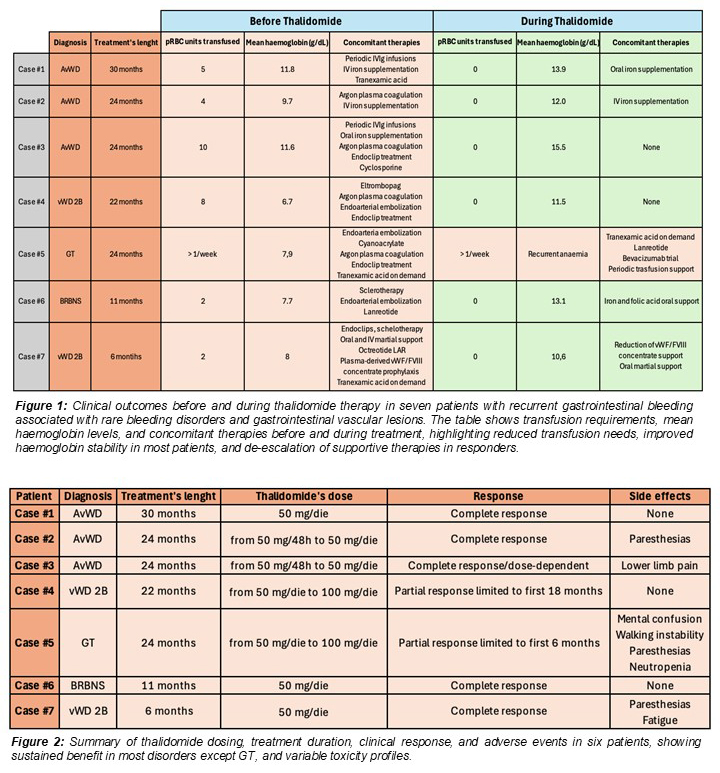
Results. Five patients achieved sustained clinical benefit, with marked reduction of GI bleeding relapses, stabilization or improvement of Hb levels, and discontinuation or de-escalation of transfusions, IVIg, octreotide, and/or vWF/FVIII concentrate support (fig. 1). Dose–response and adherence emerged as key determinants of efficacy, particularly in type 2B vWD and one AVWD patient. The BRBNS patient achieved complete bleeding control with low-dose thalidomide (50 mg/day) (fig. 2). A type 2B vWD patient with refractory jejunal angiodysplasia-related bleeding achieved sustained bleeding control with thalidomide 50 mg/day, with no need for further transfusions and hospitalizations, discontinuation of octreotide, and reduction of vWF/FVIII concentrate support over approximately 5–6 months of follow-up. Conversely, the GT patient experienced only a transient improvement, followed by recurrent bleeding and significant toxicity, limiting long-term treatment (Fig. 2). Adverse events included dose-dependent peripheral neuropathy, mild paresthesias, fatigue, constipation, and one case of suspected bone marrow suppression, in line with previously reported safety profiles.
Conclusions. In this small monocentric cohort, thalidomide provided meaningful and, in several cases, sustained control of recurrent GI bleeding in AVWD, type 2B vWD, and BRBNS, whereas efficacy was transitory in GT. These findings extend randomized trial evidence to ultra-rare bleeding conditions and support the use of thalidomide as a second-line, symptom-targeted option in carefully selected patients with bleeding disorders and recurrent GIBs, provided that toxicity is closely monitored and adherence maintained. Larger real-world studies are needed to better define optimal dosing, treatment duration, and long-term safety.

Downloads
Citations




How to Cite

This work is licensed under a Creative Commons Attribution-NonCommercial 4.0 International License.



