


CO098 | ANTI-β2GPI AND ANTI-PS/PT ANTIBODIES, AND THEIR COMBINATION, EXERT A DISTINCT PLATELET ACTIVATION PROFILE
M. Camera1|2, A. Becchetti2, M.O. Borghi3|4, M. Brambilla2, P.A. Lonati4, C. Bodio4, E. Pontara5, M.G. Cattini5, E. Bison5, M. Tonello6, N. Pozzi7, P. Meroni4, V. Pengo5 | 1Department of Pharmaceutical Sciences, University of Milano, Milano, Italy; 2Unit of Cell and Molecular Biology in Cardiovascular Diseases, Centro Cardiologico Monzino IRCCS, Milano, Italy; 3Dipartimento di Scienze Cliniche e di Comunità, Dipartimento di Eccellenza 2023-2027, University of Milano, Milano, Italy; 4IRCCS Istituto Auxologico Italiano, Milano, Italy; 5Department of Cardiac-Thoracic-Vascular Sciences and Public Health, University of Padua, Padova, Italy; 6Department of Medicine, University of Padua, Padova, Italy; 7Saint Louis University School of Medicine, St. Louis, United States
All claims expressed in this article are solely those of the authors and do not necessarily represent those of their affiliated organizations, or those of the publisher, the editors and the reviewers. Any product that may be evaluated in this article or claim that may be made by its manufacturer is not guaranteed or endorsed by the publisher.
Authors
Background and Aims. Antiphospholipid syndrome (APS) is a systemic autoimmune disorder characterized by venous and arterial thrombosis in the presence of antiphospholipid antibodies. Platelets are increasingly recognized as key cellular effectors in APS, contributing not only to thrombus formation but also to amplification of thrombo-inflammatory and procoagulant pathways. Recent evidence has shown that total IgG from high-risk APS patients can induce a platelet procoagulant profile, characterized by increased P-selectin, activated integrin αIIbβ3, and tissue factor (TF) expression. Besides anti-β2GPI antibodies, anti-phosphatidylserine/prothrombin (PS/PT) antibodies are frequently detected in high-risk APS profiles. However, the relative contribution of these antibody specificities to platelet activation remains incompletely defined. The aim of this study was therefore to compare the individual effect of anti-β2GPI and anti-PS/PT antibodies on platelet phenotype.
Methods. Immunoaffinity-purified anti-β2GPI or anti-PS/PT IgG or total IgG from tetra-positive APS patients were used to investigate platelet activation markers in whole blood by flow cytometry. 10 μl of WB (4x10^6 platelets) were incubated for 30 minutes at RT with 50 μl of anti-β2GPI or anti-PS/PT IgG (1.25-2.5 μg/ml according to each single IgG concentration). To evaluate the impact of IL-6 (100 pg/ml) and/or calcium (5 mM) on platelet activation, healthy subject (NHS) blood was stimulated with IL-6 or calcium plus anti-β2GPI or anti-PS/PT IgG at RT for 30 minutes. Samples were then labeled with specific mAb for P-selectin, aGPIIbIIIa, and TF and analyzed by flow cytometry.
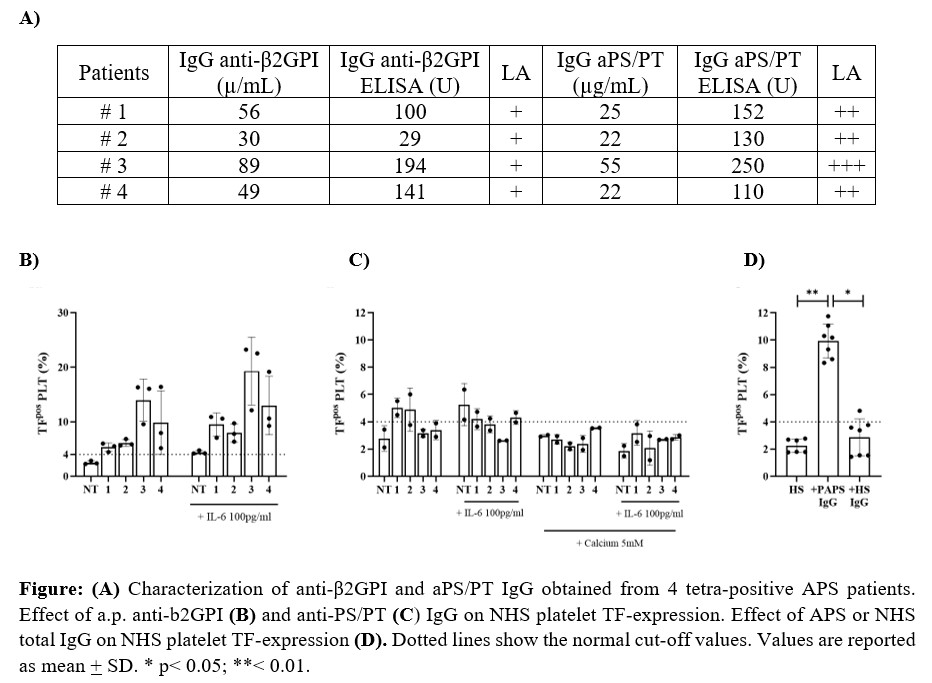
Results. Purified anti-β2GPI and anti-PS/PT IgG fractions obtained from 4 APS patients were characterized for antigen specificity, isotype, lupus anticoagulant activity, and antibody titer (Figure 1A). When tested in whole blood from healthy subjects, anti-β2GPI IgG showed limited ability to induce classical platelet activation markers (P-selectin and activated GPIIb/IIIa) when added alone. However, in the presence of IL-6, anti-β2GPI IgG induced P-selectin and activated GPIIb/IIIa expression. These findings suggest that inflammatory priming is required to fully unmask the platelet-activating potential of anti-β2GPI antibodies. In contrast, anti-β2GPI IgG were able to induce platelet TF expression even in the absence of IL-6, with a further increase under inflammatory stimulation, indicating a direct contribution of these antibodies to the acquisition of a platelet procoagulant phenotype (Figure 1B). By contrast, anti-PS/PT IgG did not induce a significative increase in platelet TF expression in the presence of calcium, either alone or in combination with IL-6, with values remaining largely comparable to controls (Figure 1C). Consistently, total IgG from high-risk APS patients induced a marked increase in TFpos-platelets compared with unstimulated whole blood and NHS IgG, suggesting that the effect is likely driven by anti-β2GPI IgG (Figure 1D).
Conclusions. Anti-β2GPI and anti-PS/PT IgG both contribute to platelet activation with distinct effects. Anti-β2GPI antibodies are primarily involved in TF induction, whereas both antibody specificities may support platelet activation in an inflammatory context. These data provide further insight into the cellular mechanisms underlying thrombosis in high-risk APS patients and support the concept that different antiphospholipid antibody specificities cooperate in shaping a platelet-driven thrombophilic phenotype.
Downloads
Citations




How to Cite

This work is licensed under a Creative Commons Attribution-NonCommercial 4.0 International License.



