


CO076 | ASSOCIATION OF MATRIX METALLOPROTEINASE 2 PLASMA LEVELS WITH CARDIOVASCULAR EVENTS IN PATIENTS WITH ATRIAL FIBRILLATION: A NESTED CASE CONTROL STUDY FROM THE ATHERO-AF COHORT
D. Menichelli1, E. Falcinelli2, P. Pignatelli3, R. Carnevale4|5, A. D’Amico4, F. Violi2, P. Gresele2, D. Pastori4|5, F. Paciullo6 | 1Dip. di Chirurgia Generale e Specialità Chirurgiche Paride Stefanini, Università La Sapienza, Roma, Italy; 2Dip. di Medicina e Chirurgia, Sez. di Medicina Interna Cardiovascolare, Università degli Studi di Perugia, Italy; 3Dip. di Scienze Medico-Chirurgiche e Biotecnologie, Università La Sapienza, Latina, Italy; 4IRCCS Neuromed, Pozzilli, Isernia, Italy; 5Dip. di Scienze Mediche e Cardiovascolari, Università La Sapienza, Roma, Italy; 6Fac. di Medicina e Chirurgia , Vita-Salute San Raffaele University, Milano, Italy
All claims expressed in this article are solely those of the authors and do not necessarily represent those of their affiliated organizations, or those of the publisher, the editors and the reviewers. Any product that may be evaluated in this article or claim that may be made by its manufacturer is not guaranteed or endorsed by the publisher.
Authors
Background and Aims. Atrial fibrillation (AF) is associated with increased cardiovascular (CV) morbidity and mortality. In addition to cardioembolic stroke, patients with AF are exposed to a significant burden of adverse CV outcomes, including myocardial infarction, peripheral arterial ischemic events, heart failure progression, and CV death. This has led to the definition of a residual CV risk not fully mitigated by anticoagulation alone. Growing evidence suggests that vascular inflammation, endothelial dysfunction, and cardiac structural remodeling may contribute to this risk. Matrix metalloproteinases (MMPs) are a heterogeneous family of zinc-dependent proteolytic enzymes involved in extracellular matrix turnover and vascular remodeling. Among them, MMP-2 has been implicated in endothelial function, smooth muscle cell migration, and atherosclerotic plaque evolution and has been proposed as a biomarker of CV risk. MMPs appear to be involved in atrial structural remodeling and fibrosis in AF, processes associated with arrhythmia persistence and disease progression. The aim of the present study was to investigate the association between circulating levels of MMP-2 and major adverse CV events (MACE) in AF patients.
Methods. We conducted a nested case-control analysis within the ATHERO-AF study, a prospective observational cohort study of patients with non-valvular atrial fibrillation. Plasma levels of MMP-2 and of its selective endogenous inhibitor, tissue inhibitor of metalloproteinase-2 (TIMP-2), were measured using standardized laboratory techniques. Patients who experienced major adverse cardiovascular events (MACE) during follow-up were compared with event-free controls matched for relevant clinical characteristics. MACE included ischemic stroke or transient ischemic attack (TIA), acute myocardial infarction (AMI), and CV death. Clinical data, comorbidities, and ongoing antithrombotic therapies were systematically recorded.
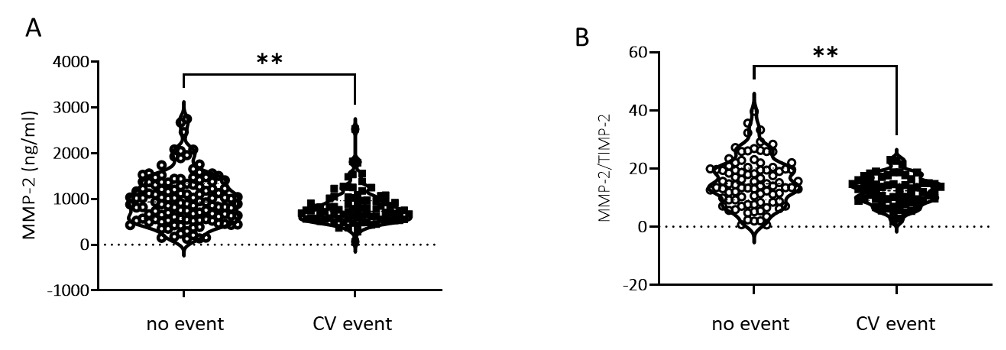
Results. A total of 211 patients with AF were included in the analysis, of whom 86 experienced at least one MACE event and 125 remained event-free during follow-up. Overall, 103 MACE were documented: 29 TIA or ischemic stroke (28.15%), 36 AMI (34.95%), and 38 CV deaths (36.9%). Patients who developed CV events exhibited significantly lower plasma levels of MMP-2 compared with controls (Fig. 1). Low MMP-2 levels were associated with MACE (χ²: 11.6; p<0.01) and, in particular, with ischemic stroke (χ²: 4.9; p<0.05). No significant differences were observed with respect to TIMP-2 levels.
Conclusions. Reduced circulating MMP-2 levels are associated with an increased risk of adverse CV outcomes in patients with chronic atrial fibrillation, independently of anticoagulant therapy. MMP-2 is involved in atrial remodeling and fibrosis, processes linked to an increased risk of cardioembolic stroke, and reduced MMP-2 activity may disrupt extracellular matrix homeostasis, promoting myocardial fibrosis and cardiac dysfunction. These findings support a potential protective role of MMP-2 in CV homeostasis and highlight the interplay between vascular remodeling, inflammation, and thrombosis in AF. Further prospective studies are warranted to clarify the mechanistic role of MMP-2 and evaluate its utility as a biomarker for residual CV risk stratification in non-valvular atrial fibrillation. Fig. 1 (A) MMP-2 plasma levels and (B) MMP-2/TIMP-2 ratio in NVAF patients with or without MACE.
Downloads
Citations




How to Cite

This work is licensed under a Creative Commons Attribution-NonCommercial 4.0 International License.



