


CO069 | POLYSTYRENE NANOPLASTICS PRIME PLATELET TO DRIVE PRO-INFLAMMATORY AND PRO-FIBROTIC ACTIVATION OF CARDIAC FIBROBLASTS
Z. Saeed1|2, M. Dovizio1|3, C. Milillo1|3, P. Lanuti1|4, S. Porro1|4, F. D’Ascanio1|4, A. Bruno1|3, P. Ballerini1|3, G. Renda1|2 | 1Center for Advanced Studies and Technology (CAST), “G. d’Annunzio” University of Chieti-Pescara, Chieti, Italy; 2Department of Neurosciences, Imaging and Clinical Sciences, "G. d'Annunzio" University of Chieti-Pescara, Chieti, Italy; 3Department of Innovative Technologies in Medicine & Dentistry, “G. d’Annunzio” University of Chieti-Pescara, Chieti, Italy; 4Department of Medicine and Aging Sciences, “G. d’Annunzio” University of Chieti-Pescara, Chieti, Italy
All claims expressed in this article are solely those of the authors and do not necessarily represent those of their affiliated organizations, or those of the publisher, the editors and the reviewers. Any product that may be evaluated in this article or claim that may be made by its manufacturer is not guaranteed or endorsed by the publisher.
Authors
Background and Aims. Nanoplastics (NPs) are emerging environmental contaminants with potential cardiovascular effects, but their impact on platelet activation and cardiac remodeling remains poorly defined. Atrial fibrosis is a key mechanism underlying atrial fibrillation (AF), driven by fibroblast transition to a pro-fibrotic phenotype. Platelets contribute to thrombo-inflammation and may infiltrate atrial tissue, modulating fibroblast phenotype. We investigated whether polystyrene NPs (PS-NPs, 50 nm) induce platelet activation in vitro and in vivo and enhance platelet-fibroblast crosstalk, promoting pro-inflammatory and pro-fibrotic signaling.
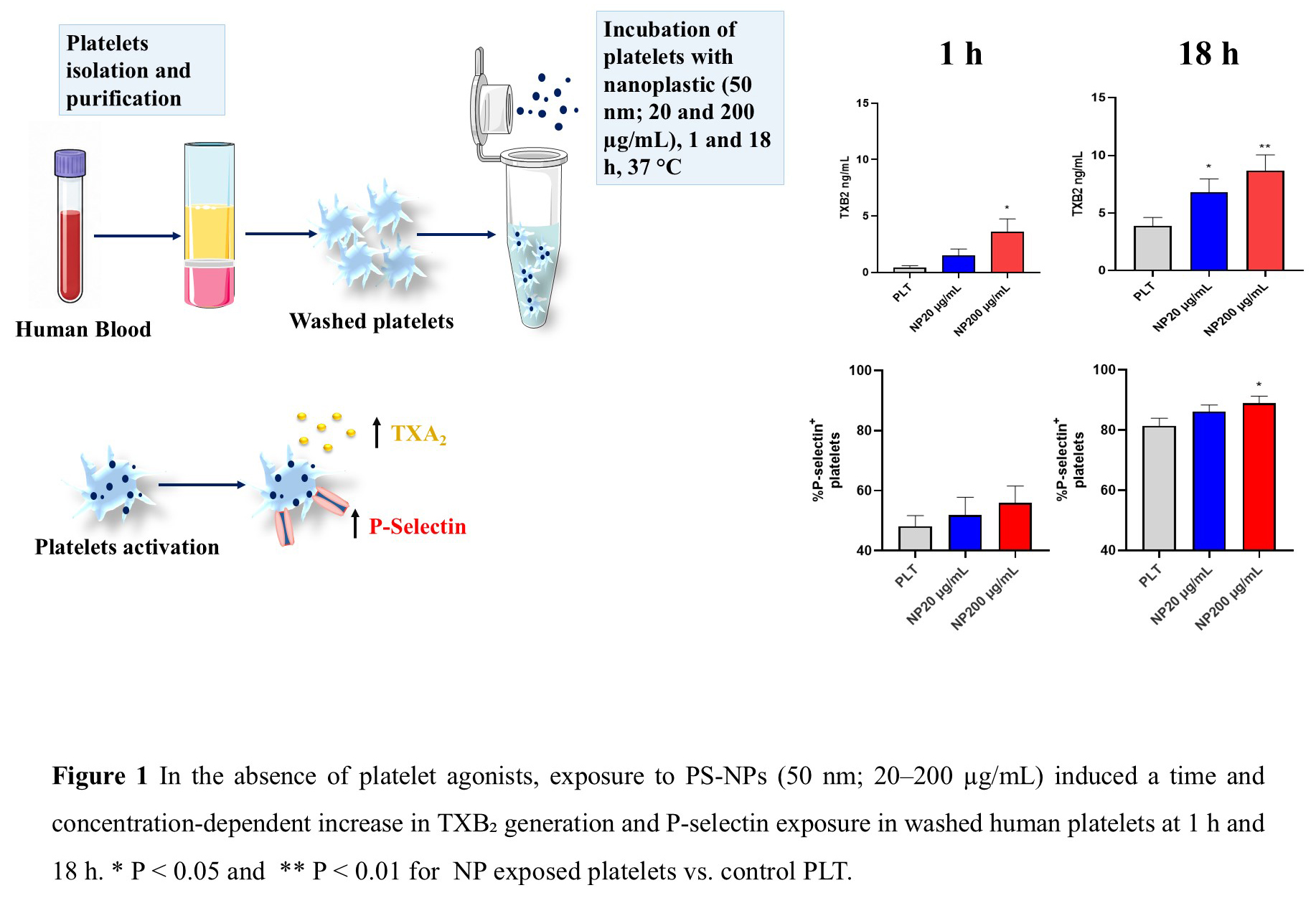
Methods. PS-NPs were administered intravenously in C57BL/6 mice, and serum thromboxane B₂ (TXB₂) was measured after 5 days as an index of platelet activation. Human isolated platelets were incubated with 50 nm PS-NPs (20 or 200 µg/mL) for 1 and 18 h at 37°C under rotational conditions and assessed for TXB₂ generation and P-selectin membrane translocation. Washed human platelets were exposed to fluorescent Dragon Green-labelled particles, and platelet-derived extracellular vesicles (EVs) release and NPs incorporation into EVs were evaluated. Human atrial fibroblasts (HCF) were incubated for 24 h with platelet releasate obtained following platelet-NP interaction to assess effects on cytokine production and Snail expression.
Results. Single-dose i.v. PS-NP administration (20 or 200 µg/mL) in C57BL/6 mice increased TXB₂ generation after 5 days (2.15- and 2.21-fold vs. baseline, p<0.01). Consistently, human platelets exposed to PS-NPs (20 or 200 µg/mL) for 1 and 18 h showed a concentration-dependent significant increase of TXB₂ levels, even in the absence of platelet agonists. PS-NP exposure also significantly enhanced P-selectin surface expression at the highest concentration (p < 0.05). Exposure to PS-NPs did not significantly affect platelet-derived EV release at 1 h or 18 h. However, the percentage of NP-positive EVs increased from ~45% to ~80% (20 vs. 200 µg/mL; p < 0.01), suggesting interaction and/or incorporation into EVs. To investigate functional consequences of platelet activation induced by PS-NPs, HCF cells were treated with platelet releasate collected after platelet incubation with PS-NP. After 24 h, releasate from PS-NP unexposed platelets significantly upregulated the expression of inflammatory and remodeling markers, including interleukin (IL)-1α, IL-6, and IL-1β, as well as the fibroblast activation marker Snail. Notably, exposure of HCFs to releasate from PS-NP–treated platelets further enhanced the expression of inflammatory cytokines and Snail, with the strongest induction observed with releasate from platelets exposed to 200 µg/mL PS-NPs, indicating an additional effect of PS-NPs on platelet activation that translates into amplified fibroblast responses.
Conclusions. PS-NPs promote platelet activation and enhance platelet–fibroblast crosstalk, amplifying thrombo-inflammatory and pro-remodeling signaling. Although the EV release was unchanged, the increase in NP-positive EVs suggests their incorporation into EVs and a potential role in their systemic distribution. By priming platelets toward a more reactive phenotype, PS-NPs may contribute to atrial remodeling, supporting their role as an underrecognized modulator of cardiovascular pathophysiology.
Downloads
Citations




How to Cite

This work is licensed under a Creative Commons Attribution-NonCommercial 4.0 International License.



