


CO067 | ELUCIDATING THE EVIL RELATIONSHIP OF METABOLIC DYSFUNCTION–ASSOCIATED FATTY LIVER DISEASE WITH CARDIOVASCULAR COMORBIDITIES: THE COMPLEX INTERPLAY AMONG HYPERCOAGULABILITY, INFLAMMATION, AND LIVER FIBROSIS
G. Gagliardi, E. Campello, A. Napolitano, B. Stocco, C. Di Gesù, G. Gobbo, I. Condonato, M. Allegra, G. Antonello, C. Portinari, C. Goffi, G. Camporese, P. Scarinzi, R. Pesavento, F. Bilora, M. Di Pascoli, C. Bulato, A. Montagna, D. Regazzo, A. Zambon, L. Fabris, P. Simioni | Department of Medicine, University of Padova, Italy
All claims expressed in this article are solely those of the authors and do not necessarily represent those of their affiliated organizations, or those of the publisher, the editors and the reviewers. Any product that may be evaluated in this article or claim that may be made by its manufacturer is not guaranteed or endorsed by the publisher.
Authors
Background and aims. Metabolic dysfunction–associated steatotic liver disease (MASLD) is highly prevalent and is associated with increased cardiovascular (CV) morbidity and mortality. We aimed to evaluate the relationship between liver fibrosis and early CV damage, hypercoagulability, and systemic inflammation in a cohort of MASLD patients.
Methods. Consecutive patients with MASLD were enrolled and stratified according to liver fibrosis severity assessed by transient elastography. The primary endpoint was the presence of a prothrombotic/hemostatic imbalance in patients with advanced fibrosis, assessed through an extensive hemostatic work-up including viscoelastic testing, procoagulant factors, natural anticoagulants (protein C/protein S/antithrombin), fibrinolysis markers (plasminogen, PAI-1), and platelet function testing in whole blood and platelet-rich plasma. Secondary endpoints included subclinical vascular damage assessed by ankle–brachial index and vascular ultrasound (carotid IMT/plaque and aortic diameter), as well as systemic inflammatory markers. All multivariable models were adjusted for age, sex, BMI, hypertension, and diabetes.
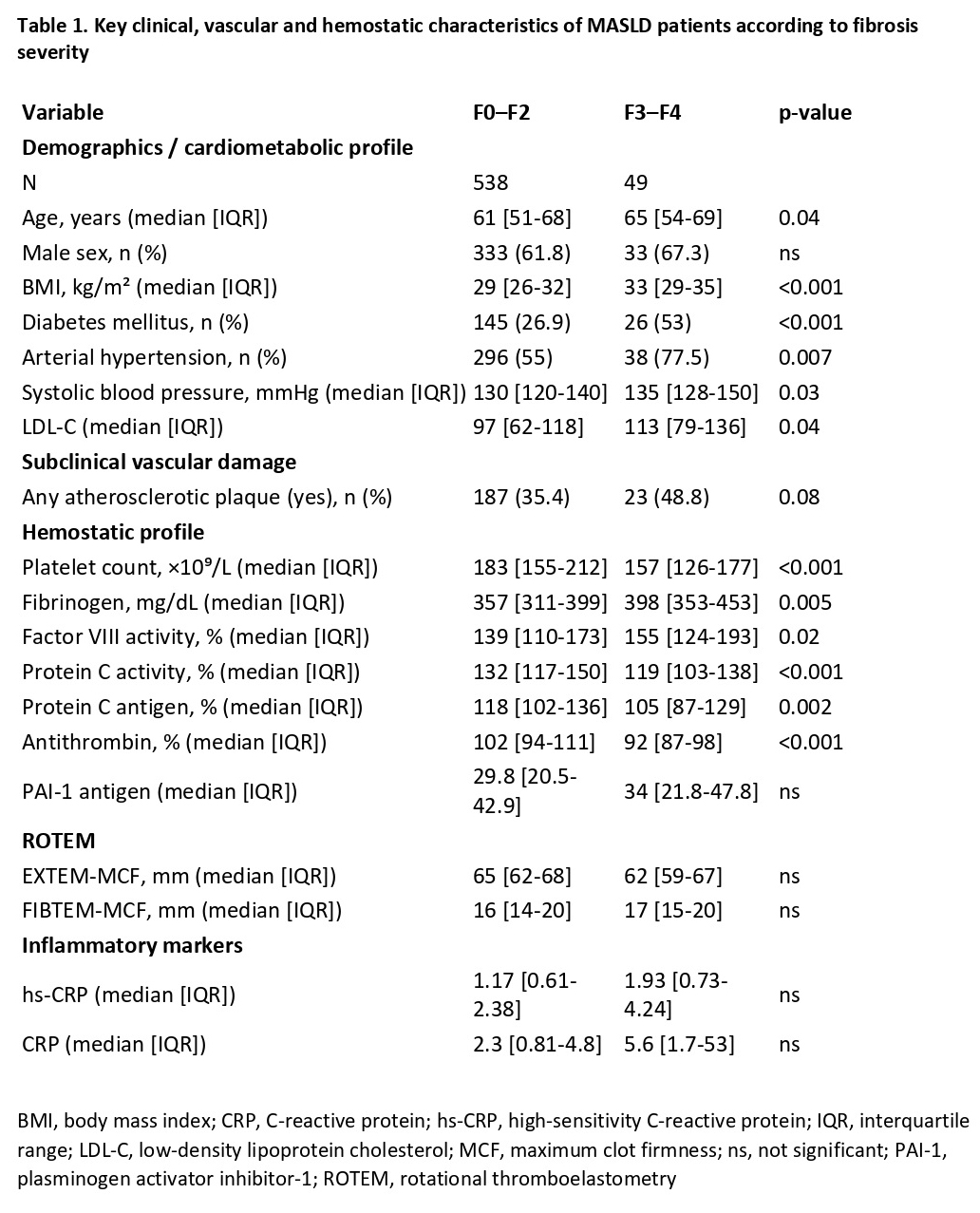
Results. Overall, 615 MASLD patients were included (median age 62 [52–69] years; median BMI 29 [26–32] kg/m²; 62.1% male); 49 (7.9%) had advanced fibrosis (F3–F4) on transient elastography (538 F0–F2; 28 missing) (Table 1). Advanced fibrosis was associated with higher systolic blood pressure independent of hypertension status (p=0.019) and with higher LDL-C levels (adjusted p=0.0004). From a hemostatic perspective, advanced fibrosis was associated with a significant shift toward a prothrombotic/rebalanced state. Specifically, platelet count was reduced (157 vs 183×10⁹/L, p<0.001), together with lower levels of natural anticoagulants, including protein C activity (119% vs 132%, p<0.001), protein C antigen (105% vs 118%, p=0.002), and antithrombin (92% vs 102%, p<0.001). Conversely, procoagulant factors were increased, with higher fibrinogen (398 vs 357 mg/dL, p=0.005) and factor VIII activity (155% vs 139%, p=0.02) (Table 1). Whole blood ROTEM parameters and platelet function testing did not show major differences across fibrosis stages. Despite these hemostatic alterations, fibrosis severity was not independently associated with subclinical atherosclerosis. The prevalence of atherosclerotic plaques was higher in advanced fibrosis (48.8% vs 35.4%), but this association was not significant after adjustment (OR 0.99, 95% CI 0.80–1.22; p=0.915), with age, sex, hypertension, and diabetes remaining the main predictors.
Conclusions. Advanced fibrosis in MASLD is associated with a significant hemostatic shift characterized by reduced natural anticoagulants and increased procoagulant factors, suggesting early progression toward a rebalanced but potentially prothrombotic state. These alterations occur independently of changes in whole-blood coagulation assays. These alterations occur independently of changes in whole-blood coagulation assays and are not directly linked to subclinical atherosclerosis, which appears to be mainly driven by traditional CV risk factors.
Downloads
Citations




How to Cite

This work is licensed under a Creative Commons Attribution-NonCommercial 4.0 International License.



