


CO066 | COAGULOPATHY IN CAR-T CELL-TREATED PATIENTS WITH LYMPHOPROLIFERATIVE DISORDERS: A RETROSPECTIVE, SINGLE-CENTER OBSERVATIONAL STUDY
I. Santo1, R. Morganti2, G. Leoni3, G. Tancredi3, L. Contino4, S. Galimberti3, R.M. Santi4, E. Orciuolo5 | 1Azienda Toscana Nord Ovest, Versilia Hospital, Italy; 2Hematology Division AOUP, Pisa, Italy; 3University of Pisa, Hematology Pisa, Italy; 4Azienda Ospedaliera Universitaria Alessandria, Italy; 5Azienda Ospedaliera Universitaria Pisana, Hematology Pisa, Italy
All claims expressed in this article are solely those of the authors and do not necessarily represent those of their affiliated organizations, or those of the publisher, the editors and the reviewers. Any product that may be evaluated in this article or claim that may be made by its manufacturer is not guaranteed or endorsed by the publisher.
Authors
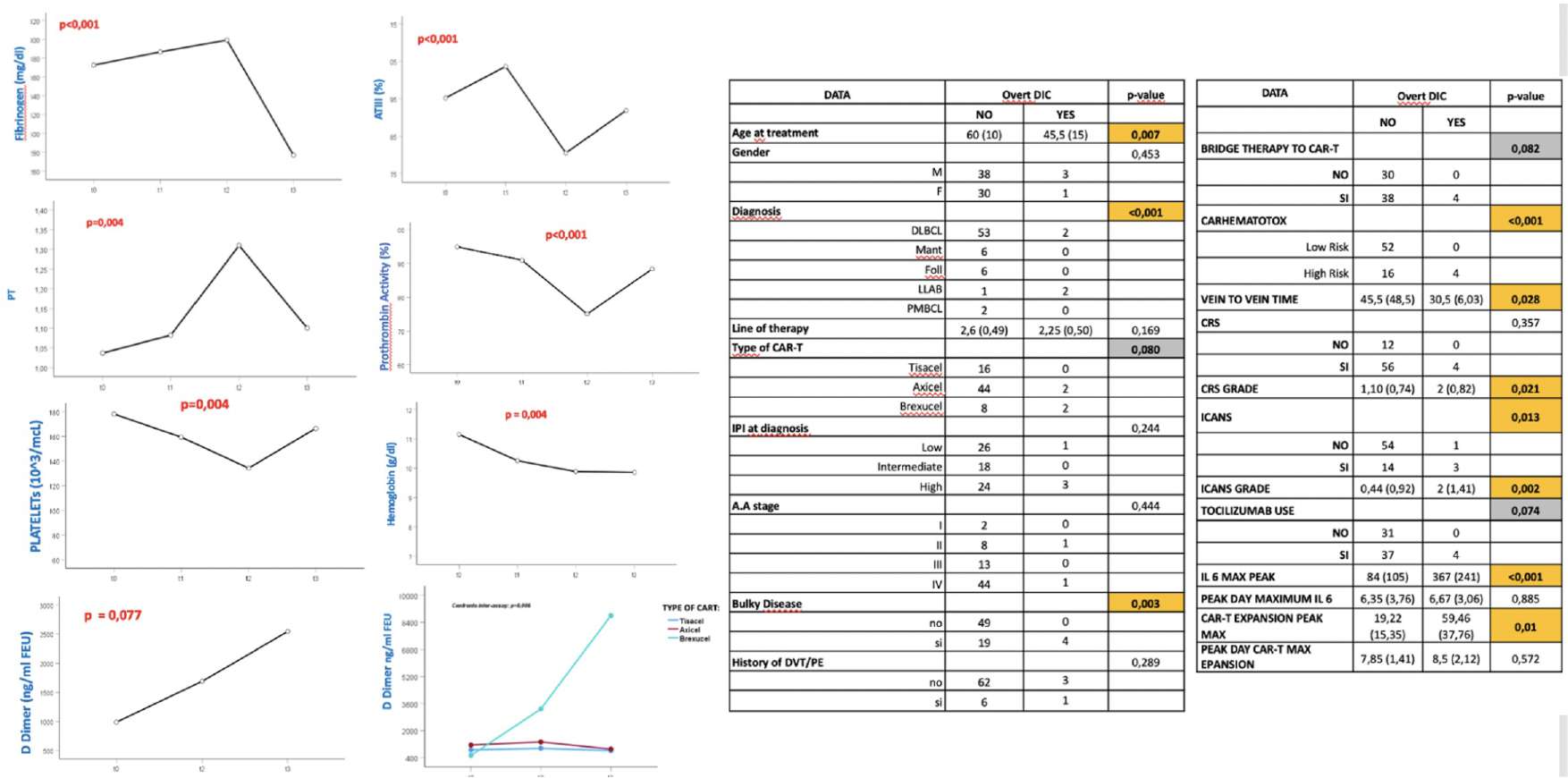
CAR‑T therapy improves outcomes in relapsed/refractory lymphoid malignancies but can cause coagulopathy. Massive cytokine release leads to endothelial injury, platelet activation, excess thrombin, and reduced fibrinolysis, inducing an initial hypercoagulable state. Clinically, it causes bleeding, thrombosis, and sometimes DIC (Disseminated Intravascular Coagulopathy), with frequent laboratory abnormalities. The aim was to evaluate, in a retrospective single-center cohort of patients with lymphoproliferative disorders treated with CAR-T cells, the incidence of post-infusion thrombotic and hemorrhagic events (within 60 days of discharge) and changes in major coagulation parameters. Additionally, we analyzed cases of overt DIC and identified predictive risk factors using univariate analysis. For each patient treated with CAR T therapy, laboratory, epidemiological, and clinical data were collected. Laboratory data included coagulation parameters (prothrombin activity, PT, aPTT, fibrinogen, D-dimer, ATIII, Hb, and PLT count), whose temporal variations were assessed at four timepoints: pre- and post-lymphodepletion (t0, t1), acute phase (t2), and subacute phase (t3); the parameters were stratified for each type of CAR-T product used. Epidemiological variables included age and sex. Clinical data included diagnosis, line of therapy, type of CAR-T, International Prognostic Index (IPI) at diagnosis, Ann Arbor (A.A.) stage, bulky disease, history of DVT/PE, bridging therapy, CAR-HEMATOTOX score, vein-to-vein time, occurrence and grade of CRS and ICANS, use of tocilizumab, IL-6 levels, and CART cell expansion kinetics. Statistical analysis used descriptive statistics, repeated-measures ANOVA, and SPSS (p < 0.05). Between November 2020 and August 2025, a total of 72 patients with lymphoproliferative disorders treated with CAR-T therapy were included. Severe hemorrhagic events were rare (1 out of 72 pt, 1.3%), whereas thrombotic events occurred in 4.1% of cases (3 out of 72 pt). Analysis of coagulation parameters showed significant temporal variations in PT, fibrinogen, prothrombin activity, ATIII, PLT, and Hb, while aPTT did not demonstrate significant changes. D-dimer was significant only in patients treated with brexucabtagene autoleucel. Overt DIC was observed in 5.5% of patients (4 out of 72 pt), with additional subclinical cases (3 out of 72 pt, 4.1%). The overall incidence of coagulation abnormalities was 9.6%. The mortality rate associated with overt DIC was 1 out of 4 patients (25%). Factors associated with overt-DIC included age, diagnosis, bulky disease, CAR-HEMATOTOX score, vein-to-vein time, severity of CRS/ICANS, IL-6 serum levels, and CAR-T cell expansion (p<0.05). No significant association with DIC was observed for IPI, A.A. stage, presence of CRS, or prior thrombotic history. Bridging therapy and tocilizumab use, although not significantly associated, showed a trend toward potential significance. Thrombotic events often occur after discharge, indicating a need for prolonged anticoagulant prophylaxis. Hemostasis shows a biphasic pattern: early inflammation with high fibrinogen and PT changes, followed by consumption with low fibrinogen and ATIII. Overt DIC (5.5%) carries high mortality. Risk factors include young age, Brexu-cel use, bulky disease, high CAR‑HEMATOTOX score, short vein‑to‑vein time, severe CRS/ICANS, high IL‑6 serum level, and strong CAR‑T expansion. Future approaches should target inflammation and endothelial protection.
Downloads
Citations




How to Cite

This work is licensed under a Creative Commons Attribution-NonCommercial 4.0 International License.



