


CO064 | THROMBOTIC AND BLEEDING EVENTS IN PATIENTS WITH VASCULAR INVASION BY ADVANCED HEPATOCELLULAR CARCINOMA: A SYSTEMATIC REVIEW
L. Leoni1, G. Tosti2, F.R. Ponziani2, A. Porfidia2, F. Landi2, A. Gasbarrini2, R. Pola2, F. Santopaolo2, R. Talerico2 | 1Internal Medicine Department, Vita-Salute San Raffaele University, IRCCS, Milano, Italy; 2Department of Medical and Surgical Sciences, Fondazione Policlinico Universitario A. Gemelli IRCCS, Università Cattolica del Sacro Cuore, Roma, Italy
All claims expressed in this article are solely those of the authors and do not necessarily represent those of their affiliated organizations, or those of the publisher, the editors and the reviewers. Any product that may be evaluated in this article or claim that may be made by its manufacturer is not guaranteed or endorsed by the publisher.
Authors
Background. The role of anticoagulation in advanced hepatocellular carcinoma (HCC) with macrovascular invasion remains uncertain. While anticoagulation may be associated with a lower incidence of venous thromboembolism (VTE), it may also increase bleeding risk, particularly in patients with portal hypertension.
Methods. We conducted a systematic review of studies reporting thrombotic and bleeding outcomes in anticoagulated (AC) versus non-anticoagulated (NOT AC) adult patients with advanced HCC and vascular invasion. Pooled weighted incidences were calculated, and risk of bias was assessed with the Newcastle–Ottawa Scale.
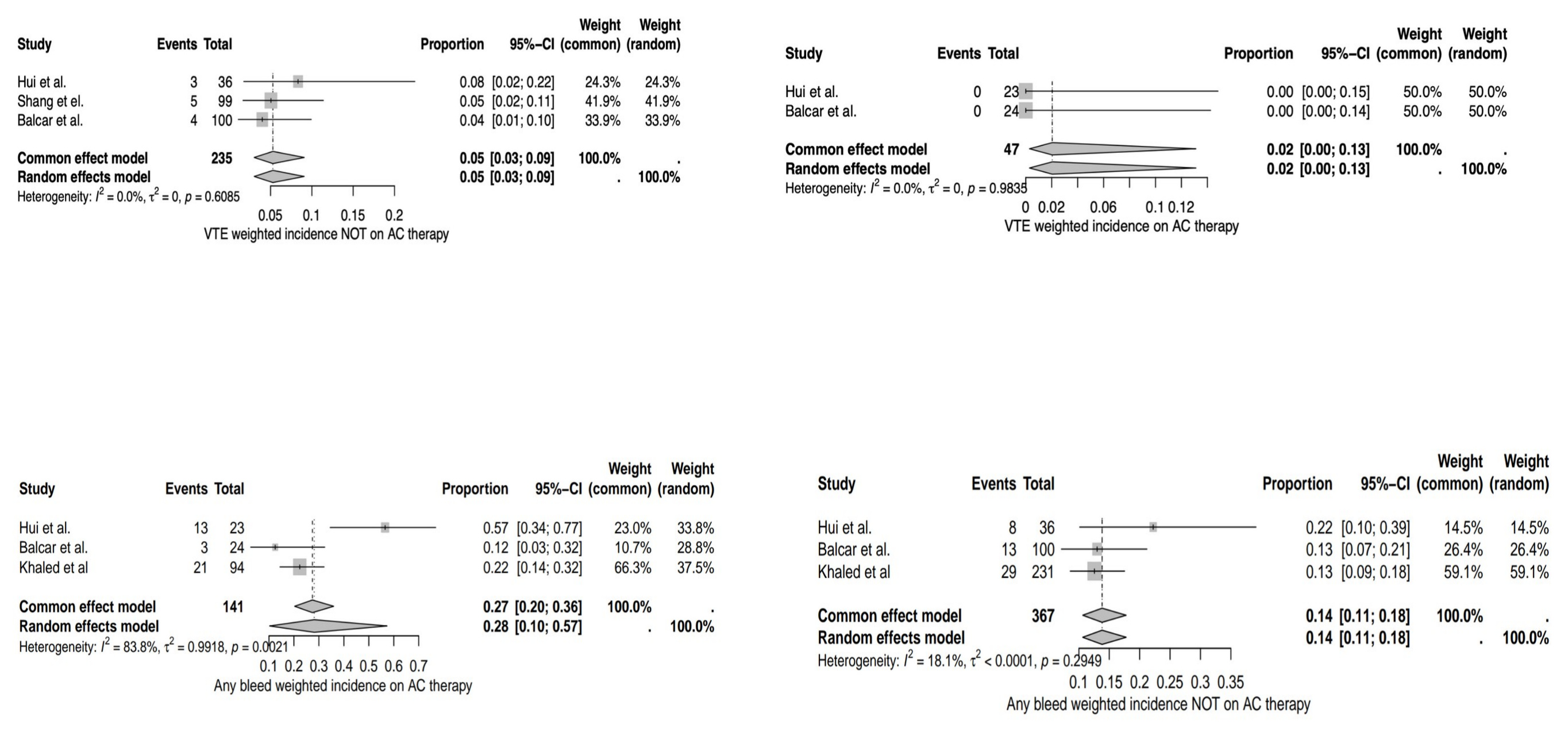
Results. Four retrospective cohort studies (n=608; 142 AC, 466 NOT AC) were included. VTE incidence was low overall and numerically lower in AC patients (2.0%) compared with NOT AC patients (5.3%). In contrast, bleeding events were more frequent in the AC group (28.1% vs 13.8%), with higher rates of both major (MB) and clinically relevant non-major bleeding (CRNMB), particularly in the largest cohort. Mortality was high across studies and primarily driven by tumor progression. No pooled effect estimates were calculated due to sparse data and heterogeneity.
Conclusions. Available evidence indicates a numerically lower VTE incidence was observed in anticoagulated patients, alongside a higher incidence of bleeding events in patients with advanced HCC and vascular invasion. Given the limited and heterogeneous evidence, the net clinical benefit remains uncertain. Prospective studies are urgently needed to better define patient selection in this high-risk population.
Downloads
Citations




How to Cite

This work is licensed under a Creative Commons Attribution-NonCommercial 4.0 International License.



