


CO062 | REDUCED-DOSE DOACs IN EXTENDED TREATMENT OF CANCER-ASSOCIATED THROMBOSIS (RED-CAT): INTERIM ANALYSIS FROM A MULTICENTER RETROSPECTIVE OBSERVATIONAL STUDY (COORDINATING CENTER DATA)
S. Bergonzi1|2|3, A. Ghigo4, L. Carpisassi4, G. Murante1|2|3, M. Capetta1|2|3, F. Valeri1|2, C. Dainese1|2, A. Valpreda3|5, R. Pastorino3|5, F. Bocchi3|5, A. Porreca6|7, B. Bruno2|3, A. Borchiellini1|2 | 1Regional Centre for Hemorrhagic and Thrombotic Diseases, AOU Città della Salute e della Scienza, Turin, Italy; 2Division of Hematology, AOU Città della Salute e della Scienza, Università di Torino, Italy; 3Department of Molecular Biotechnology and Health Sciences, University of Turin, Italy; 4Division of Internal Medicine, AOU Città della Salute e della Scienza, Università di Torino, Italy; 5Central Laboratory Baldi and Riberi, AOU Città della Salute e della Scienza, Università di Torino, Italy; 6Department of Human Sciences and Quality of Life Promotion, San Raffaele University, Roma, Italy; 7Clinical and Molecular Epidemiology, IRCCS San Raffaele, Roma, Italy
All claims expressed in this article are solely those of the authors and do not necessarily represent those of their affiliated organizations, or those of the publisher, the editors and the reviewers. Any product that may be evaluated in this article or claim that may be made by its manufacturer is not guaranteed or endorsed by the publisher.
Authors
Background and Aims. The risk of venous thromboembolism (VTE) in cancer patients is increased by 4-7-fold compared to the general population; guidelines recommend continuation of anticoagulation beyond 6 months in patients with VTE and active cancer. The API-CAT trial demonstrated the non-inferiority of apixaban 2.5 mg twice daily (BID) vs. 5 mg BID in preventing VTE recurrence with a reduced risk of bleeding. The ReD-CAT study aims to confirm these findings in a real-world setting and extend them to rivaroxaban. The primary endpoint is VTE recurrence with reduced-dose DOACs versus full-dose; secondary endpoints include bleeding events and comparison between apixaban and rivaroxaban.
Methods. This is a multicenter retrospective study conducted across 6 hemostasis centers in Piedmont, Italy, with ethics committee approval. Data on 2233 patients treated with rivaroxaban or apixaban from March 2017 to February 2026 were analyzed, extracted from the AIFA registry of the coordinating center; among these, 569 cancer patients were identified, of whom 247 met the inclusion criteria (age ≥18 years, proximal VTE and/or non-subsegmental pulmonary embolism, ≥6 months of full-dose anticoagulation, active malignancy, and no disease progression). Data were collected from electronic records. Patients were stratified into four cohorts by DOAC type and dose used for secondary prophylaxis: apixaban 5 mg BID (C-AP) or 2.5 mg BID (P-AP) and rivaroxaban 20/15 mg once daily (C-RI) or 10 mg once daily (P-RI). Group comparisons were performed using a descriptive-comparative approach; safety (bleeding) and efficacy (VTE recurrence) endpoints were assessed using Kaplan–Meier estimates of cumulative incidence over time.
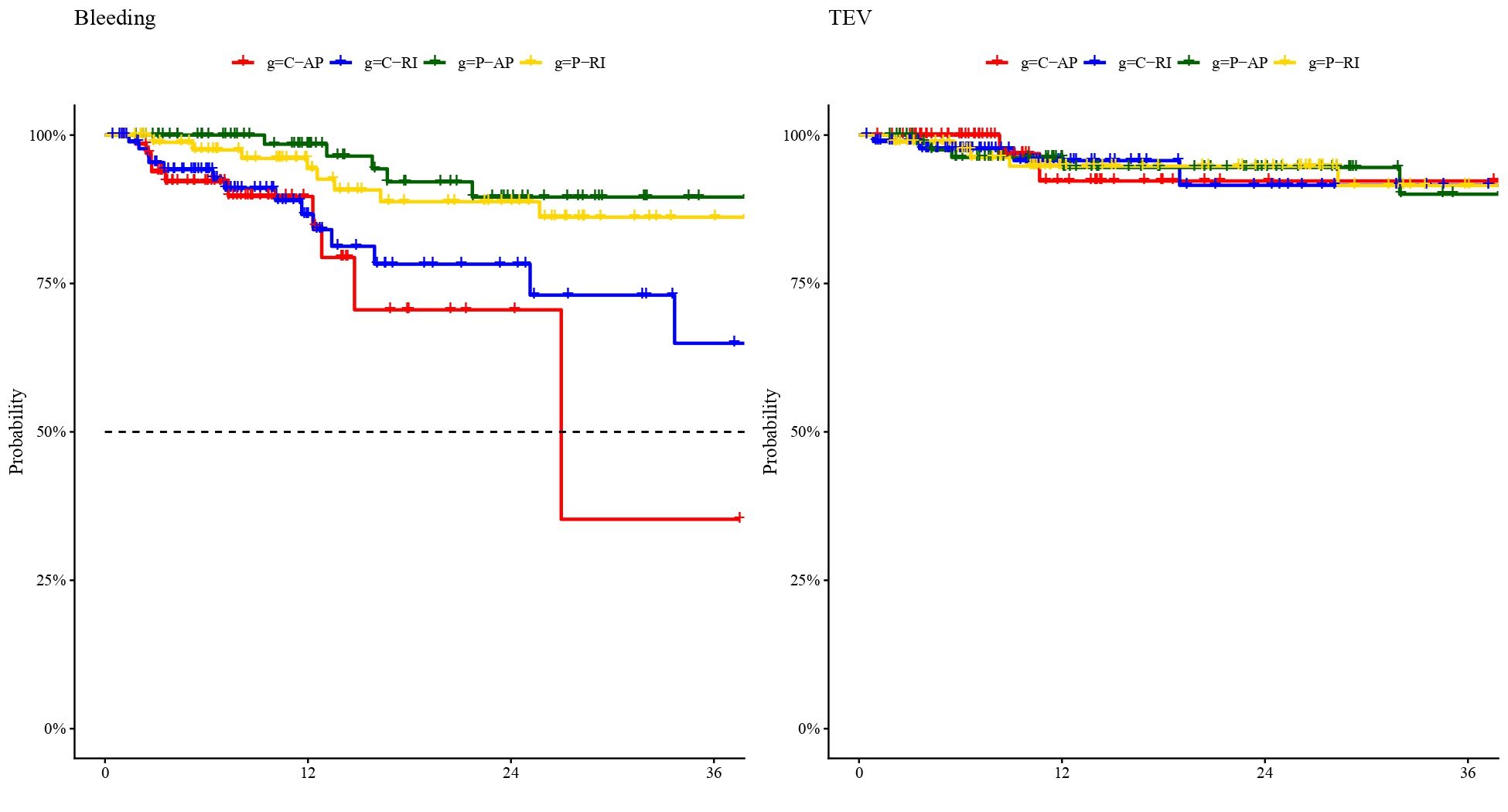
Results. 334 exposures were analyzed: 67 C-AP, 93 C-RI, 87 P-AP, and 87 P-RI. Median follow-up was 13 months (8.4 in C-AP; 10 in C-RI; 17.7 in P-AP; 23.1 in P-RI). Baseline characteristics (age, sex, weight, prothrombotic and bleeding risk factors, disease stage, and duration of anticoagulation prior to enrollment) were well balanced across groups. In terms of safety, cumulative bleeding incidence was higher in full-dose groups (C-AP: 10% at 12 months and 65% at 30–36 months; C-RI: 13% and 35%, respectively) compared to reduced-dose groups (P-AP: 1.5% at 12 months and 10% at 30–36 months; P-RI: 5.5% and 14%, respectively). Ten major bleeding events (out of 37 total) were recorded, 6 of which occurred in the C-AP group. Regarding efficacy, cumulative VTE recurrence was comparable across groups: at 12 months, C-AP 8%, C-RI 4%, P-AP 4%, and P-RI 5% and remained <10% at 36 months in all cohorts. (Figure 1)
Conclusions. This represents the first real-world head-to-head study comparing rivaroxaban and apixaban in cancer patients with VTE. Reduced-dose apixaban showed an improved safety profile compared to full-dose, consistent with the API-CAT trial, with comparable findings for rivaroxaban. Overall, while efficacy was comparable across all groups, safety emerged as the main clinical discriminator, with reduced-dose regimens providing the best balance between thrombotic prevention and bleeding risk over a follow-up of up to 36 months. Among full-dose regimens, a trend toward lower bleeding risk was observed with rivaroxaban compared to apixaban. Despite the retrospective design, the good balance of cohorts and consistency with existing literature support the reliability of these findings. Results will be further strengthened with data from the remaining centers.
Downloads
Citations




How to Cite

This work is licensed under a Creative Commons Attribution-NonCommercial 4.0 International License.



